Logo Title
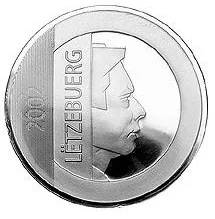
obverse
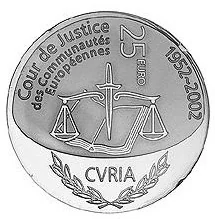
reverse
Banque centrale du Luxembourg

25 Euro (European Court System) – Grand Duchy of Luxembourg

Non-circulating coins
Commemoration: 50th Anniversary of the European Court System
Luxembourg
Context
Year: 2002
Country: Luxembourg Country flag
Issuing organization: Central Bank of Luxembourg
Ruler: Henry
Currency:
(since 2002)
Total mintage: 20,000
Material
Diameter: 37 mm
Weight: 22.85 g
Silver weight: 21.14 g
Shape: Round
Composition: 92.5% Silver
Magnetic: No
Technique: Milled
References
KM: #Click to copy to clipboard83
Numista: #19784
Value
Exchange value: 25 EUR = $29.54
Bullion value: $59.79
Inflation-adjusted value: 41.89 EUR

Obverse

Description:
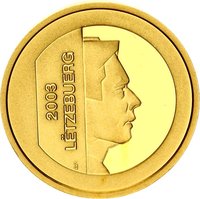
Grand Duke Henri of Luxembourg, right profile.
Inscription:
2002

LËTZEBUERG
Translation:
Luxembourg
Script: Latin
Languages: Luxembourgish, German

Reverse

Description:
A stylized justice symbol.
Inscription:
Cour de Justice

des communautés

Européennes

25 EURO

1952-2002

CVRIA
Translation:
Court of Justice

of the European

Communities

25 EURO

1952-2002

CVRIA
Script: Latin
Language: French

Edge


Mints

NameMark
Royal Dutch Mint

Mintings

YearMint MarkMintageQualityCollection
200220,000Proof

Historical background

In 2002, the Grand Duchy of Luxembourg underwent a profound monetary transition, as it, along with eleven other founding members, irrevocably adopted the euro as its official currency. This marked the culmination of a multi-year process of economic convergence under the Maastricht Treaty criteria, to which Luxembourg, with its stable economy, low public debt, and strong financial sector, easily adhered. The physical introduction of euro banknotes and coins on 1 January 2002 (E-Day) replaced the Luxembourgish franc (LUF), which had been pegged to the Belgian franc since the 1920s under the Belgium-Luxembourg Economic Union (BLEU). For the first two months of the year, both currencies circulated in parallel before the franc ceased to be legal tender.

This change was largely seamless for Luxembourg's economy, given its high degree of international integration and the fact that its financial sector had long operated in multiple currencies. The fixed conversion rate was set at 40.3399 Luxembourgish francs to one euro. A key national particularity was that Luxembourg, unlike other euro area members, did not initially issue its own standard euro coins; it used Belgian coins until 2004 when it finally began minting coins with the effigy of Grand Duke Henri. This delay was due to complex negotiations regarding seigniorage rights with Belgium, a legacy of their long-standing monetary union.

The adoption solidified Luxembourg's position at the heart of the European project and eliminated exchange rate risks for its critical cross-border workforce and its vast banking and investment fund industry. Domestically, it required a significant public information campaign and technical adjustments for businesses and vending machines. While some sentimental attachment to the franc persisted, the transition was broadly accepted as a logical step for a founding EU member state, further embedding its economy into the single market and enhancing monetary stability for its future development.
Somewhat Rare