

5 francs – France
Add to wishlist
France
Context
Years: 1844–1848
Issuer: France
Ruler: Louis Philippe I
Currency:
(1795—1959)
Demonetization: 25 June 1928
Total mintage: 57,013,075
Material
References
KM: #
Numista: #196469
Value
Bullion value: $56.15
Obverse
Description:
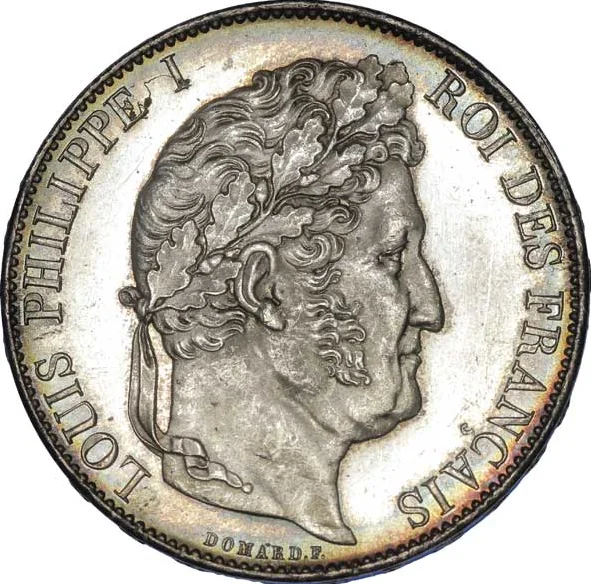
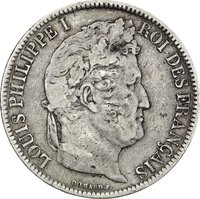
Louis-Philippe I faces right, wearing an oak crown with a trailing ribbon end. Signed "DOMARD. F." below the neck against the border.
Inscription:
LOUIS PHILIPPE I ROI DES FRANÇAIS
DOMARD.F.
DOMARD.F.
Translation:
LOUIS PHILIPPE I KING OF THE FRENCH
DOMARD.F.
DOMARD.F.
Script: Latin
Language: French
Engraver: Joseph-François Domard
Reverse
Description:
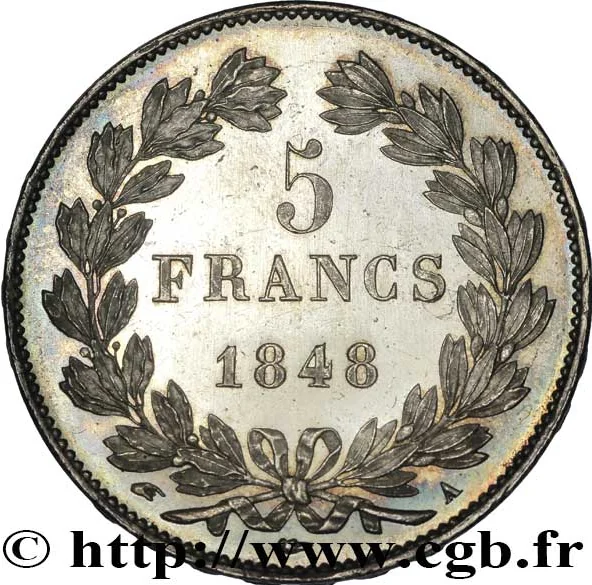
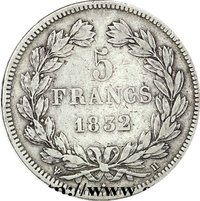
Above 1848, a crown of laurel and olive branches tied with a ribbon. Below, the General Engraver's mark, flanked by the Director's mark and the workshop letter A.
Inscription:
5
FRANCS
1848
A
FRANCS
1848
A
Script: Latin
Engraver: Joseph-François Domard
Edge
Embossed lettering
Legend:
***DIEU PROTEGE LA FRANCE
Translation:
GOD PROTECT FRANCE
Language: French
Mints
| Name | Mark |
|---|---|
| Monnaie de Paris | A |
| Rouen | B |
| Strasbourg | BB |
| Bordeaux | K |
| Lille | W |
Mintings
| Year | Mint Mark | Mintage | Quality | Collection |
|---|---|---|---|---|
| 1844 | A | 1,970,463 | ||
| 1844 | B | 306,142 | ||
| 1844 | W | 8,824,673 | ||
| 1844 | BB | 1,896,113 | ||
| 1844 | K | 393,582 | ||
| 1845 | K | 537,439 | ||
| 1845 | A | 3,095,362 | ||
| 1845 | BB | 2,032,521 | ||
| 1845 | W | 11,128,840 | ||
| 1846 | K | 481,727 | ||
| 1846 | BB | 810,013 | ||
| 1846 | A | 5,535,528 | ||
| 1846 | W | 1,490,249 | ||
| 1847 | K | 166,842 | ||
| 1847 | A | 12,617,926 | ||
| 1847 | BB | 1,613,128 | ||
| 1848 | BB | 898,220 | ||
| 1848 | K | 165,615 | ||
| 1848 | A | 3,048,692 |
Historical background
In 1844, France's currency system was in a state of transition, governed by the bimetallic standard established under the Franc Germinal in 1803. This law fixed the value of the franc to specific quantities of both gold and silver (1 franc = 4.5 grams of fine silver, or 0.29 grams of gold), with a legal ratio of 15.5 ounces of silver to 1 ounce of gold. However, this system was under immense strain due to global market fluctuations in the value of the two metals. Throughout the 1830s and early 1840s, the fixed mint ratio increasingly diverged from the market ratio, leading to the phenomenon of "bad money driving out good" (Gresham's Law). As silver became overvalued at the mint compared to its market price, it was profitably coined, while gold was hoarded or exported, causing a worrying scarcity of gold coinage in circulation.
The situation created significant economic uncertainty and debate. Bankers, economists, and politicians were divided between "bimetallists," who believed the state could maintain the fixed ratio, and "monometallists," who advocated for switching to a gold-only standard to achieve greater stability. The Banque de France, the country's central bank established in 1800, held the exclusive right of note issue in Paris and was tasked with maintaining convertibility of its banknotes into specie (coin). Its reserves and policies were central to the monetary stability of the nation, but the bimetallic imbalance complicated its management of the money supply.
By 1844, the government of Prime Minister François Guizot was actively seeking a solution. The period was one of quiet preparation for legislative change, culminating in the law of 1845 which attempted to shore up the system by slightly adjusting silver coinage standards. However, this proved to be only a temporary measure. The fundamental instability of bimetallism would persist, leading to France's eventual leadership in forming the Latin Monetary Union in 1865, which sought to create a multinational bimetallic zone, before the global shift toward the gold standard later in the century.
The situation created significant economic uncertainty and debate. Bankers, economists, and politicians were divided between "bimetallists," who believed the state could maintain the fixed ratio, and "monometallists," who advocated for switching to a gold-only standard to achieve greater stability. The Banque de France, the country's central bank established in 1800, held the exclusive right of note issue in Paris and was tasked with maintaining convertibility of its banknotes into specie (coin). Its reserves and policies were central to the monetary stability of the nation, but the bimetallic imbalance complicated its management of the money supply.
By 1844, the government of Prime Minister François Guizot was actively seeking a solution. The period was one of quiet preparation for legislative change, culminating in the law of 1845 which attempted to shore up the system by slightly adjusting silver coinage standards. However, this proved to be only a temporary measure. The fundamental instability of bimetallism would persist, leading to France's eventual leadership in forming the Latin Monetary Union in 1865, which sought to create a multinational bimetallic zone, before the global shift toward the gold standard later in the century.
🌱 Very Common