

Obverse
Description:
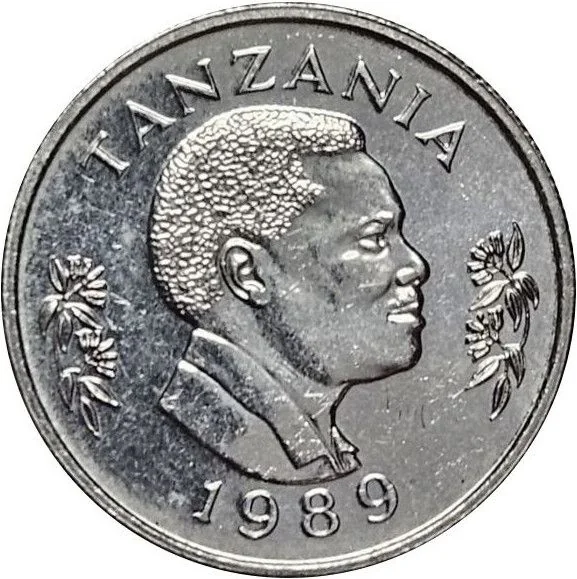
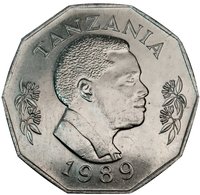
Ali Hassan Mwinyi – right-facing bust (Tanzania's second president).
Inscription:
TANZANIA
1990
1990
Script: Latin
Reverse
Description:
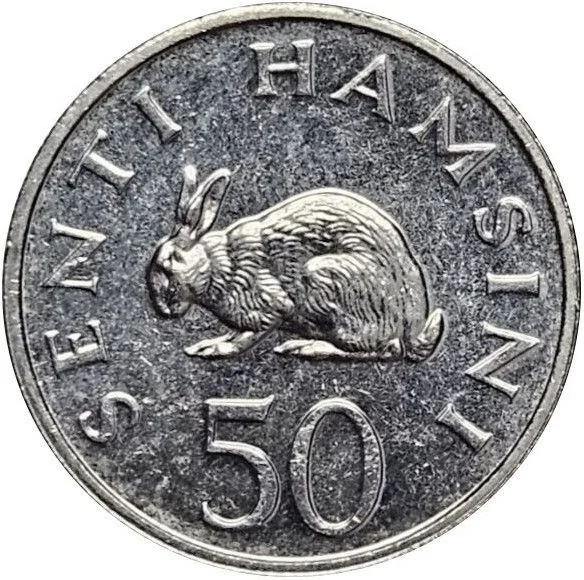
_Leporidae poelagus_, left-facing rabbit.
Inscription:
SENTI HAMSINI
50
50
Translation:
Fifty Cents
Script: Latin
Language: Maltese
Engraver: Christopher Ironside
Edge
Reeded
Mints
| Name | Mark |
|---|---|
| Royal Mint | — |
Mintings
| Year | Mint Mark | Mintage | Quality | Collection |
|---|---|---|---|---|
| 1988 | — | 10,000,000 | ||
| 1989 | — | — | ||
| 1990 | — | — |
Historical background
In 1988, Tanzania was in the midst of a prolonged economic crisis, grappling with the severe consequences of the structural adjustment programs (SAPs) imposed by the International Monetary Fund (IMF) and World Bank. The Tanzanian shilling was fundamentally overvalued and subject to strict exchange controls under a fixed official rate, which bore little relation to its actual market value. This created a thriving black market for foreign currency, particularly US dollars, where the shilling traded at a fraction of its official value. This dual system severely distorted trade, discouraged official exports, and led to chronic shortages of imported essential goods.
The government, under President Ali Hassan Mwinyi and his policy of "Ruksa" (permission or openness), had begun a cautious and politically sensitive shift away from the socialist Ujamaa principles of his predecessor, Julius Nyerere. A pivotal step was the introduction of a "Own Funds" import scheme in 1984, which allowed businesses with access to foreign currency abroad to import goods outside the state-controlled system. By 1988, this parallel market was a critical, yet inefficient, pressure valve for the economy. The core dilemma was the unsustainable official exchange rate, which drained foreign reserves and stifled formal sector growth, while the government hesitated on full devaluation due to fears of triggering inflation and public unrest.
Consequently, 1988 represented a tense holding pattern. The currency situation was characterized by a widening gap between the official and parallel market rates, mounting external debt, and persistent macroeconomic instability. Pressure from international financial institutions for a significant devaluation and further liberalization was intensifying. This set the stage for the more radical reforms that would follow in the early 1990s, including the establishment of a bureau de change system and eventually a floating exchange rate, marking the end of the fixed-rate regime and a decisive turn toward a market-oriented economy.
The government, under President Ali Hassan Mwinyi and his policy of "Ruksa" (permission or openness), had begun a cautious and politically sensitive shift away from the socialist Ujamaa principles of his predecessor, Julius Nyerere. A pivotal step was the introduction of a "Own Funds" import scheme in 1984, which allowed businesses with access to foreign currency abroad to import goods outside the state-controlled system. By 1988, this parallel market was a critical, yet inefficient, pressure valve for the economy. The core dilemma was the unsustainable official exchange rate, which drained foreign reserves and stifled formal sector growth, while the government hesitated on full devaluation due to fears of triggering inflation and public unrest.
Consequently, 1988 represented a tense holding pattern. The currency situation was characterized by a widening gap between the official and parallel market rates, mounting external debt, and persistent macroeconomic instability. Pressure from international financial institutions for a significant devaluation and further liberalization was intensifying. This set the stage for the more radical reforms that would follow in the early 1990s, including the establishment of a bureau de change system and eventually a floating exchange rate, marking the end of the fixed-rate regime and a decisive turn toward a market-oriented economy.
🌱 Very Common