

10 kroner (Hans Christian Andersen) – Denmark
Add to wishlist
Non-circulating coins
Commemoration: 200th Anniversary of the Birth of Hans Christian Andersen
Denmark
Context
Material
References
KM: #
Numista: #195933
Value
Exchange value: 10 DKK
Bullion value: $1198.86
Inflation-adjusted value: 14.18 DKK
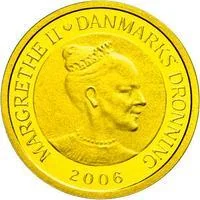
Obverse
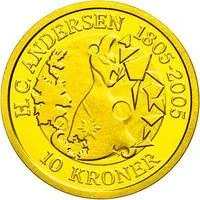
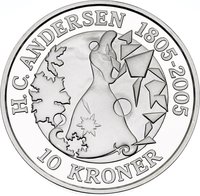
Reverse
Description:
Snow Queen illustration encircled by text and value.
Inscription:
H.C. ANDERSEN 1805-2005
10 KRONER
10 KRONER
Script: Latin
Edge
Plain
Categories
| Event> Birth anniversary |
Mints
| Name | Mark |
|---|---|
| Royal Danish Mint | — |
Mintings
| Year | Mint Mark | Mintage | Quality | Collection |
|---|---|---|---|---|
| 2006 | ♥︎ | 3,075 |
Historical background
In 2006, Denmark's currency situation was defined by its long-standing and stable membership of the European Exchange Rate Mechanism II (ERM II). Since 1999, the Danish krone (DKK) had been pegged to the euro with a central rate of 7.46038 and a very narrow fluctuation band of ±2.25%. This policy was a political compromise, following the 2000 referendum where Danes rejected adopting the euro, but chose to maintain a fixed exchange rate to ensure monetary stability and align closely with the eurozone, its primary trading partner.
The Danish central bank, Danmarks Nationalbank, actively managed this peg through interest rate policy and foreign exchange interventions. Its primary objective was to maintain the krone's stability against the euro, even if this meant setting interest rates independently of the European Central Bank (ECB). In 2006, this led to a period of higher interest rates in Denmark compared to the eurozone, as the bank acted to curb domestic inflationary pressures and defend the currency peg, which faced upward pressure due to Denmark's strong economic fundamentals.
Overall, the currency framework in 2006 was considered a success, providing a predictable environment for trade and investment. The krone experienced minimal volatility against the euro, and the system enjoyed broad political and public support as a proven alternative to full euro adoption. This stability was seen as a cornerstone of Denmark's small, open economy, insulating it from speculative shocks while reaping the benefits of European monetary integration without formal membership.
The Danish central bank, Danmarks Nationalbank, actively managed this peg through interest rate policy and foreign exchange interventions. Its primary objective was to maintain the krone's stability against the euro, even if this meant setting interest rates independently of the European Central Bank (ECB). In 2006, this led to a period of higher interest rates in Denmark compared to the eurozone, as the bank acted to curb domestic inflationary pressures and defend the currency peg, which faced upward pressure due to Denmark's strong economic fundamentals.
Overall, the currency framework in 2006 was considered a success, providing a predictable environment for trade and investment. The krone experienced minimal volatility against the euro, and the system enjoyed broad political and public support as a proven alternative to full euro adoption. This stability was seen as a cornerstone of Denmark's small, open economy, insulating it from speculative shocks while reaping the benefits of European monetary integration without formal membership.
💎 Extremely Rare