

2000 Forint (St Margaret of Hungary) – Hungary
Non-circulating coins
Commemoration: 775th Anniversary of the Birth of St Margaret of Hungary (1242-1270)
Hungary
Context

Material
Diameter: 22 mm
Weight: 4.2 g
Thickness: 1.5 mm
Shape: Round
Composition: Nickel brass
Magnetic: No
Technique: Milled
Alignment: Medal alignment
flip
References
KM: #Click to copy to clipboard918
Numista: #108276
Value
Exchange value: 2000 HUF = $6.30
Inflation-adjusted value: 3385.58 HUF
Obverse
Description:
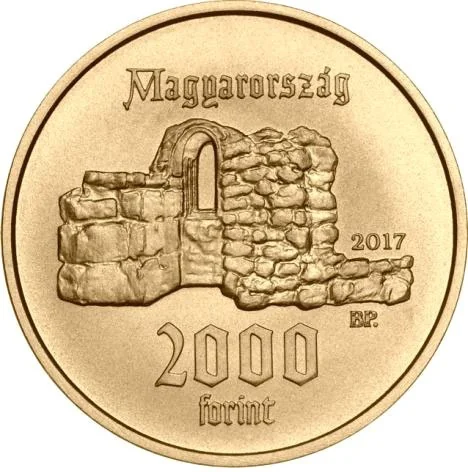
Text above and below an image of the Dominican convent ruins on Margaret Island.
Inscription:
Magyarország
2017
BP.
2000
forint
2017
BP.
2000
forint
Translation:
Hungary
2017
Budapest
2000
forint
2017
Budapest
2000
forint
Script: Latin
Language: Hungarian
Engraver: Enikő Szöllőssy
Reverse
Description:
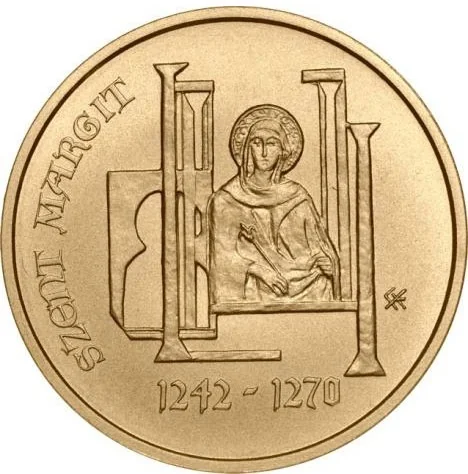
Saint Margaret of Hungary framed by stone columns.
Inscription:
SZENT MARGIT
1242-1270
1242-1270
Translation:
SAINT MARGARET
1242-1270
1242-1270
Script: Latin
Language: Hungarian
Engraver: Enikő Szöllőssy
Edge
Plain
Categories
| Event> Birth anniversary |
Mints
| Name | Mark |
|---|---|
| Hungarian mint | — |
Mintings
| Year | Mint Mark | Mintage | Quality | Collection |
|---|---|---|---|---|
| 2017 | BP. | 5,000 |
Historical background
In 2017, Hungary's currency situation was characterized by a period of relative stability and deliberate weakening of the Hungarian Forint (HUF) by the central bank, following years of volatility. The National Bank of Hungary (MNB), under its "self-financing" strategy, maintained historically low interest rates and used unconventional tools to keep the forint weak. This policy aimed to reduce the country's external vulnerability by encouraging the repayment of foreign-currency mortgages (a legacy of the pre-2008 crisis) and to boost export competitiveness through a cheaper currency.
This approach was largely successful in its domestic goals. The low interest rate environment, with the base rate held at a record low of 0.90% throughout the year, spurred economic growth and helped facilitate the government's program to convert household foreign-currency loans into forint-denominated ones. However, it came with trade-offs, notably contributing to rising inflation, which exceeded the central bank's 3% target for most of the year. Furthermore, the weak forint policy created tensions with the European Central Bank, which was concerned about potential spillover effects within the Eurozone.
Overall, 2017 represented a year of strategic monetary policy where currency management was explicitly used as a tool for domestic economic restructuring and growth, rather than being solely focused on price stability. The MNB prioritized reducing external debt, supporting the government's housing loan conversion scheme, and fueling export-led growth, even as it navigated the side effects of higher inflation and international scrutiny.
This approach was largely successful in its domestic goals. The low interest rate environment, with the base rate held at a record low of 0.90% throughout the year, spurred economic growth and helped facilitate the government's program to convert household foreign-currency loans into forint-denominated ones. However, it came with trade-offs, notably contributing to rising inflation, which exceeded the central bank's 3% target for most of the year. Furthermore, the weak forint policy created tensions with the European Central Bank, which was concerned about potential spillover effects within the Eurozone.
Overall, 2017 represented a year of strategic monetary policy where currency management was explicitly used as a tool for domestic economic restructuring and growth, rather than being solely focused on price stability. The MNB prioritized reducing external debt, supporting the government's housing loan conversion scheme, and fueling export-led growth, even as it navigated the side effects of higher inflation and international scrutiny.
💎 Very Rare