

1 Franc – Katanga
Democratic Republic of the Congo
Context
Year: 1961
Country: Democratic Republic of the Congo 
Issuer: Katanga
Issuing organization: National Bank of Katanga
Period:
(1960—1963)
Currency:
(1960—1963)
Demonetization: January 1963
Total mintage: 2,500,000
Material
References
KM: #Click to copy to clipboard1
Numista: #6915
Obverse
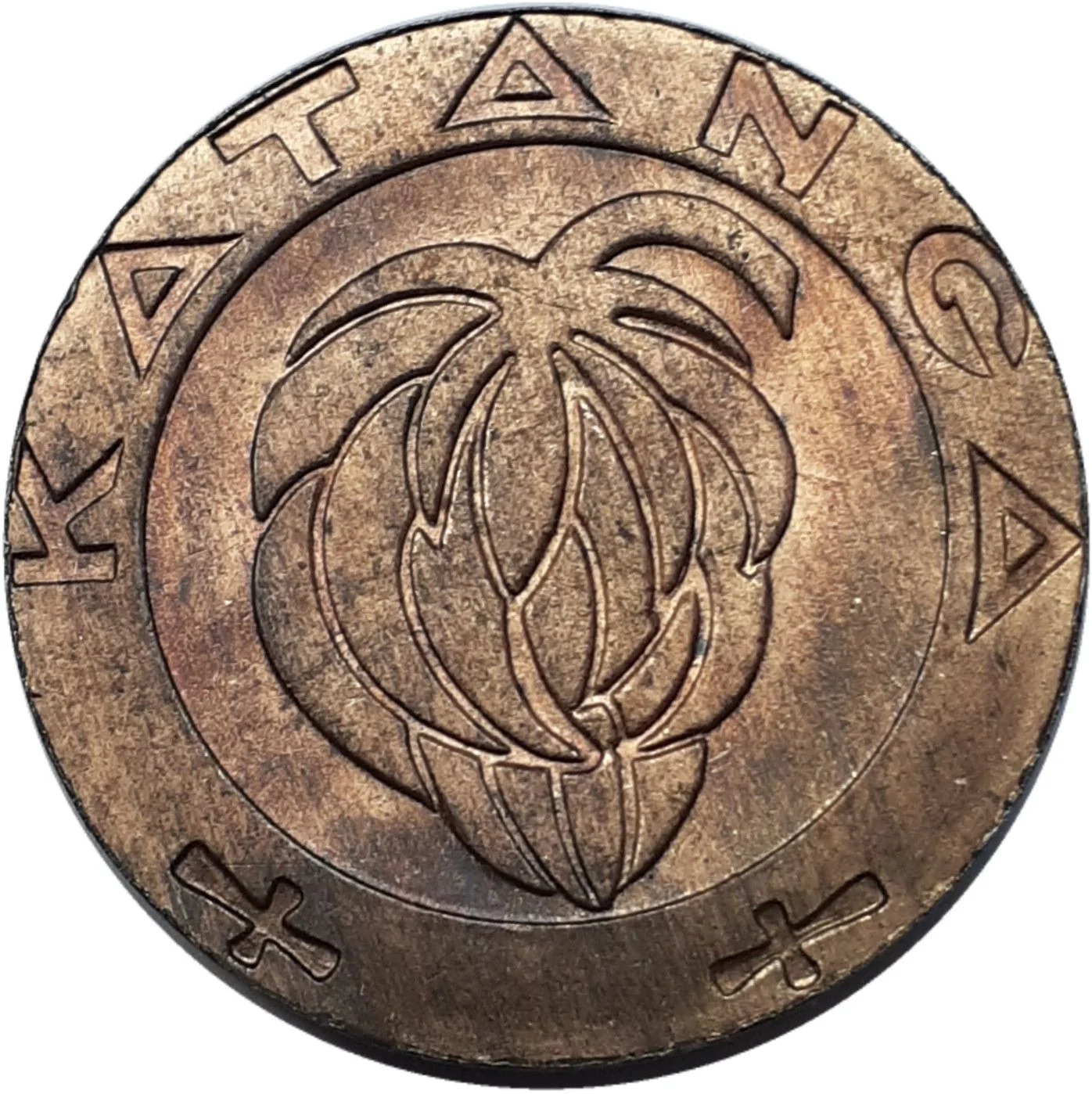
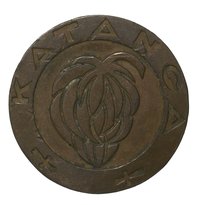
Description:
Bananas (Musa x paradisiaca) encircled.
Inscription:
+ KATANGA +
Script: Latin
Designer: Claude Charlier
Reverse
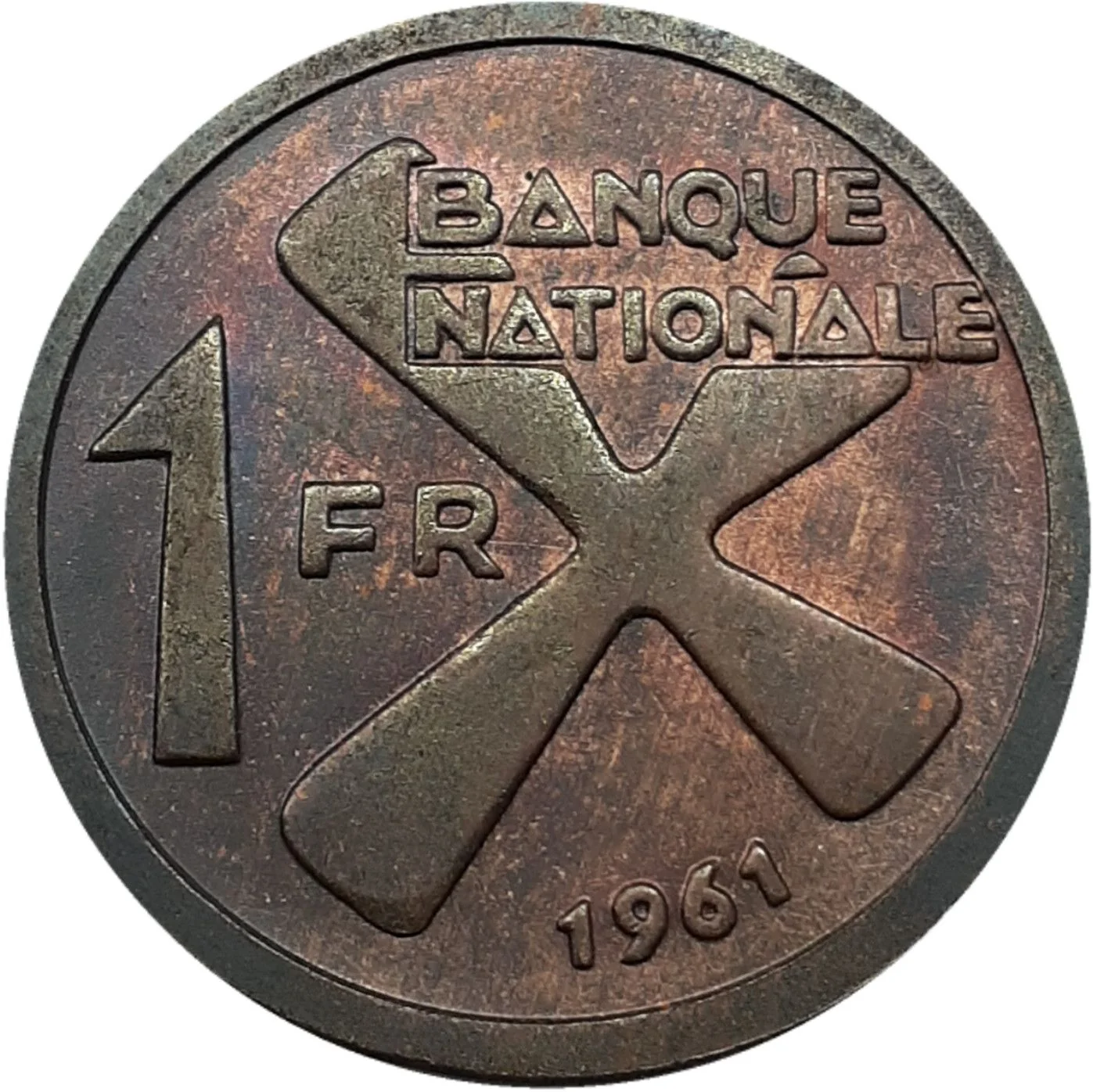
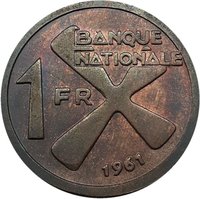
Description:
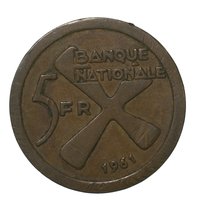
Katanga Cross, circle enclosing value and date.
Inscription:
BANQUE NATIONALE
1 FR
1961
1 FR
1961
Translation:
National Bank
1 Franc
1961
1 Franc
1961
Script: Latin
Language: French
Designer: Claude Charlier
Edge
Plain
Mints
| Name | Mark |
|---|---|
| Kings Norton Metal Company | — |
Mintings
| Year | Mint Mark | Mintage | Quality | Collection |
|---|---|---|---|---|
| 1961 | — | 2,500,000 |
Historical background
In 1961, the secessionist State of Katanga, having unilaterally declared independence from the newly formed Republic of the Congo, faced an urgent need to establish its own monetary system as a pillar of sovereignty. The central Congolese government in Léopoldville, led by Prime Minister Patrice Lumumba and later Joseph Iléo, had severed Katanga's access to the national currency, the Congolese franc. This forced the regime of Moïse Tshombe, backed by Belgian commercial interests and foreign mercenaries, to create a distinct Katangese franc to facilitate government operations, pay its forces, and assert economic autonomy.
The currency was fundamentally underpinned by the region's immense mineral wealth, particularly copper and cobalt from the Union Minière du Haut-Katanga. Revenues from these exports were intended to provide the necessary backing for the new franc, which was introduced at par with the Belgian franc. However, the Katangese franc struggled with legitimacy and practical challenges from its inception. It was not recognized internationally, its circulation was largely confined to urban centers, and it coexisted uneasily with Belgian francs and even Congolese francs in many transactions, creating a complex and unstable multi-currency environment.
Ultimately, the Katangese currency was a symbol of the secession's fragile and contested nature. Its viability was entirely tied to the survival of Tshombe's regime and the continued flow of mineral exports through non-Congolese channels. When the Katangese secession was militarily and diplomatically crushed in early 1963, the Katangese franc was promptly withdrawn from circulation, ending its brief existence as a failed instrument of a breakaway state.
The currency was fundamentally underpinned by the region's immense mineral wealth, particularly copper and cobalt from the Union Minière du Haut-Katanga. Revenues from these exports were intended to provide the necessary backing for the new franc, which was introduced at par with the Belgian franc. However, the Katangese franc struggled with legitimacy and practical challenges from its inception. It was not recognized internationally, its circulation was largely confined to urban centers, and it coexisted uneasily with Belgian francs and even Congolese francs in many transactions, creating a complex and unstable multi-currency environment.
Ultimately, the Katangese currency was a symbol of the secession's fragile and contested nature. Its viability was entirely tied to the survival of Tshombe's regime and the continued flow of mineral exports through non-Congolese channels. When the Katangese secession was militarily and diplomatically crushed in early 1963, the Katangese franc was promptly withdrawn from circulation, ending its brief existence as a failed instrument of a breakaway state.
🌱 Very Common