

5 Francs – Switzerland
Switzerland
Context
Years: 1968–2025
Issuer: Switzerland 
Period:
(since 1848)
Currency:
(since 1850)
Total mintage: 228,193,910
References
KM: #Click to copy to clipboard40a
Numista: #195
Value
Exchange value: 5 CHF = $6.46
Inflation-adjusted value: 17.34 CHF
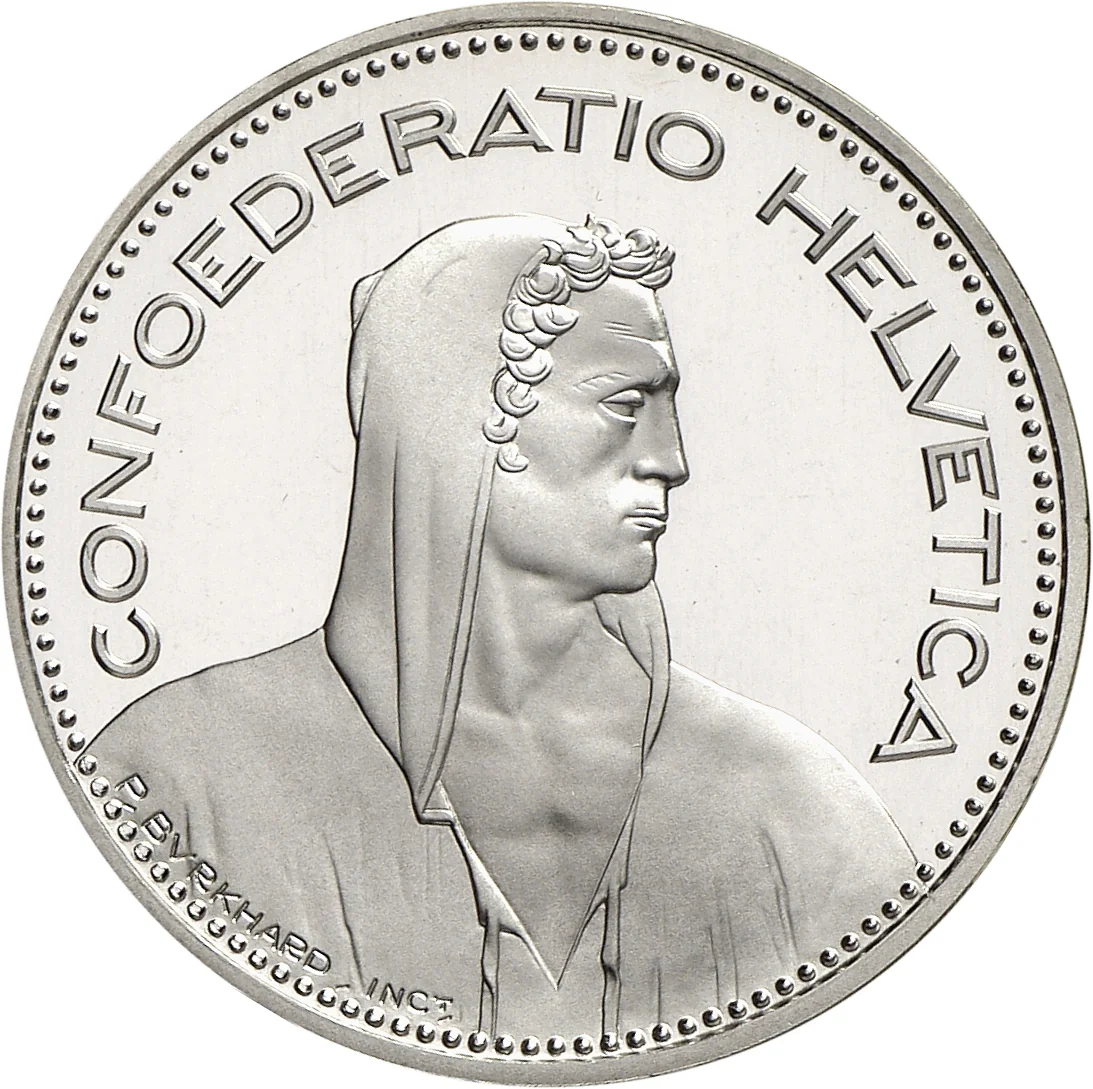
Obverse
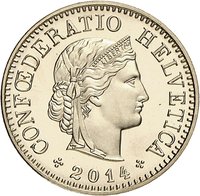
Description:
Bust of a curly-haired herdsman in a hooded shirt, facing right; commonly misidentified as William Tell.
Inscription:
CONFOEDERATIO HELVETICA
P , BVRKHARD , INCᵀ,
P , BVRKHARD , INCᵀ,
Translation:
Swiss Confederation
P. Burkhard, Inc.
P. Burkhard, Inc.
Script: Latin
Designer: Paul Burkhard
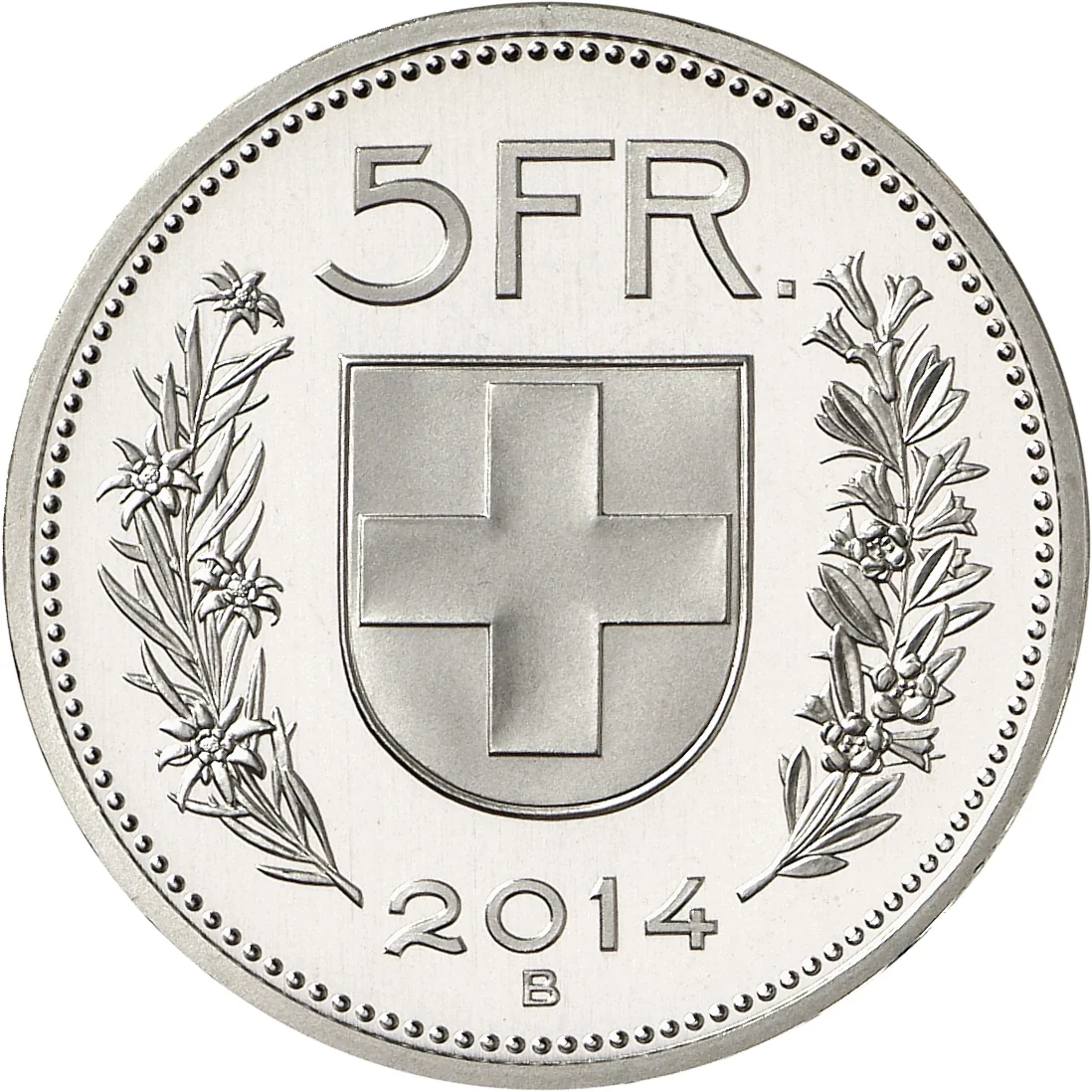
Reverse
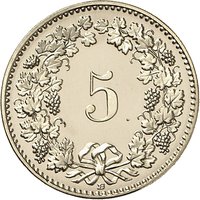
Description:
Swiss coat of arms on a square shield, with an edelweiss to the left and an alpenrose to the right.
Inscription:
5 FR.
1994
B
1994
B
Script: Latin
Designer: Paul Burkhard
Edge
Embossed lettering.
Legend:
★★★ DOMINUS | PROVIDEBIT | ★★★★★★★★★★ |
Translation:
The Lord will provide.
Language: Latin
Mints
| Name | Mark |
|---|---|
| Bern | B |
Mintings
| Year | Mint Mark | Mintage | Quality | Collection |
|---|---|---|---|---|
| 1968 | B | 33,871,000 | ||
| 1970 | — | 6,300,000 | ||
| 1973 | — | 5,000,000 | ||
| 1974 | — | 6,007,000 | ||
| 1974 | — | 2,400 | Proof | |
| 1975 | — | 4,015,000 | ||
| 1975 | — | 10,000 | Proof | |
| 1976 | — | 3,007,000 | ||
| 1976 | — | 5,130 | Proof | |
| 1977 | — | 2,009,000 | ||
| 1977 | — | 7,030 | Proof | |
| 1978 | — | 4,411,000 | ||
| 1978 | — | 10,000 | Proof | |
| 1979 | — | 4,011,000 | ||
| 1979 | — | 10,000 | Proof | |
| 1980 | — | 4,026,000 | ||
| 1980 | B | 10,000 | Proof | |
| 1981 | — | 6,018,000 | ||
| 1981 | — | 10,000 | Proof | |
| 1982 | — | 5,050,000 | ||
| 1982 | — | 10,000 | Proof | |
| 1983 | — | 4,033,000 | ||
| 1983 | — | 11,000 | Proof | |
| 1984 | — | 3,953,000 | ||
| 1984 | — | 14,000 | Proof | |
| 1994 | B | 12,023,000 | ||
| 1994 | B | 6,100 | Proof | |
| 1995 | B | 12,024,000 | ||
| 1995 | B | 6,100 | Proof | |
| 1996 | B | 12,023,000 | ||
| 1996 | B | 6,100 | Proof | |
| 1997 | B | 9,022,000 | ||
| 1997 | B | 5,500 | Proof | |
| 1998 | B | 9,021,000 | ||
| 1998 | B | 4,800 | Proof | |
| 1999 | B | 9,021,000 | ||
| 1999 | B | 5,000 | Proof | |
| 2000 | B | 5,500 | Proof | |
| 2000 | B | 7,026,000 | ||
| 2001 | B | 1,028,000 | ||
| 2001 | B | 6,000 | Proof | |
| 2002 | B | 6,000 | Proof | |
| 2002 | B | 1,030,000 | ||
| 2003 | B | 1,027,500 | ||
| 2003 | B | 5,500 | Proof | |
| 2004 | B | 529,000 | ||
| 2004 | B | 5,000 | Proof | |
| 2005 | B | 529,000 | ||
| 2005 | B | 4,500 | Proof | |
| 2006 | B | 530,000 | ||
| 2006 | B | 4,000 | Proof | |
| 2007 | B | 4,000 | Proof | |
| 2007 | B | 528,000 | ||
| 2008 | B | 526,000 | ||
| 2008 | B | 4,000 | Proof | |
| 2009 | B | 2,026,000 | ||
| 2009 | B | 4,000 | Proof | |
| 2010 | B | 5,026,000 | ||
| 2010 | B | 4,000 | Proof | |
| 2011 | B | 4,000 | Proof | |
| 2011 | B | 3,026,000 | ||
| 2012 | B | 8,026,000 | ||
| 2012 | B | 4,000 | Proof | |
| 2013 | B | 3,500 | Proof | |
| 2013 | B | 8,023,500 | ||
| 2014 | B | 7,022,000 | ||
| 2014 | B | 3,000 | Proof | |
| 2015 | B | 3,000 | Proof | |
| 2015 | B | 5,026,000 | ||
| 2016 | B | 4,028,000 | ||
| 2016 | B | 3,000 | Proof | |
| 2017 | B | 3,029,500 | ||
| 2017 | B | 2,500 | Proof | |
| 2018 | B | 3,027,000 | ||
| 2018 | B | 2,500 | Proof | |
| 2019 | B | 3,022,000 | ||
| 2019 | B | 2,500 | Proof | |
| 2020 | B | 3,020,000 | ||
| 2020 | B | 2,500 | Proof | |
| 2021 | B | 2,500 | Proof | |
| 2021 | B | 2,021,000 | ||
| 2022 | B | 1,013,000 | ||
| 2022 | B | 2,000 | Proof | |
| 2023 | B | 1,020,750 | ||
| 2023 | B | 2,000 | Proof | |
| 2024 | B | 2,012,000 | ||
| 2024 | B | 2,000 | Proof | |
| 2025 | B | 2,000 | Proof | |
| 2025 | B | — |
Historical background
In 1968, Switzerland faced a significant monetary crisis, primarily driven by intense international pressure on the Swiss franc. The currency was widely perceived as a "safe-haven" asset, a reputation strengthened by the country's political neutrality, low inflation, and strong economy. This status attracted massive capital inflows, particularly from investors seeking refuge from the turmoil of the May 1968 protests in France and broader global currency instability. The resulting surge in demand caused the franc to appreciate sharply, threatening the competitiveness of Switzerland's vital export industries.
The Swiss National Bank (SNB) intervened aggressively to defend a fixed exchange rate peg, but the scale of the speculative inflows made this increasingly difficult and expensive. To stem the tide, the authorities resorted to extraordinary measures, including the implementation of negative interest rates on foreign bank deposits—a radical tool for its time. This policy aimed to deter "hot money" by charging foreign investors for holding Swiss franc balances, rather than paying them interest. Concurrently, the government and the SNB explored other capital controls and even political agreements with source countries to limit inflows.
The crisis of 1968 proved to be a pivotal moment, fundamentally challenging the existing monetary order. It highlighted the severe constraints of maintaining a fixed exchange rate in the face of overwhelming market forces and safe-haven demand. The lessons learned directly informed Switzerland's subsequent monetary policy evolution, culminating in the decision to float the Swiss franc in 1973, allowing its value to be set by the market. Thus, 1968 marked the beginning of the end for the Bretton Woods-era parity system in Switzerland, setting the stage for the country's modern approach to exchange rate management.
The Swiss National Bank (SNB) intervened aggressively to defend a fixed exchange rate peg, but the scale of the speculative inflows made this increasingly difficult and expensive. To stem the tide, the authorities resorted to extraordinary measures, including the implementation of negative interest rates on foreign bank deposits—a radical tool for its time. This policy aimed to deter "hot money" by charging foreign investors for holding Swiss franc balances, rather than paying them interest. Concurrently, the government and the SNB explored other capital controls and even political agreements with source countries to limit inflows.
The crisis of 1968 proved to be a pivotal moment, fundamentally challenging the existing monetary order. It highlighted the severe constraints of maintaining a fixed exchange rate in the face of overwhelming market forces and safe-haven demand. The lessons learned directly informed Switzerland's subsequent monetary policy evolution, culminating in the decision to float the Swiss franc in 1973, allowing its value to be set by the market. Thus, 1968 marked the beginning of the end for the Bretton Woods-era parity system in Switzerland, setting the stage for the country's modern approach to exchange rate management.
🌱 Very Common