

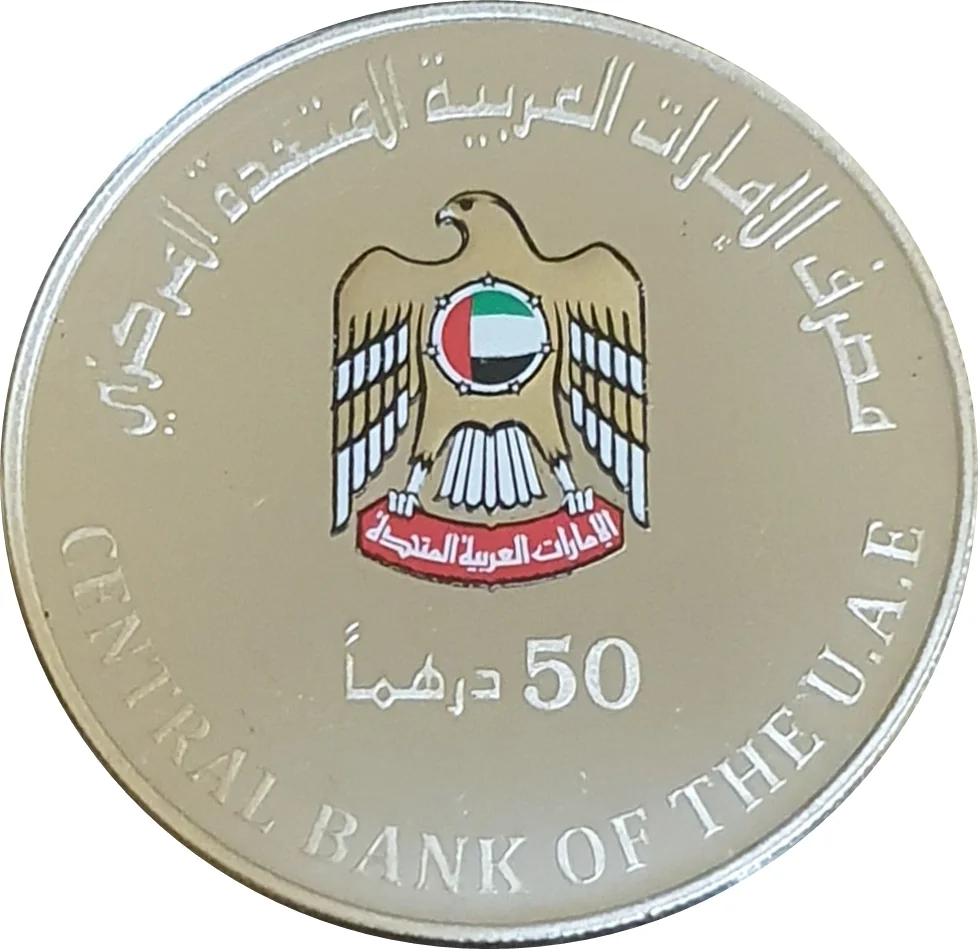
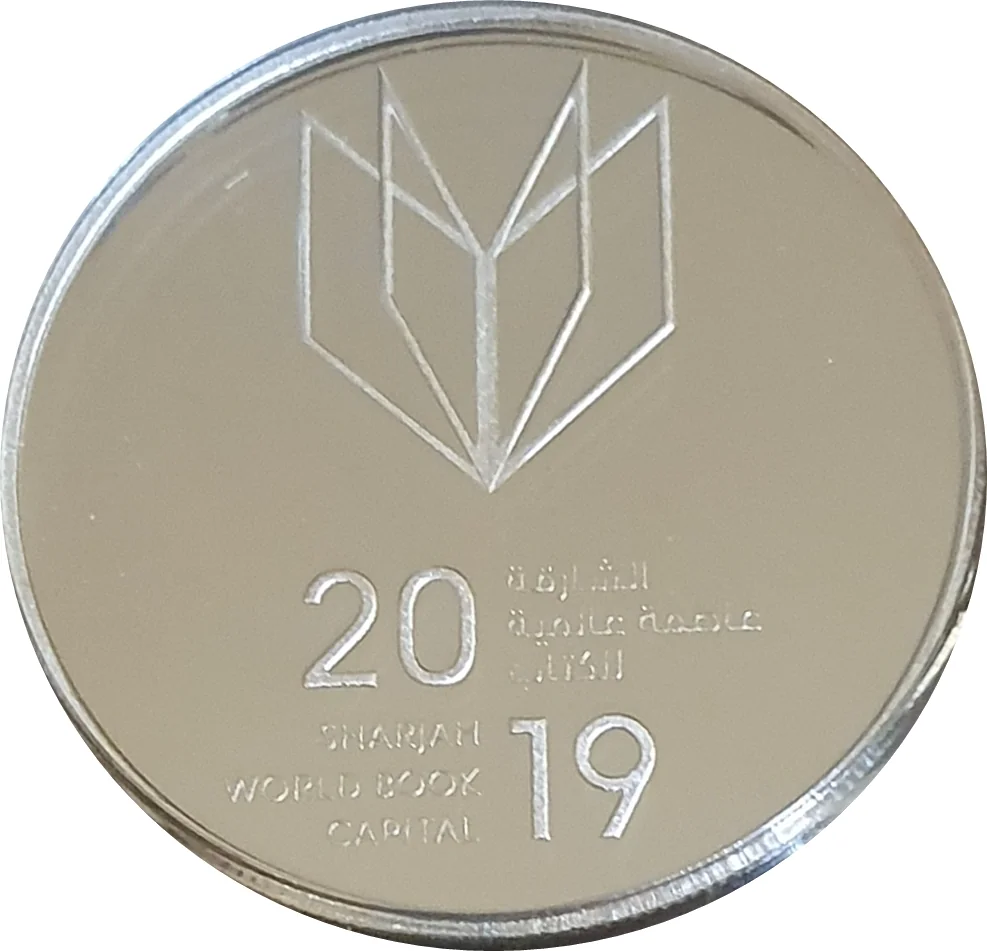
50 dirhams – United Arab Emirates
Add to wishlist
Non-circulating coins
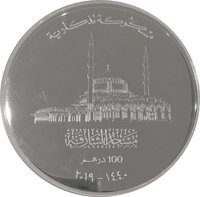
Commemoration: Selection of Sharjah City as the World Book Capital 2019
United Arab Emirates
Context
Year: 2019
Issuer: United Arab Emirates
Ruler: Khalifa bin Zayed Al Nahyan
Currency:
(since 1973)
Total mintage: 1,000
Material
References
KM: #
Numista: #194017
Value
Exchange value: 50 AED
Bullion value: $70.79
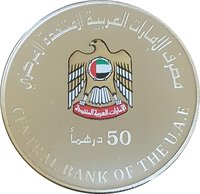
Obverse
Reverse
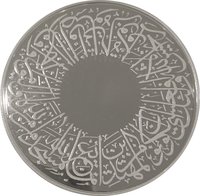
Edge
Reeded, except for 2 small smooth segments with the serial number inscribed on each
Legend:
314-1000 /// 314-1000
Categories
| Symbols> Coat of Arms |
Mintings
| Year | Mint Mark | Mintage | Quality | Collection |
|---|---|---|---|---|
| 2019 | — | 1,000 | Proof |
Historical background
In 2019, the United Arab Emirates maintained a stable and robust currency regime, with the UAE Dirham (AED) firmly pegged to the US Dollar (USD) at a fixed rate of approximately AED 3.6725 per USD. This long-standing peg, established in 1997, provided a cornerstone for the nation's economic policy, ensuring monetary stability, low inflation, and predictability for international trade and investment. The peg was managed by the UAE Central Bank, which held substantial foreign currency reserves, primarily in USD, to defend the fixed exchange rate. This policy was widely seen as a key factor in the UAE's rapid economic development, particularly for Dubai and Abu Dhabi, by insulating the economy from oil price volatility and fostering a favorable environment for business and finance.
The year saw the currency's value indirectly influenced by US Federal Reserve interest rate decisions, to which the UAE Central Bank generally mirrored due to the peg. As the Fed shifted from a tightening cycle to cutting rates in mid-2019, the UAE followed suit, lowering its own key policy rates. This linkage meant the Dirham strengthened against currencies like the Euro and British Pound when the USD was strong, impacting sectors like tourism and real estate, where many buyers and visitors came from Europe and Asia. Domestically, the strong dollar-pegged Dirham kept the cost of imported goods and services in check, contributing to a low inflation environment, with the CPI averaging around 1.5-2% for the year.
Looking forward, 2019 also laid the groundwork for future financial integration within the Gulf Cooperation Council (GCC). While plans for a single GCC currency remained stalled, the UAE continued to work closely with its neighbors, particularly Saudi Arabia, on monetary policy coordination and payment system linkages. The stability of the Dirham peg was unquestioned, providing a secure platform as the UAE diversified its economy further and prepared to host major global events like Expo 2020. There was no serious public debate about abandoning the dollar peg, as its benefits for the UAE's open, trade-dependent economy were considered to far outweigh any constraints on independent monetary policy.
The year saw the currency's value indirectly influenced by US Federal Reserve interest rate decisions, to which the UAE Central Bank generally mirrored due to the peg. As the Fed shifted from a tightening cycle to cutting rates in mid-2019, the UAE followed suit, lowering its own key policy rates. This linkage meant the Dirham strengthened against currencies like the Euro and British Pound when the USD was strong, impacting sectors like tourism and real estate, where many buyers and visitors came from Europe and Asia. Domestically, the strong dollar-pegged Dirham kept the cost of imported goods and services in check, contributing to a low inflation environment, with the CPI averaging around 1.5-2% for the year.
Looking forward, 2019 also laid the groundwork for future financial integration within the Gulf Cooperation Council (GCC). While plans for a single GCC currency remained stalled, the UAE continued to work closely with its neighbors, particularly Saudi Arabia, on monetary policy coordination and payment system linkages. The stability of the Dirham peg was unquestioned, providing a secure platform as the UAE diversified its economy further and prepared to host major global events like Expo 2020. There was no serious public debate about abandoning the dollar peg, as its benefits for the UAE's open, trade-dependent economy were considered to far outweigh any constraints on independent monetary policy.

✨ Legendary