


5 angel – Isle of Man
Add to wishlist
Non-circulating coins
Commemoration: Archangel Michael
Context
Year: 2013
Country: British Crown dependencies
Issuer: Isle of Man
Ruler: Elizabeth II
Currency:
(since 1984)
Total mintage: 5,000
Material
Diameter: 65 mm
Weight: 155.5 g
Silver Weight:: 155.34 g
Shape: Round
Composition: 99.9% Silver
Standard: Silver 5 ounces
Magnetic: No
Technique: Milled
Alignment: Medal alignment
flip

References
Numista: #107944
Value
Bullion value: $378.06
Obverse
Description:
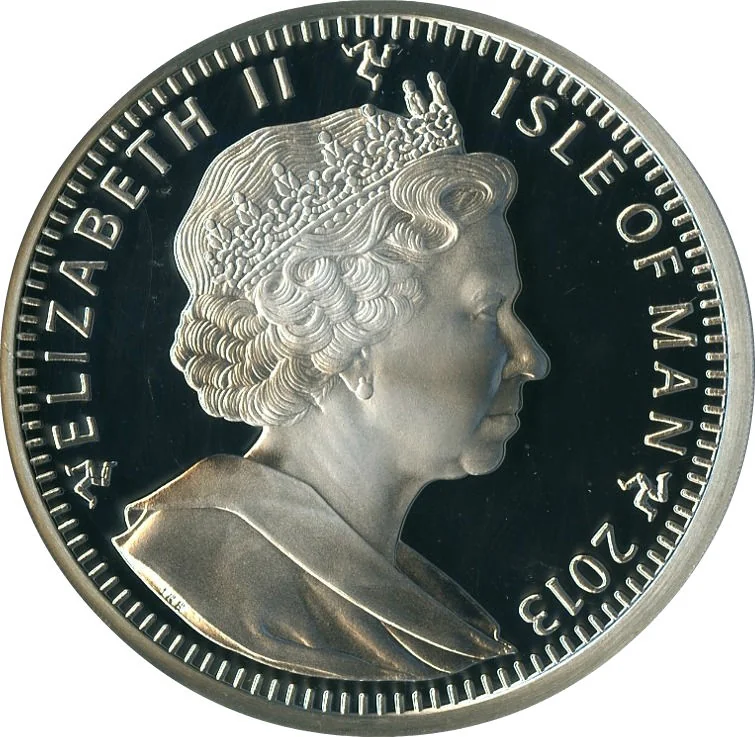
Queen Elizabeth II right-facing portrait in the "Girls of Great Britain and Ireland" Tiara, surrounded by legend and date.
Inscription:
ELIZABETH II ISLE OF MAN 2013
IRB
IRB
Translation:
ELIZABETH II ISLE OF MAN 2013
IRB
IRB
Script: Latin
Designer: Ian Rank-Broadley
Reverse
Edge
Reeded
Categories
| Object> Cold weapons |
| Mythology> Fantastic animal |
| Object> Armour |
| Person> Religious figure |
Mints
| Name | Mark |
|---|---|
| Pobjoy Mint | (PM) |
Mintings
| Year | Mint Mark | Mintage | Quality | Collection |
|---|---|---|---|---|
| 2013 | PM | 5,000 | Proof |
Historical background
In 2013, the Isle of Man's currency situation was characterised by its long-standing and stable framework of issuing its own distinct currency, the Manx pound (IMP), which was pegged at par with the British pound sterling (GBP). This arrangement, in place for decades, meant that sterling was also legal tender on the island and circulated alongside Manx notes and coins. The Manx government, through its Treasury, maintained this peg by holding sufficient sterling reserves to back the local currency in circulation, ensuring confidence and facilitating seamless trade and travel with its largest partner, the United Kingdom.
The year did not see any major monetary policy crises, but the context was significantly shaped by the aftermath of the 2008 global financial crisis and the ongoing Eurozone debt crisis. While the Isle of Man's economy and banking sector demonstrated resilience, there was an underlying awareness of external pressures. The stability of the sterling peg was a key asset, but it also meant the island was indirectly exposed to the Bank of England's quantitative easing policies and the broader economic performance of the UK, which was itself experiencing a period of subdued growth and austerity measures.
Furthermore, 2013 fell within a period of enhanced scrutiny on international finance centres regarding tax transparency and regulation. While not directly a currency issue, this evolving global regulatory landscape impacted the island's financial services sector—a key pillar of its economy. Maintaining a robust and credible currency system was part of the Isle of Man's broader strategy to project stability and legitimacy as a well-regulated jurisdiction, amidst international efforts to combat tax evasion and improve financial accountability. Thus, the currency situation reflected both traditional stability and a need to navigate a changing external financial environment.
The year did not see any major monetary policy crises, but the context was significantly shaped by the aftermath of the 2008 global financial crisis and the ongoing Eurozone debt crisis. While the Isle of Man's economy and banking sector demonstrated resilience, there was an underlying awareness of external pressures. The stability of the sterling peg was a key asset, but it also meant the island was indirectly exposed to the Bank of England's quantitative easing policies and the broader economic performance of the UK, which was itself experiencing a period of subdued growth and austerity measures.
Furthermore, 2013 fell within a period of enhanced scrutiny on international finance centres regarding tax transparency and regulation. While not directly a currency issue, this evolving global regulatory landscape impacted the island's financial services sector—a key pillar of its economy. Maintaining a robust and credible currency system was part of the Isle of Man's broader strategy to project stability and legitimacy as a well-regulated jurisdiction, amidst international efforts to combat tax evasion and improve financial accountability. Thus, the currency situation reflected both traditional stability and a need to navigate a changing external financial environment.

✨ Legendary