

20 euro – Finland
Add to wishlist
Non-circulating coins
Commemoration: Centennial of Finland's independence
Finland
Context
Material
References
KM: #
Numista: #193181
Value
Exchange value: 20 EUR
Bullion value: $57.41
Inflation-adjusted value: 24.79 EUR
Obverse
Description:
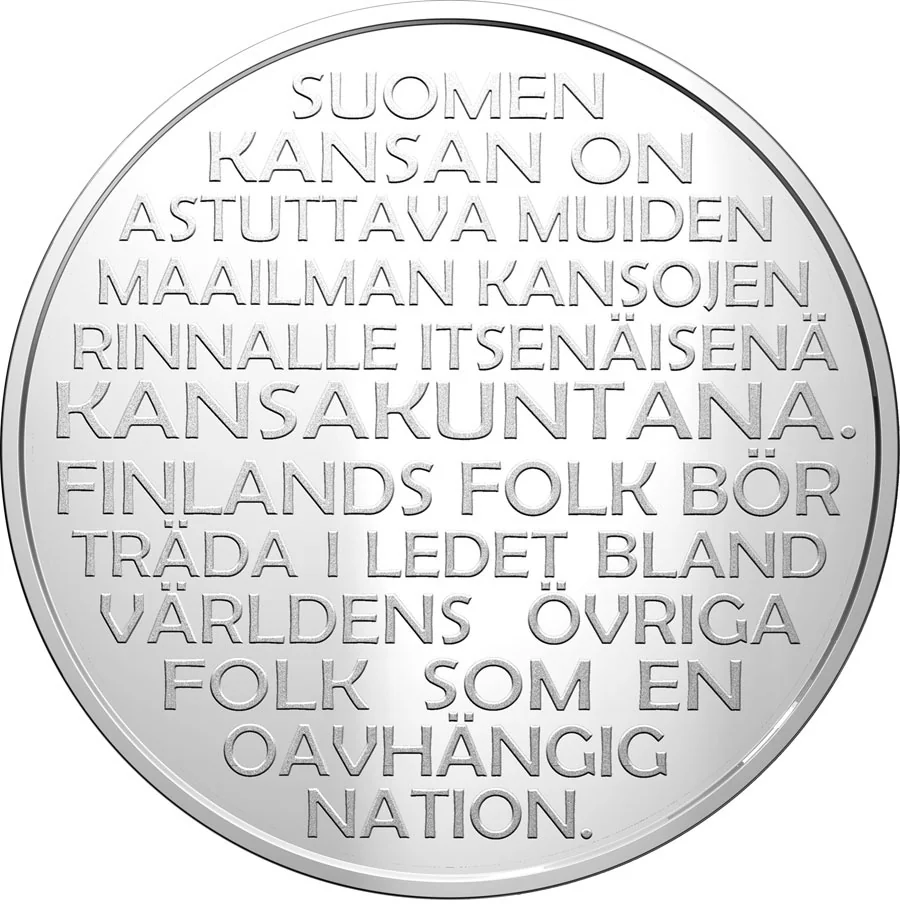
Finland's declaration of independence extract in Finnish and Swedish.
Inscription:
SUOMEN KANSAN ON ASTUTTAVA MUIDEN MAAILMAN KANSOJEN RINNALLE ITSENÄISENÄ KANSAKUNTANA.
FINLANDS FOLK BÖR TRÄDA I LEDET BLAND VÄRLDENS ÖVRIGA FOLK SOM EN OAVHÄNGIG NATION.
FINLANDS FOLK BÖR TRÄDA I LEDET BLAND VÄRLDENS ÖVRIGA FOLK SOM EN OAVHÄNGIG NATION.
Translation:
The Finnish people must step into the ranks of the world's other peoples as an independent nation.
Script: Latin
Engraver: Ilkka Suppanen
Reverse
Description:
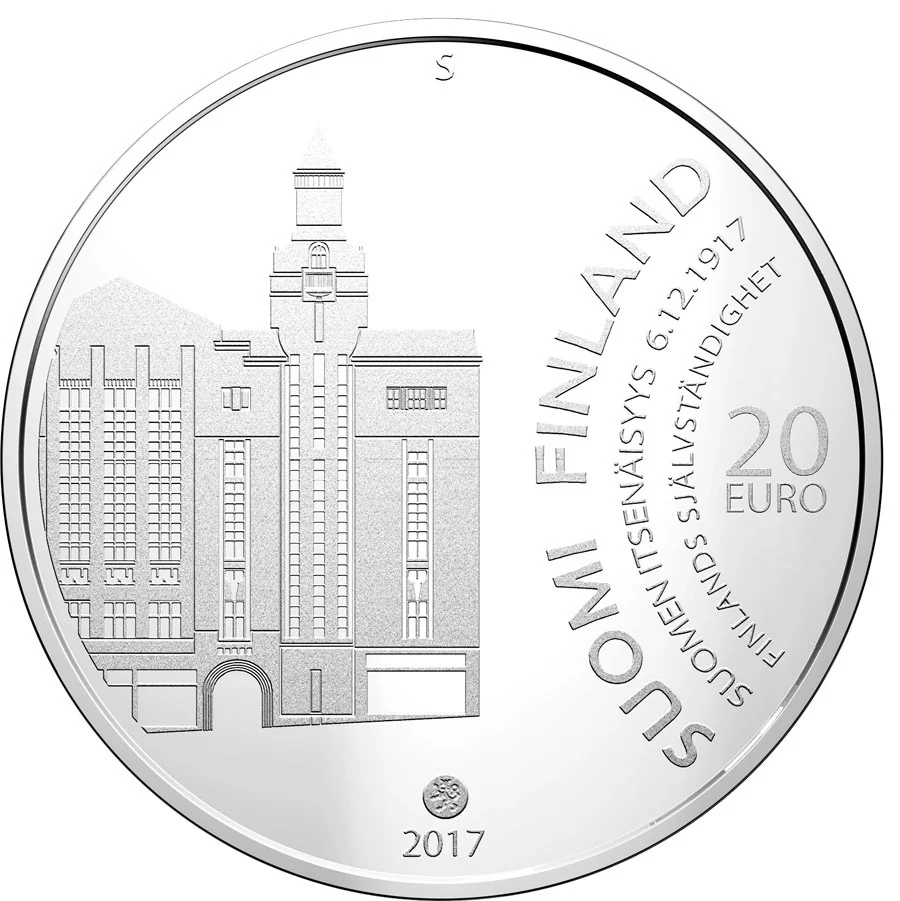
A photo of Helsinki's former art nouveau Heimola Building at Kluuvikatu 5. Top: engraver's initial (S). Bottom: Mint of Finland mark.
Inscription:
S
SUOMI FINLAND
SUOMEN ITSENÄISYYS 6.12.1917
FINLANDS SJÄLVSTÄNDIGHET
20 EURO
SUOMI FINLAND
SUOMEN ITSENÄISYYS 6.12.1917
FINLANDS SJÄLVSTÄNDIGHET
20 EURO
Translation:
Finland
Finland's Independence 6.12.1917
Finland's Independence
20 Euro
Finland's Independence 6.12.1917
Finland's Independence
20 Euro
Script: Latin
Engraver: Ilkka Suppanen
Edge
Plain
Categories
| Event> Independence |
Mints
| Name | Mark |
|---|---|
| Mint of Finland | — |
Mintings
| Year | Mint Mark | Mintage | Quality | Collection |
|---|---|---|---|---|
| 2017 | — | 2,017 | Proof |
Historical background
In 2017, Finland remained a committed member of the Eurozone, using the euro (€) as its sole official currency since its introduction in 2002. The broader monetary policy, including interest rates and quantitative easing measures, was set by the European Central Bank (ECB) in Frankfurt. For Finland, this meant its economic recovery and currency stability were intrinsically tied to Eurozone-wide decisions and the performance of the common currency against major global counterparts like the US dollar. Domestically, the euro facilitated seamless trade within the bloc, a critical factor for an export-driven economy like Finland's.
The year was marked by a period of cautious economic optimism. After a prolonged slump following the 2008 financial crisis and the decline of Nokia's mobile phone dominance, the Finnish economy showed signs of strengthening growth. This recovery, however, was not without its challenges in the currency context. A key domestic discussion revolved around competitiveness, as some exporters felt the euro's exchange rate could be disadvantageous compared to a theoretical independent Finnish markka. Nevertheless, the stability provided by the euro was generally seen as a net positive, shielding the country from potential speculative currency crises.
Furthermore, 2017 saw Finland continuing to navigate the practical and political dimensions of the single currency. The country was an active participant in Eurozone governance discussions, advocating for fiscal responsibility and completion of the Banking Union. Domestically, the rise of digital payments accelerated, with Finnish consumers and businesses being among the most avid users of electronic and card-based transactions in Europe, a trend that gradually reshaped the physical use of cash euros in everyday life. Thus, the currency situation was one of embedded stability within the Eurozone framework, supporting a recovering economy while longer-term debates about digitalization and competitiveness quietly persisted.
The year was marked by a period of cautious economic optimism. After a prolonged slump following the 2008 financial crisis and the decline of Nokia's mobile phone dominance, the Finnish economy showed signs of strengthening growth. This recovery, however, was not without its challenges in the currency context. A key domestic discussion revolved around competitiveness, as some exporters felt the euro's exchange rate could be disadvantageous compared to a theoretical independent Finnish markka. Nevertheless, the stability provided by the euro was generally seen as a net positive, shielding the country from potential speculative currency crises.
Furthermore, 2017 saw Finland continuing to navigate the practical and political dimensions of the single currency. The country was an active participant in Eurozone governance discussions, advocating for fiscal responsibility and completion of the Banking Union. Domestically, the rise of digital payments accelerated, with Finnish consumers and businesses being among the most avid users of electronic and card-based transactions in Europe, a trend that gradually reshaped the physical use of cash euros in everyday life. Thus, the currency situation was one of embedded stability within the Eurozone framework, supporting a recovering economy while longer-term debates about digitalization and competitiveness quietly persisted.
✨ Legendary