

25 kuna – Croatia
Add to wishlist
Circulating commemorative coins
Commemoration: Croatian Presidency of the Council of the European Union (January - June 2020)
Croatia
Context
Material
Diameter: 32 mm
Weight: 12.75 g
Thickness: 2.2 mm
Shape: Dodecagonal
Technique: Milled
Alignment: Medal alignment
flip
References
KM: #
Numista: #192983
Value
Exchange value: 25 HRK
Obverse
Description:
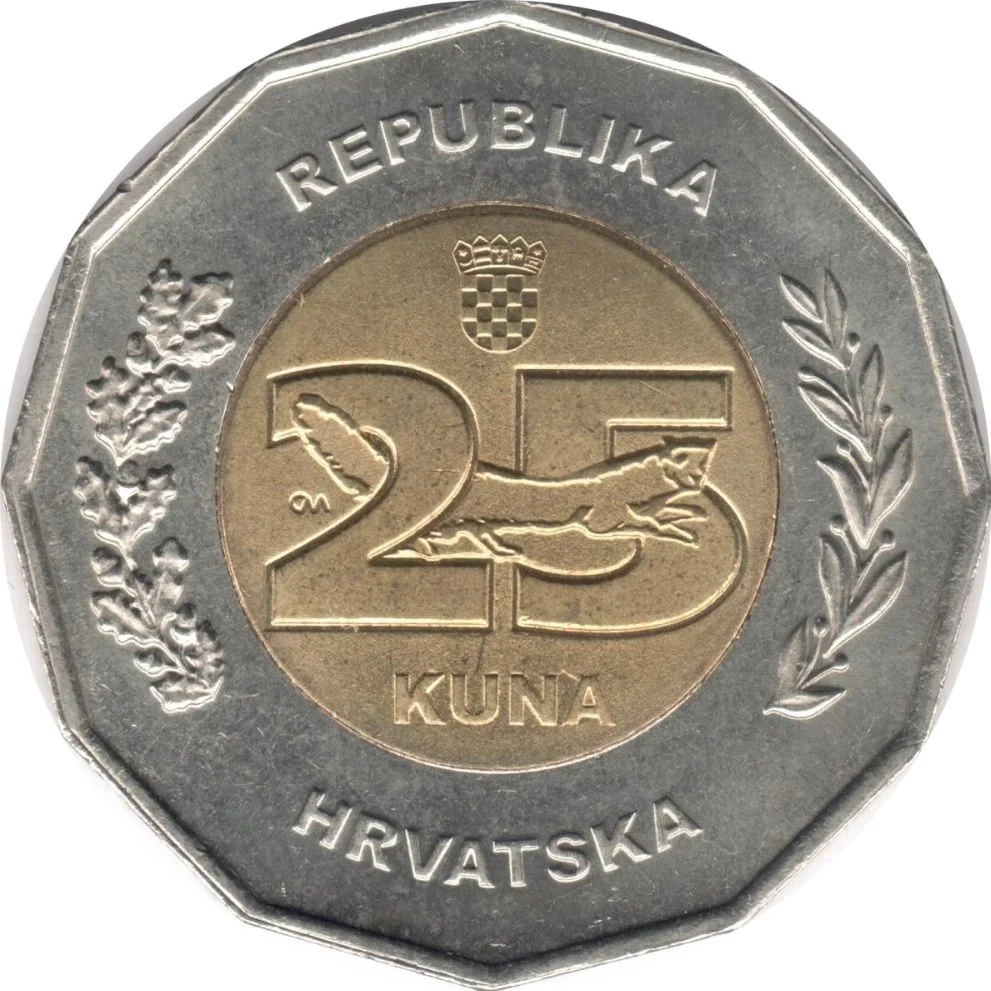
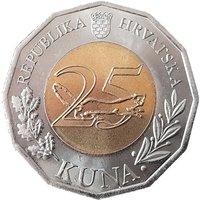
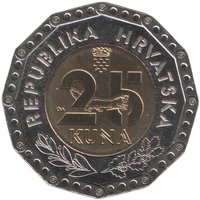
The coin's core features the stylized numeral "25", its outlines forming a right-facing marten. The Croatian coat of arms is above this, and the word "KUNA" below. On the surrounding ring, a common oak branch with acorns is left of the core and a blooming laurel branch is right. "REPUBLIKA" is inscribed above the core on the ring, and "HRVATSKA" below.
Inscription:
REPUBLIKA
25
KUNA
HRVATSKA
25
KUNA
HRVATSKA
Translation:
REPUBLIC
25
KUNAS
CROATIA
25
KUNAS
CROATIA
Script: Latin
Language: Croatian
Engraver: Damir Mataušić
Reverse
Description:
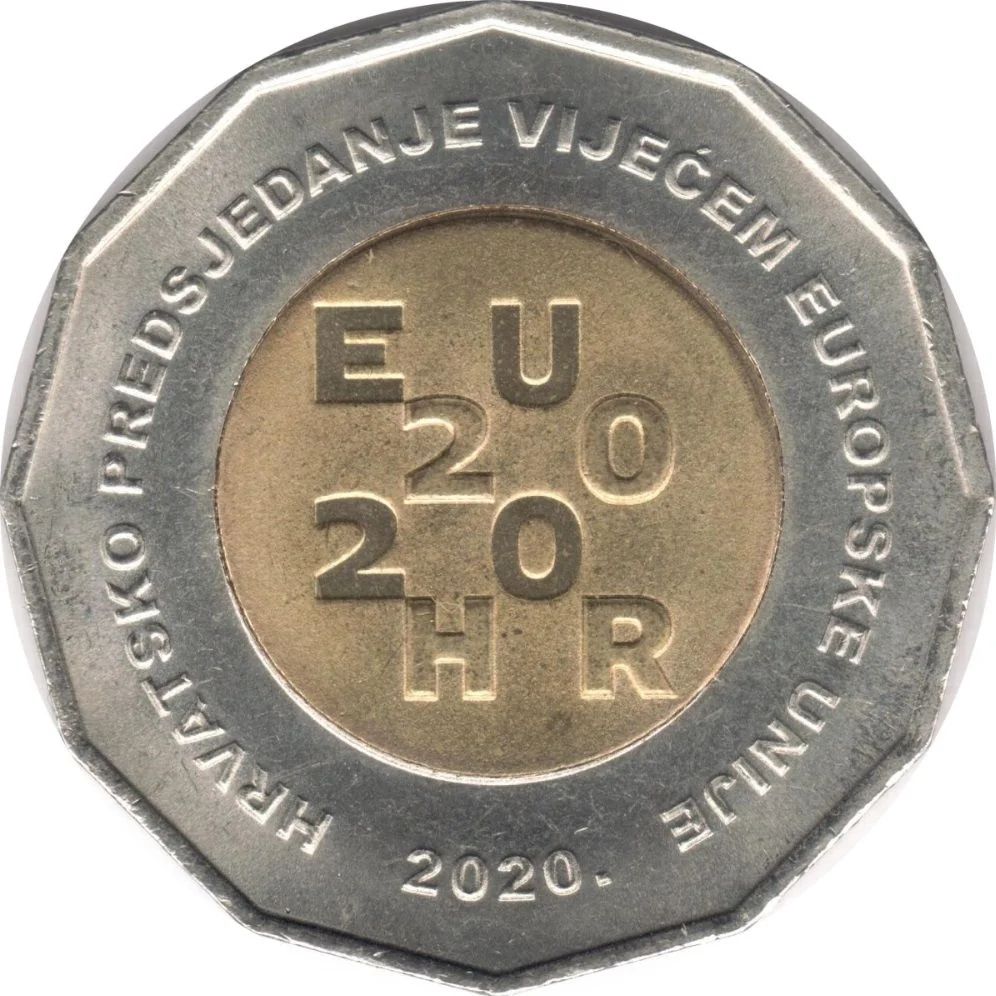
The core features the “Typographic Chessboard” logo for Croatia’s 2020 EU Council Presidency. This design uses the letters and numbers “HR,” “EU,” and “2020” to evoke the Croatian coat of arms and symbolize the Croatia-EU connection. The ring bears the circular inscription “HRVATSKO PREDSJEDANJE VIJEĆEM EUROPSKE UNIJE.” The release year “2020” is stamped below the core on the ring.
Inscription:
HRVATSKO PREDSJEDANJE VIJEĆEM EUROPSKE UNIJE
EU
HR
2020
EU
HR
2020
Translation:
Croatian Presidency of the Council of the European Union
EU
HR
2020
EU
HR
2020
Script: Latin
Language: Croatian
Engraver: Damir Mataušić
Edge
Plain
Mints
| Name | Mark |
|---|---|
| Croatian Mint | — |
Mintings
| Year | Mint Mark | Mintage | Quality | Collection |
|---|---|---|---|---|
| 2020 | — | 30,000 |
Historical background
In 2020, Croatia's currency situation was defined by its longstanding pursuit of adopting the euro, operating within the framework of the European Exchange Rate Mechanism II (ERM II). The national currency, the kuna (HRK), had been pegged to the euro since its introduction in 1994, first via the German Mark and then directly, ensuring remarkable stability for decades. This stability was a key strategic priority, and by 2020, Croatia had successfully met all formal convergence criteria—including price stability, sound public finances, and exchange rate stability—paving the way for a final decision on euro adoption.
The year was pivotal, as Croatia received crucial political endorsements. In July 2020, after nearly two years of preparation, Croatia was formally admitted into ERM II, often called the "euro waiting room." This required the kuna to maintain a central rate of 7.53450 to the euro with a standard fluctuation band of ±15%. Concurrently, Croatia joined the European Banking Union. These milestones were confirmed by the European Council and signaled a firm commitment from both Croatian authorities and EU institutions that the country was on an irreversible path to replacing the kuna with the euro.
Despite the stable peg, the broader economic context in 2020 was dominated by the COVID-19 pandemic, which caused a sharp recession. The government implemented significant fiscal measures to support the economy, leading to increased public debt. However, the currency peg itself remained unchallenged and provided an anchor of stability during the crisis, preventing exchange rate volatility. The focus throughout the year was less on managing currency fluctuations and more on finalizing the legal and technical preparations for the planned euro changeover, which was subsequently achieved on January 1, 2023.
The year was pivotal, as Croatia received crucial political endorsements. In July 2020, after nearly two years of preparation, Croatia was formally admitted into ERM II, often called the "euro waiting room." This required the kuna to maintain a central rate of 7.53450 to the euro with a standard fluctuation band of ±15%. Concurrently, Croatia joined the European Banking Union. These milestones were confirmed by the European Council and signaled a firm commitment from both Croatian authorities and EU institutions that the country was on an irreversible path to replacing the kuna with the euro.
Despite the stable peg, the broader economic context in 2020 was dominated by the COVID-19 pandemic, which caused a sharp recession. The government implemented significant fiscal measures to support the economy, leading to increased public debt. However, the currency peg itself remained unchallenged and provided an anchor of stability during the crisis, preventing exchange rate volatility. The focus throughout the year was less on managing currency fluctuations and more on finalizing the legal and technical preparations for the planned euro changeover, which was subsequently achieved on January 1, 2023.
🌱 Fairly Common