

5 Francs – France
Non-circulating coins
Commemoration: 1998 World Cup, France
France
Obverse
Description:
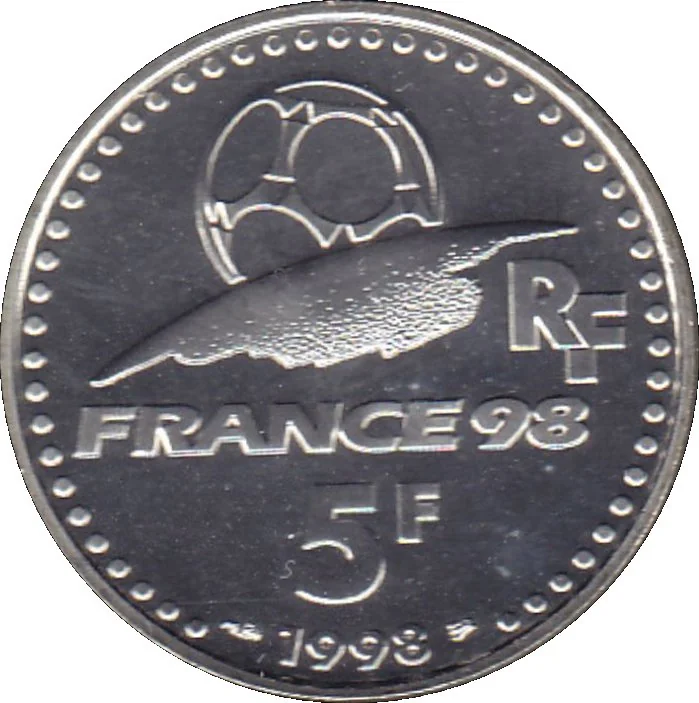
Football at top / "FRANCE 98" in center / Value below / "RF" on right / Year in bottom legend
Inscription:
RF
FRANCE 98
5F
1998
FRANCE 98
5F
1998
Script: Latin
Reverse
Description:
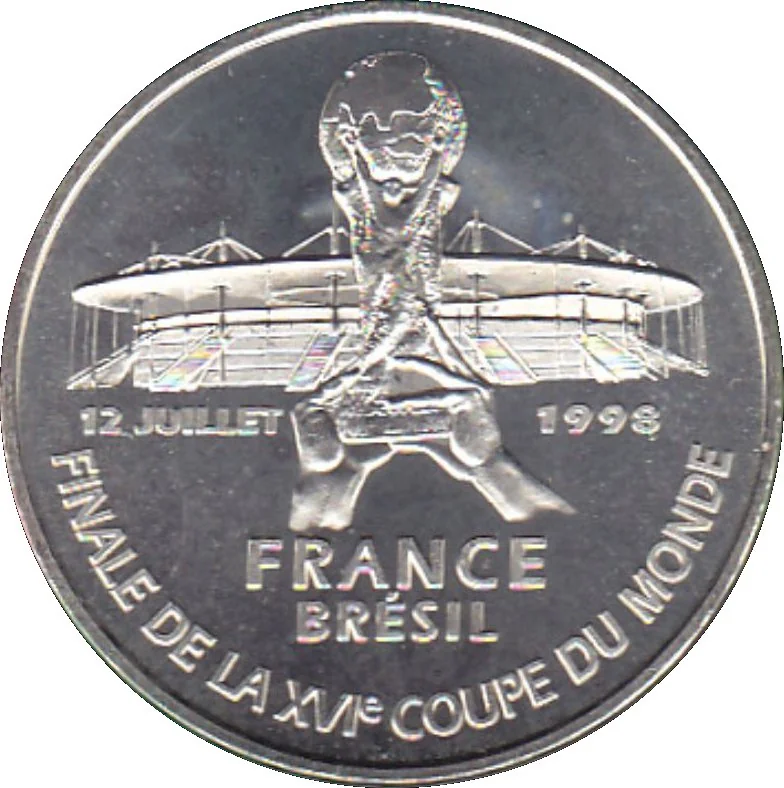
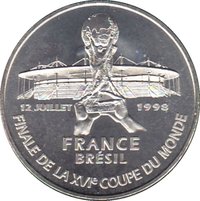
"FRANCE 98" World Cup Final commemorative: Trophy with Stade de France backdrop, "12 JULY 1998" and "FRANCE BRESIL" inscribed. Honors France's victory over Brazil.
Inscription:
12 JUILLET 1998
FRANCE
BRÉSIL
FINALE DE LA XVIe COUPE DU MONDE
FRANCE
BRÉSIL
FINALE DE LA XVIe COUPE DU MONDE
Translation:
12 July 1998
France
Brazil
Final of the XVI World Cup
France
Brazil
Final of the XVI World Cup
Script: Latin
Language: French
Edge
Reeded
Categories
| Sport> Sports venue |
| Sport> Football> FIFA World Cup |
Mints
| Name | Mark |
|---|---|
| Monnaie de Paris | — |
Mintings
| Year | Mint Mark | Mintage | Quality | Collection |
|---|---|---|---|---|
| 1998 | — | 100,000 | Proof |
Historical background
In 1998, France's currency situation was defined by its pivotal role in the final, irreversible transition to the euro. As a founding and driving force of the European Monetary Union (EMU), France, alongside other member states, had spent the preceding years rigorously meeting the Maastricht Treaty convergence criteria on inflation, interest rates, budget deficits, and public debt. The French franc, a symbol of national sovereignty, was in its final phase of existence, permanently locked into a fixed exchange rate with other participating currencies on January 1, 1999, at the establishment of the European Central Bank.
Domestically, this period was characterized by a state of "legal limbo" where prices were displayed in both francs and euros to acclimatize the public, though the franc remained the sole legal tender for everyday transactions. The Banque de France, operating under the new European System of Central Banks, was tasked with ensuring monetary stability and preparing for the logistical enormity of the physical currency changeover, scheduled for January 2002. Public sentiment was mixed, blending pride in European leadership with nostalgic anxiety over the loss of a familiar national symbol.
Thus, the currency situation in 1998 was one of confident technical preparation and profound symbolic transition. France had successfully aligned its economy with European partners, and the framework for the euro was legally and institutionally solidified. The year was less about economic crisis or fluctuation and more about the quiet yet historic countdown to surrendering monetary sovereignty, marking the end of the franc after centuries of circulation and a definitive step toward deeper European integration.
Domestically, this period was characterized by a state of "legal limbo" where prices were displayed in both francs and euros to acclimatize the public, though the franc remained the sole legal tender for everyday transactions. The Banque de France, operating under the new European System of Central Banks, was tasked with ensuring monetary stability and preparing for the logistical enormity of the physical currency changeover, scheduled for January 2002. Public sentiment was mixed, blending pride in European leadership with nostalgic anxiety over the loss of a familiar national symbol.
Thus, the currency situation in 1998 was one of confident technical preparation and profound symbolic transition. France had successfully aligned its economy with European partners, and the framework for the euro was legally and institutionally solidified. The year was less about economic crisis or fluctuation and more about the quiet yet historic countdown to surrendering monetary sovereignty, marking the end of the franc after centuries of circulation and a definitive step toward deeper European integration.

🌟 Limited