


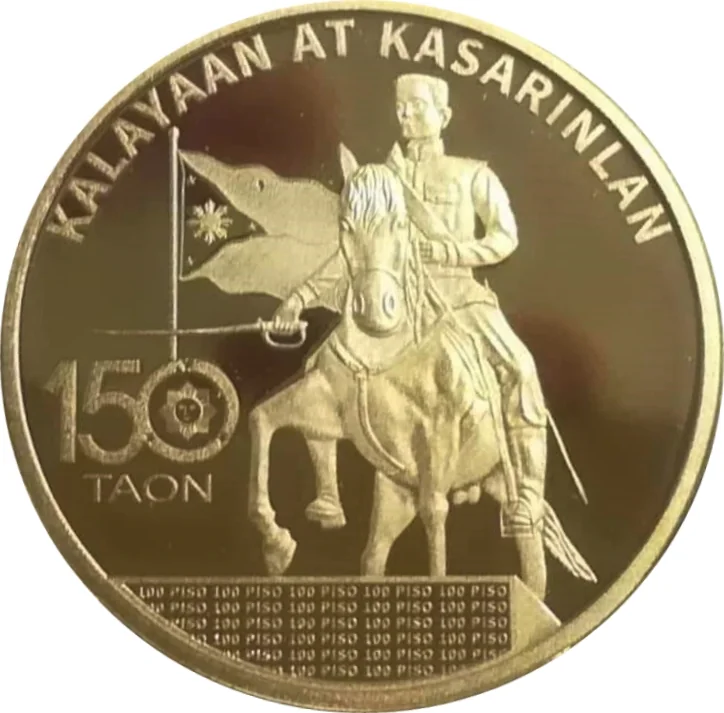
100 pesos (Emilio Aguinaldo) – Philippines
Add to wishlist
Non-circulating coins
Commemoration: 150th Birth Anniversary of Emilio Aguinaldo
Philippines
Context
Year: 2019
Issuer: Philippines
Issuing organization: Central Bank of the Philippines
Period:
(since 1946)
Currency:
(since 1967)
Total mintage: 5,000
Material
Diameter: 34 mm
Weight: 15 g
Thickness: 2.4 mm
Shape: Round
Composition: Nordic gold
Magnetic: No
Technique: Milled
Alignment: Medal alignment
flip
References
KM: #
Numista: #192732
Value
Exchange value: 100 PHP
Obverse
Description:
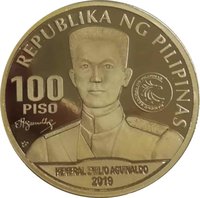
Emilio Aguinaldo bust in uniform, with bank seal and signature.
Inscription:
REPUBLIKA NG PILIPINAS
100
PISO
HENERAL EMILIO AGUINALDO
2019
BANGKO SENTRAL NG PILIPINAS
100
PISO
HENERAL EMILIO AGUINALDO
2019
BANGKO SENTRAL NG PILIPINAS
Translation:
REPUBLIC OF THE PHILIPPINES
100
PESOS
GENERAL EMILIO AGUINALDO
2019
CENTRAL BANK OF THE PHILIPPINES
100
PESOS
GENERAL EMILIO AGUINALDO
2019
CENTRAL BANK OF THE PHILIPPINES
Script: Latin
Reverse
Edge
Categories
| Event> Birth anniversary |
| Person> Military leader |
| Person> Politician |
| Symbol> Flag |
Mints
| Name | Mark |
|---|---|
| BSP Security Plant Complex | (PI) |
Mintings
| Year | Mint Mark | Mintage | Quality | Collection |
|---|---|---|---|---|
| 2019 | PI | 5,000 |
Historical background
In 2019, the Philippine peso (PHP) demonstrated relative stability but remained under persistent, moderate pressure, averaging around ₱51 to the US dollar for much of the year. This represented a continuation of the gradual depreciation trend observed since 2013, when the peso traded in the low-40s. The primary drivers of this pressure were the nation's widening trade deficit, fueled by robust imports of capital goods and raw materials for the government's ambitious "Build, Build, Build" infrastructure program, alongside strong consumer demand. Furthermore, the Philippines' current account shifted into a deficit, increasing reliance on foreign portfolio investments ("hot money") and remittances to balance its external accounts, making the currency sensitive to shifts in global investor sentiment.
Domestically, the economic context provided mixed signals. Inflation, which had spiked sharply in 2018 due to food supply issues and new tax reforms, decelerated significantly throughout 2019, allowing the Bangko Sentral ng Pilipinas (BSP, the central bank) to reverse its earlier monetary tightening. The BSP cut key interest rates by a total of 75 basis points and lowered bank reserve requirements, injecting liquidity into the system. While these actions supported domestic economic growth, which remained among the fastest in Asia at over 6%, the lower interest rate differential with the United States reduced the appeal of peso-denominated assets, contributing to the currency's softness.
Externally, the peso was buffeted by global headwinds. The ongoing US-China trade war created volatility in regional currencies and financial markets, often leading to risk-off episodes that triggered capital outflows from emerging markets like the Philippines. Additionally, a generally stronger US dollar throughout the period exerted broad downward pressure on Asian currencies. Despite these challenges, the peso's depreciation in 2019 was considered orderly and manageable. The BSP periodically intervened in the foreign exchange market to smooth volatility, and the nation's strong fundamentals—including consistent GDP growth, healthy foreign exchange reserves, and steady Overseas Filipino Worker (OFW) remittances—provided a solid buffer against more severe currency instability.
Domestically, the economic context provided mixed signals. Inflation, which had spiked sharply in 2018 due to food supply issues and new tax reforms, decelerated significantly throughout 2019, allowing the Bangko Sentral ng Pilipinas (BSP, the central bank) to reverse its earlier monetary tightening. The BSP cut key interest rates by a total of 75 basis points and lowered bank reserve requirements, injecting liquidity into the system. While these actions supported domestic economic growth, which remained among the fastest in Asia at over 6%, the lower interest rate differential with the United States reduced the appeal of peso-denominated assets, contributing to the currency's softness.
Externally, the peso was buffeted by global headwinds. The ongoing US-China trade war created volatility in regional currencies and financial markets, often leading to risk-off episodes that triggered capital outflows from emerging markets like the Philippines. Additionally, a generally stronger US dollar throughout the period exerted broad downward pressure on Asian currencies. Despite these challenges, the peso's depreciation in 2019 was considered orderly and manageable. The BSP periodically intervened in the foreign exchange market to smooth volatility, and the nation's strong fundamentals—including consistent GDP growth, healthy foreign exchange reserves, and steady Overseas Filipino Worker (OFW) remittances—provided a solid buffer against more severe currency instability.


💎 Extremely Rare