

Obverse
Description:
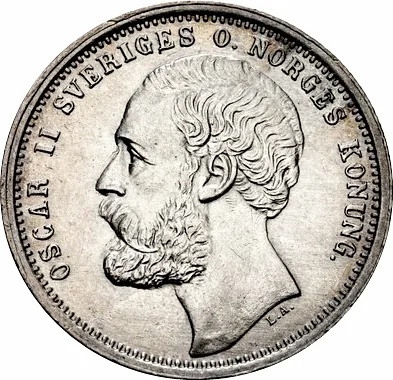
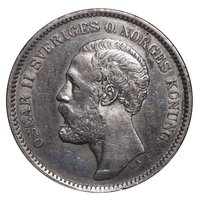
King Oscar II facing left, engraver initials below neck, legend around rim.
Inscription:
OSCAR II SVERIGES O. NORGES KONUNG
L.A.
L.A.
Translation:
Oscar II Sweden's and Norway's King
L.A.
L.A.
Script: Latin
Engraver: Lea Ahlborn
Reverse
Description:
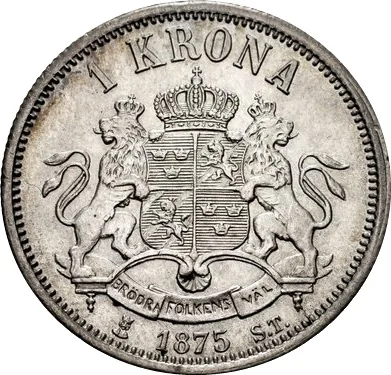
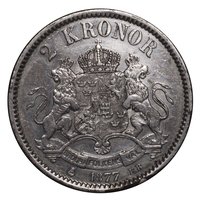
Crowned coat of arms flanked by lions, with a motto scroll below. The value is above the arms; the date and mintmark are near the rim.
Inscription:
1 KRONA
BRÖDRAFOLKENS VÄL
1875 S.T.
BRÖDRAFOLKENS VÄL
1875 S.T.
Translation:
1 KRONA
THE WELFARE OF THE BROTHER PEOPLES
1875 S.T.
THE WELFARE OF THE BROTHER PEOPLES
1875 S.T.
Script: Latin
Language: Swedish
Engraver: Lea Ahlborn
Edge
Milled
Mints
| Name | Mark |
|---|---|
| Kungliga Myntet | — |
Mintings
| Year | Mint Mark | Mintage | Quality | Collection |
|---|---|---|---|---|
| 1875 | — | 3,531,422 | ||
| 1876 | — | 2,510,327 |
Historical background
In 1875, Sweden stood at a pivotal moment in its monetary history, transitioning from a complex and outdated system to a modern, standardized one. For centuries, the nation had operated with the Riksdaler Riksmynt as its principal unit, but its circulation was complicated by the simultaneous existence of the older Riksdaler Specie and a plethora of private banknotes. This duality created confusion in everyday commerce and hindered both domestic trade and international financial integration, particularly as Scandinavia’s economies became more intertwined.
The solution was the Scandinavian Monetary Union, formed with Denmark in 1873 and joined by Norway in 1875. This groundbreaking agreement established a common gold standard and created new, decimal-based currencies: the Swedish krona (crown), divided into 100 öre, replaced the Riksdaler. The reform was legislated in 1873 but took full practical effect in 1875, aligning Sweden's currency directly with its neighbours' (krone in Denmark and Norway) at a fixed parity, making them effectively interchangeable across borders.
Thus, 1875 marks the year the modern Swedish krona was fully implemented, symbolising a move toward monetary stability, economic rationality, and regional cooperation. The reform successfully simplified the domestic economy and facilitated trade, laying a stable foundation for Sweden’s rapid industrialisation in the coming decades. Although the formal Monetary Union dissolved in the early 20th century, the legacy of this reform endures, as the krona remains Sweden’s currency to this day.
The solution was the Scandinavian Monetary Union, formed with Denmark in 1873 and joined by Norway in 1875. This groundbreaking agreement established a common gold standard and created new, decimal-based currencies: the Swedish krona (crown), divided into 100 öre, replaced the Riksdaler. The reform was legislated in 1873 but took full practical effect in 1875, aligning Sweden's currency directly with its neighbours' (krone in Denmark and Norway) at a fixed parity, making them effectively interchangeable across borders.
Thus, 1875 marks the year the modern Swedish krona was fully implemented, symbolising a move toward monetary stability, economic rationality, and regional cooperation. The reform successfully simplified the domestic economy and facilitated trade, laying a stable foundation for Sweden’s rapid industrialisation in the coming decades. Although the formal Monetary Union dissolved in the early 20th century, the legacy of this reform endures, as the krona remains Sweden’s currency to this day.
🌱 Common