

500 francs cfa (Monetary Union) – Western African States
Add to wishlist
Non-circulating coins
Commemoration: 10th Anniversary of the Monetary Union
Context
Year: 1972
Issuer: Western African States
Issuing organization: Central Bank of Western African States
Currency:
(since 1958)
Total mintage: 100,000
Material
References
KM: #
Numista: #19027
Value
Exchange value: 500 XOF
Bullion value: $56.08
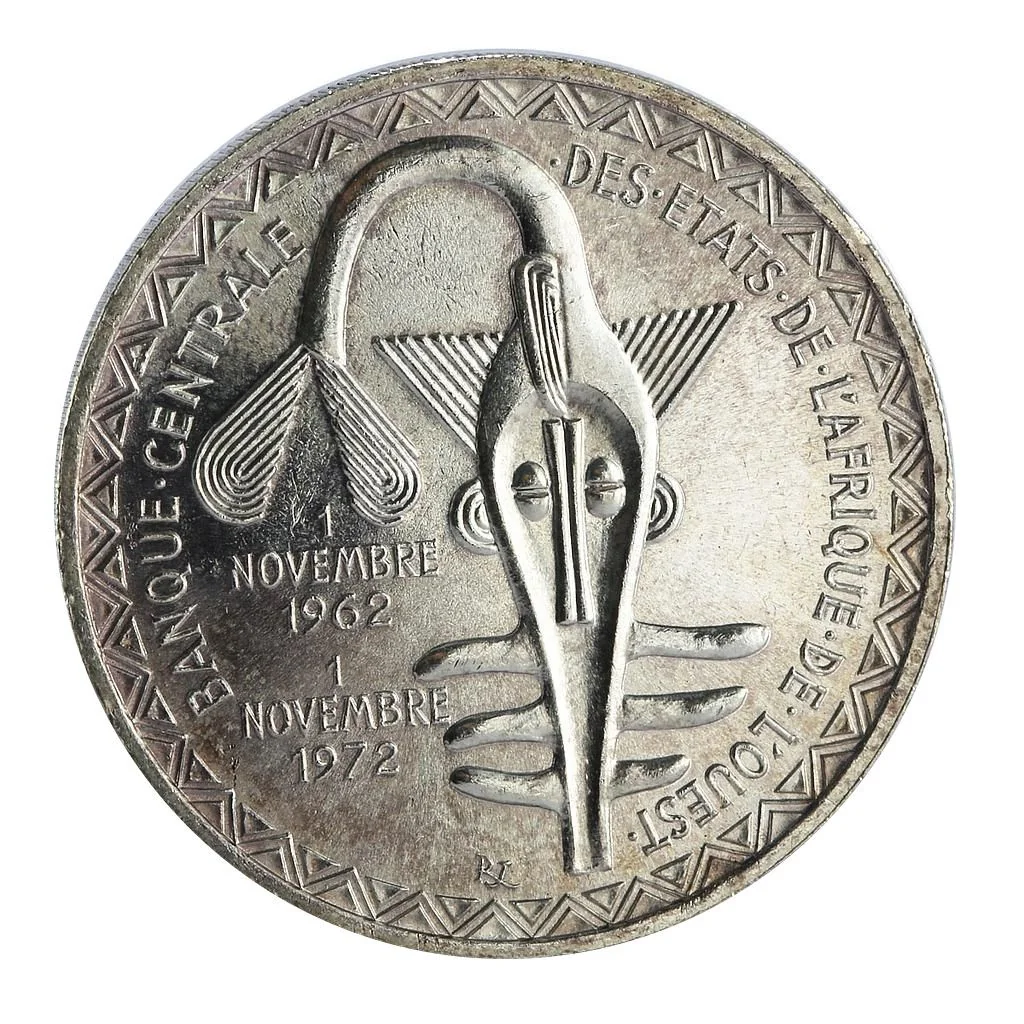
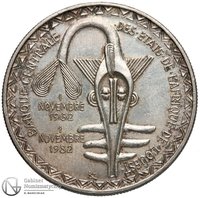
Obverse
Description:
Central Bank of West African States emblem
Inscription:
BANQUE CENTRALE DES ETATS D'AFRIQUE DE L'OUEST
1 NOVEMBRE 1962
1 NOVEMBRE 1972
RJ
1 NOVEMBRE 1962
1 NOVEMBRE 1972
RJ
Translation:
CENTRAL BANK OF THE WEST AFRICAN STATES
NOVEMBER 1, 1962
NOVEMBER 1, 1972
RJ
NOVEMBER 1, 1962
NOVEMBER 1, 1972
RJ
Script: Latin
Language: French
Engraver: Raymond Joly
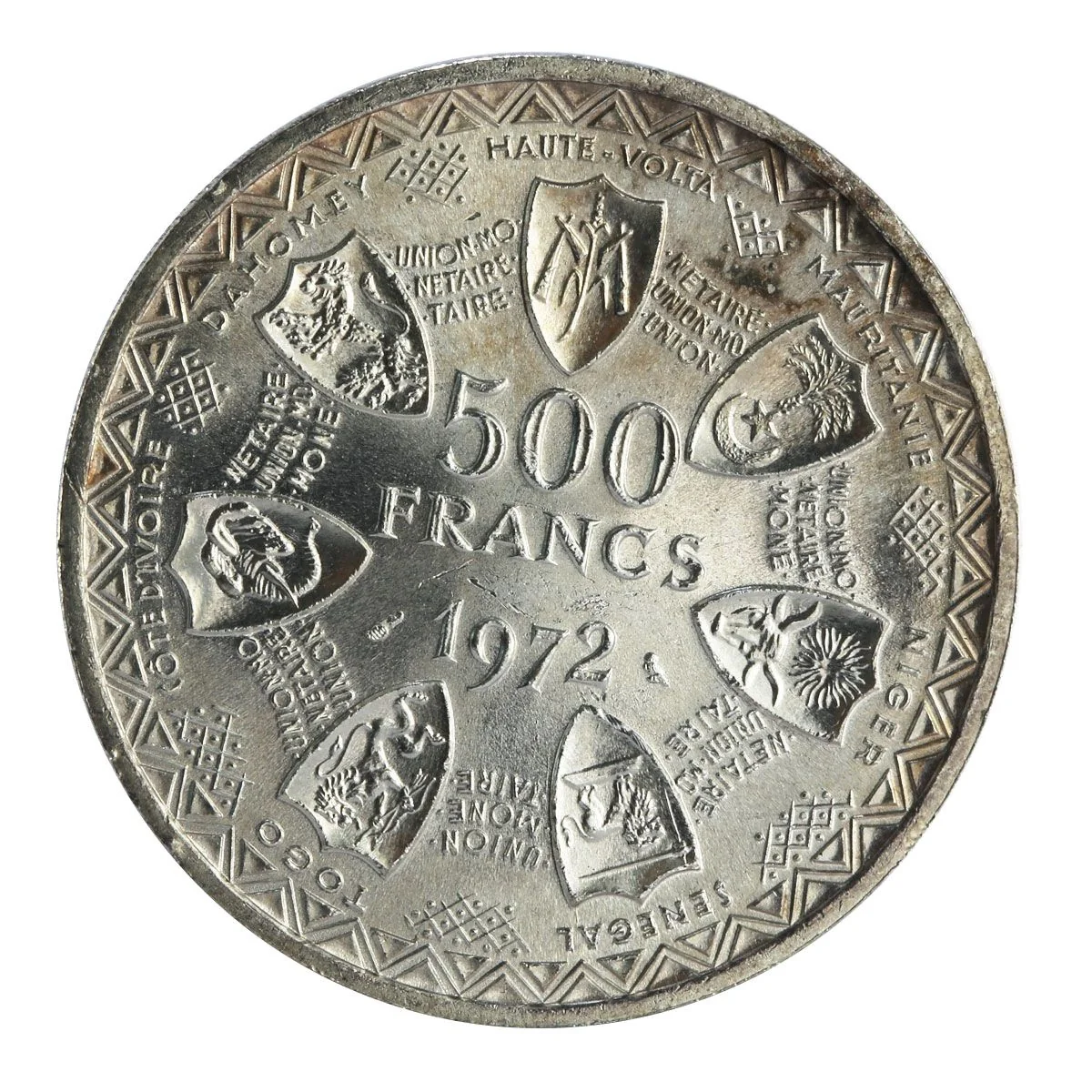
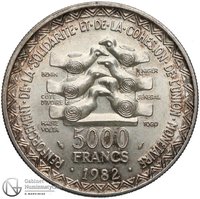
Reverse
Description:
Denomination; heraldry
Inscription:
HAUTE-VOLTA MAURITANIE NIGER SENEGAL TOGO COTE D'IVOIRE DAHOMEY
500 FRANCS
1972
500 FRANCS
1972
Translation:
Upper Volta Mauritania Niger Senegal Togo Ivory Coast Dahomey
500 Francs
1972
500 Francs
1972
Script: Latin
Language: French
Engraver: Raymond Joly
Edge
Reeded
Categories
| Symbols> Coat of Arms |
Mints
| Name | Mark |
|---|---|
| Monnaie de Paris | — |
Mintings
| Year | Mint Mark | Mintage | Quality | Collection |
|---|---|---|---|---|
| 1972 | — | 100,000 |
Historical background
In 1972, the currency landscape of West Africa was predominantly shaped by the legacy of French colonialism and the early years of post-independence monetary cooperation. The core of the region's financial system was the CFA franc, which stood for Communauté Financière Africaine (African Financial Community). This currency, created in 1945, was used by seven newly independent states: Côte d'Ivoire, Dahomey (now Benin), Upper Volta (now Burkina Faso), Mali, Mauritania, Niger, and Senegal. These nations, along with Togo, constituted the West African Monetary Union (UMOA), established in 1962. The CFA franc was pegged to the French franc at a fixed and guaranteed exchange rate, with its convertibility backed by the French Treasury, requiring member states to deposit a significant portion of their foreign reserves in Paris.
However, the arrangement was not uniform across the region. A major exception was Mali, which had withdrawn from the CFA zone in 1962 and introduced its own national currency, the Malian franc. By 1972, Mali's experiment with an independent currency was facing severe difficulties, characterized by economic isolation and instability, setting the stage for its eventual return to the UMOA framework later in the decade. Meanwhile, the larger Anglophone nations like Nigeria and Ghana operated entirely outside this Francophone system. Nigeria had introduced its own Naira in 1973, transitioning from the British pound sterling system, while Ghana used the Cedi, both of which were subject to their own domestic economic pressures and different colonial monetary legacies.
Thus, the currency situation in 1972 reflected a region divided into distinct monetary spheres. The Francophone core enjoyed the stability and guaranteed convertibility of the CFA franc but operated under a system that limited sovereign monetary policy and maintained strong post-colonial ties to France. At the same time, other major economies pursued independent monetary paths, with varying degrees of success. This fragmented landscape highlighted the ongoing challenge of regional economic integration and the complex balance between monetary sovereignty, stability, and colonial inheritance in the post-independence era.
However, the arrangement was not uniform across the region. A major exception was Mali, which had withdrawn from the CFA zone in 1962 and introduced its own national currency, the Malian franc. By 1972, Mali's experiment with an independent currency was facing severe difficulties, characterized by economic isolation and instability, setting the stage for its eventual return to the UMOA framework later in the decade. Meanwhile, the larger Anglophone nations like Nigeria and Ghana operated entirely outside this Francophone system. Nigeria had introduced its own Naira in 1973, transitioning from the British pound sterling system, while Ghana used the Cedi, both of which were subject to their own domestic economic pressures and different colonial monetary legacies.
Thus, the currency situation in 1972 reflected a region divided into distinct monetary spheres. The Francophone core enjoyed the stability and guaranteed convertibility of the CFA franc but operated under a system that limited sovereign monetary policy and maintained strong post-colonial ties to France. At the same time, other major economies pursued independent monetary paths, with varying degrees of success. This fragmented landscape highlighted the ongoing challenge of regional economic integration and the complex balance between monetary sovereignty, stability, and colonial inheritance in the post-independence era.
🌱 Fairly Common