

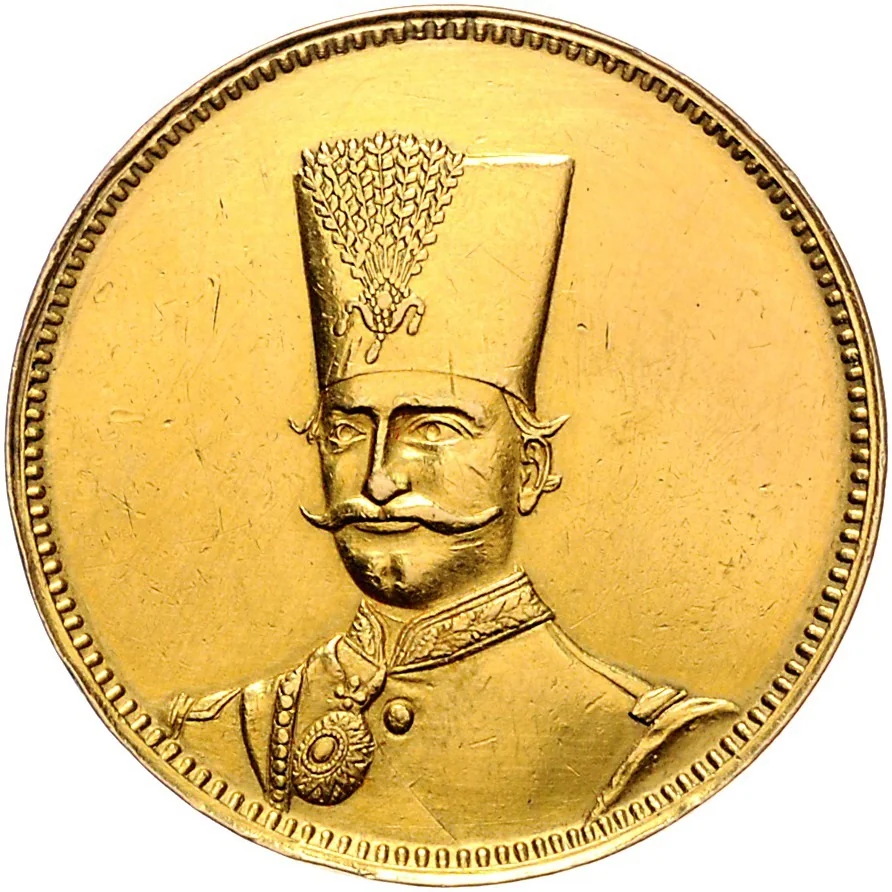
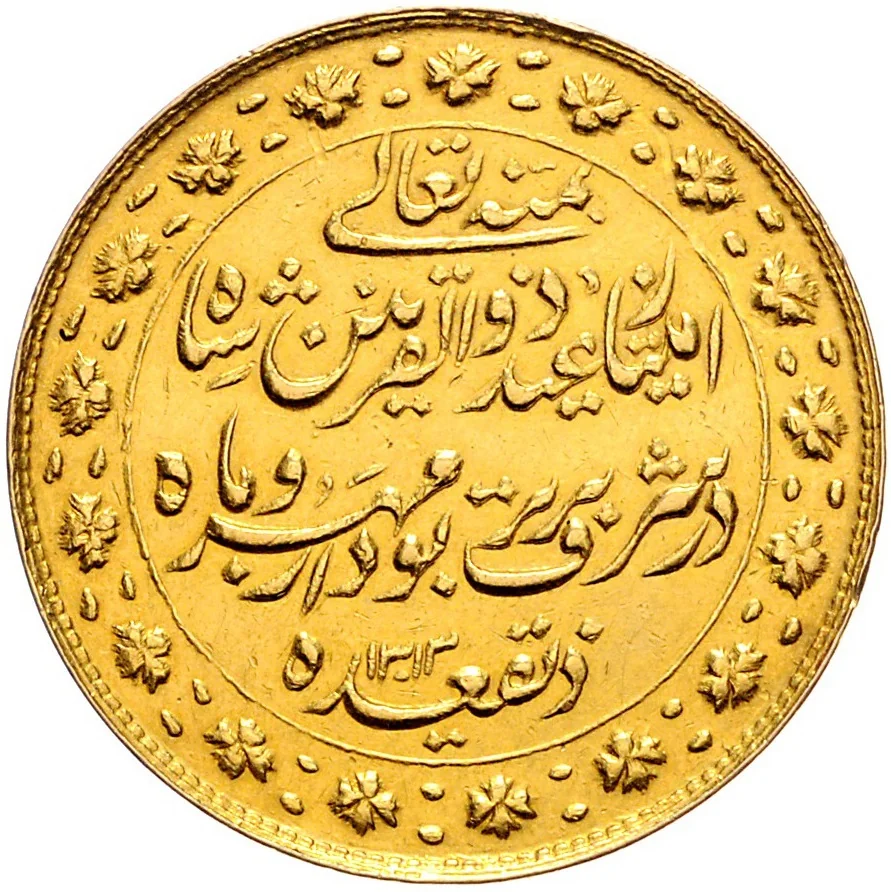
10 toman (Naser al-Din Qajar reign) – Iran
Add to wishlist
Non-circulating coins
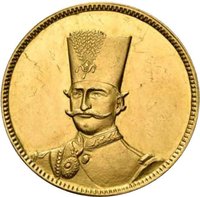
Commemoration: 50th anniversary of Naser al-Din Qajar reign
Iran
Context
Year: 1896
Islamic (Hijri) Year:: 1313
Issuer: Iran
Ruler: Naser al-Din Shah
Currency:
(1825—1932)
Demonetized: Yes
Material
References
Numista: #189505
Value
Bullion value: $3896.41
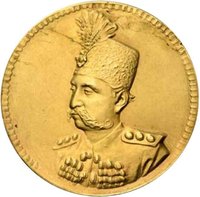
Obverse
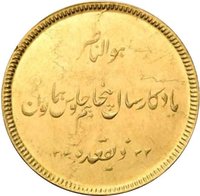
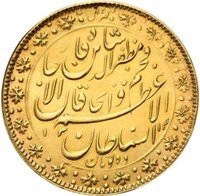
Reverse
Inscription:
بمنّه تعالی
امتیاز عید ذوالقرنین شاه
در شرف برتر بود از مهـــر و ماه
ذیقعـــده ۱۳۱۳
امتیاز عید ذوالقرنین شاه
در شرف برتر بود از مهـــر و ماه
ذیقعـــده ۱۳۱۳
Translation:
By the grace of God,
Commemorating the Eid-e Zu al-Qarnayn of the Shah,
He was superior in rank to the sun and the moon.
Dhu al-Qi'dah 1313 (Hijri)
Commemorating the Eid-e Zu al-Qarnayn of the Shah,
He was superior in rank to the sun and the moon.
Dhu al-Qi'dah 1313 (Hijri)
Script: Persian (nastaliq)
Language: Persian
Edge
Mints
| Name | Mark |
|---|---|
| Tehran | — |
Mintings
| Year | Mint Mark | Mintage | Quality | Collection |
|---|---|---|---|---|
| 1896 | — | — |
Historical background
In 1896, Iran’s currency system was in a state of profound disarray, a legacy of the Qajar dynasty’s long-term fiscal mismanagement and foreign interference. The monetary landscape was a chaotic patchwork of domestic and foreign coins. The primary unit was the silver qiran (also spelled kran), but its value and silver content had been drastically debased over decades to finance royal extravagance and deficits. Alongside it circulated a bewildering variety of gold coins like the toman (worth 10 qirans), copper shahis, and a massive influx of foreign silver coins—particularly Russian rubles and British Indian rupees—which dominated trade in their respective spheres of influence. This lack of a unified, trusted national currency crippled domestic commerce and facilitated economic exploitation.
The root of the crisis lay in the state’s financial weakness. The Qajar treasury, drained by costly royal tours, concessions to foreign interests, and a series of disastrous trade agreements (known as capitulations), had little bullion reserve. To raise revenue, the government repeatedly reduced the silver content of the qiran, leading to severe inflation and a loss of public confidence. People hoarded older, purer coins or preferred foreign currencies, following Gresham’s Law where "bad money drives out good." Furthermore, the country lacked a central bank; coin minting was farmed out to various provincial mints, leading to inconsistencies in weight and fineness across different regions, which complicated trade and encouraged fraud.
This monetary anarchy had dire consequences, embedding Iran deeper into a semi-colonial economic status. The instability discouraged foreign investment outside of exploitative concession deals and made the government increasingly dependent on foreign loans, particularly from Russia and Britain, which sought political influence in return. The situation would reach a tipping point shortly after 1896, as the pressures of global economic integration and state bankruptcy forced major reforms. In 1898, just two years later, the Belgian expert Joseph Naus would be hired to overhaul the customs service, setting the stage for more systematic monetary reforms in the early 20th century, including the eventual establishment of a national bank and a new currency.
The root of the crisis lay in the state’s financial weakness. The Qajar treasury, drained by costly royal tours, concessions to foreign interests, and a series of disastrous trade agreements (known as capitulations), had little bullion reserve. To raise revenue, the government repeatedly reduced the silver content of the qiran, leading to severe inflation and a loss of public confidence. People hoarded older, purer coins or preferred foreign currencies, following Gresham’s Law where "bad money drives out good." Furthermore, the country lacked a central bank; coin minting was farmed out to various provincial mints, leading to inconsistencies in weight and fineness across different regions, which complicated trade and encouraged fraud.
This monetary anarchy had dire consequences, embedding Iran deeper into a semi-colonial economic status. The instability discouraged foreign investment outside of exploitative concession deals and made the government increasingly dependent on foreign loans, particularly from Russia and Britain, which sought political influence in return. The situation would reach a tipping point shortly after 1896, as the pressures of global economic integration and state bankruptcy forced major reforms. In 1898, just two years later, the Belgian expert Joseph Naus would be hired to overhaul the customs service, setting the stage for more systematic monetary reforms in the early 20th century, including the eventual establishment of a national bank and a new currency.
✨ Legendary