

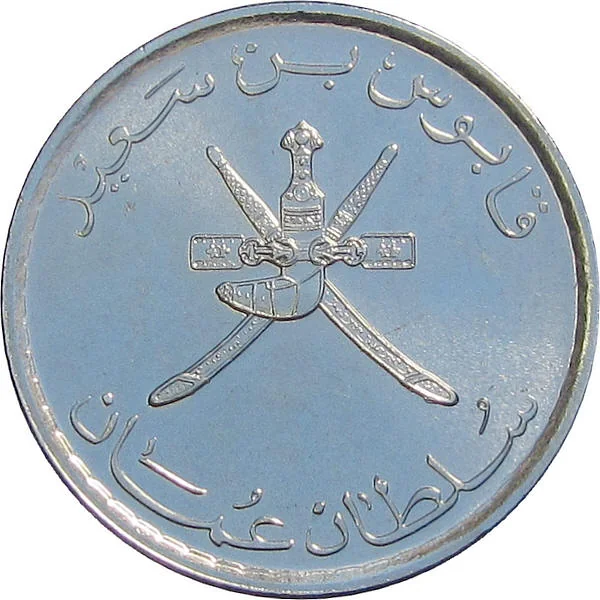
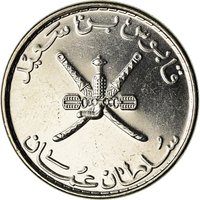
Obverse
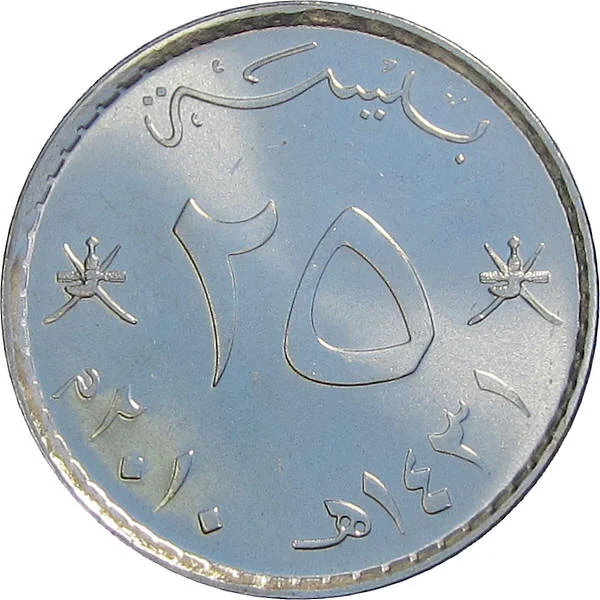
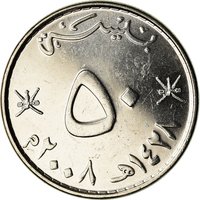
Reverse
Edge
Reeded
Categories
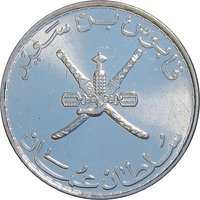
| Symbols> Coat of Arms |
| Object> Cold weapons |
Mints
| Name | Mark |
|---|---|
| Royal Canadian Mint of Winnipeg | — |
Mintings
| Year | Mint Mark | Mintage | Quality | Collection |
|---|---|---|---|---|
| 2010 | — | — | ||
| 2013 | — | — |
Historical background
In 2010, Oman's currency situation was defined by its long-standing and stable peg to the US Dollar. The Omani Rial (OMR) was formally fixed at a rate of 1 OMR = 2.6008 USD, a parity maintained since 1986. This policy, managed by the Central Bank of Oman, provided critical stability for the hydrocarbon-dependent economy, anchoring inflation, facilitating predictable trade and investment flows, and simplifying monetary policy. The peg was a cornerstone of economic planning, reflecting Oman's close financial ties and the dollar's role as the global currency for oil transactions, which accounted for the vast majority of government revenue.
The global financial crisis of 2008-2009 had lingering effects, but by 2010 Oman's economy was in a phase of recovery and modest growth, supported by rebounding oil prices. The fixed exchange rate, while a source of stability, also meant Oman imported the US Federal Reserve's accommodative monetary policy, leading to historically low interest rates. This environment, combined with increased government spending to stimulate the economy and support development plans, raised mild concerns among some analysts about potential inflationary pressures and the competitiveness of non-oil exports. However, these were secondary considerations to the overwhelming official and market confidence in the peg's benefits.
Overall, the currency regime in 2010 was not a subject of significant debate or imminent change. The Omani Rial was considered one of the most stable currencies in the region, backed by substantial hydrocarbon reserves and prudent foreign asset management by the government. The focus was instead on broader economic diversification efforts within the framework of the fixed exchange rate, as outlined in Oman's long-term development strategy, "Vision 2020." The stability of the peg provided a predictable foundation for these diversification plans, even as it meant relinquishing an independent monetary policy tool.
The global financial crisis of 2008-2009 had lingering effects, but by 2010 Oman's economy was in a phase of recovery and modest growth, supported by rebounding oil prices. The fixed exchange rate, while a source of stability, also meant Oman imported the US Federal Reserve's accommodative monetary policy, leading to historically low interest rates. This environment, combined with increased government spending to stimulate the economy and support development plans, raised mild concerns among some analysts about potential inflationary pressures and the competitiveness of non-oil exports. However, these were secondary considerations to the overwhelming official and market confidence in the peg's benefits.
Overall, the currency regime in 2010 was not a subject of significant debate or imminent change. The Omani Rial was considered one of the most stable currencies in the region, backed by substantial hydrocarbon reserves and prudent foreign asset management by the government. The focus was instead on broader economic diversification efforts within the framework of the fixed exchange rate, as outlined in Oman's long-term development strategy, "Vision 2020." The stability of the peg provided a predictable foundation for these diversification plans, even as it meant relinquishing an independent monetary policy tool.
🌱 Very Common