

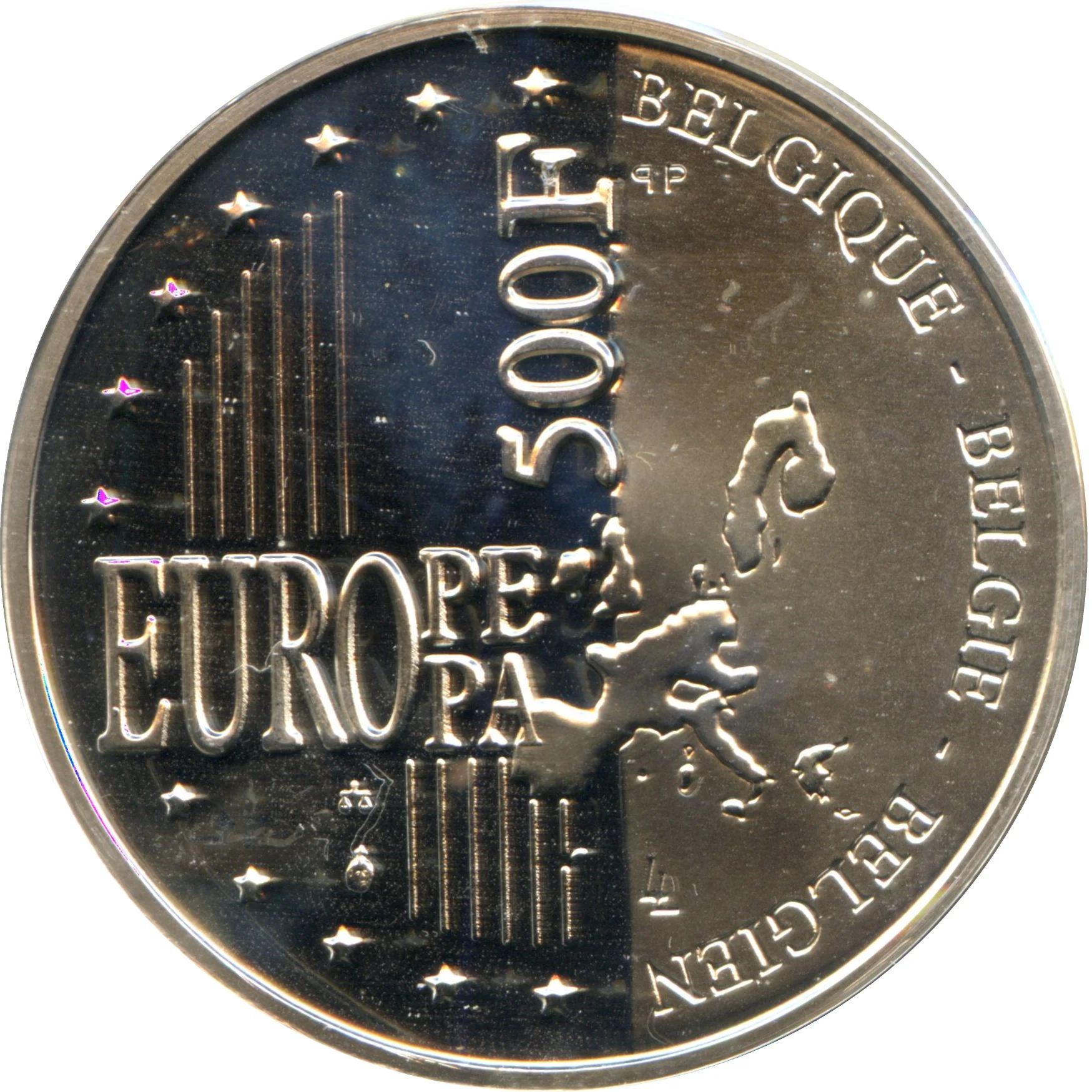
500 francs (European Culture Capital) – Belgium
Add to wishlist
Non-circulating coins
Commemoration: Brussels - European Culture Capital; 400 Years Marriage of Albert and Isabella
Belgium
Context
Material
References
KM: #
Numista: #18863
Value
Exchange value: 500 BEF
Bullion value: $51.85
Inflation-adjusted value: 893.29 BEF
Obverse
Reverse
Description:
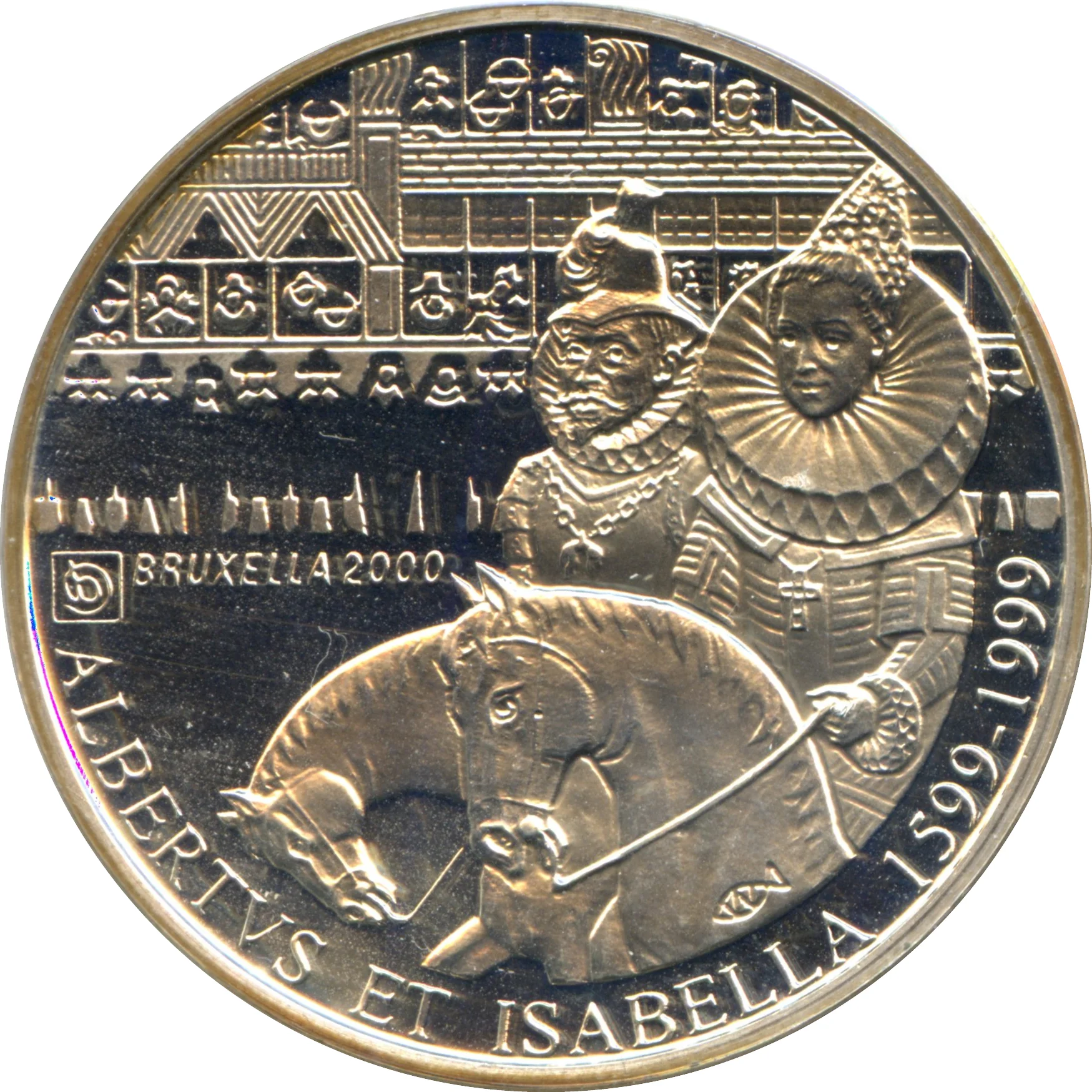
Albert and Isabella on horseback before Brussels. Designer's mark on right horse's neck. Latin text below.
Inscription:
BRUXELLA 2000
ALBERTVS ET ISABELLA 1599-1999
ALBERTVS ET ISABELLA 1599-1999
Translation:
Brussels 2000
Albert and Isabella 1599-1999
Albert and Isabella 1599-1999
Script: Latin
Language: Latin
Engraver: Willem Vis
Edge
Plain (Proof) or Reeded (others)
Mints
| Name | Mark |
|---|---|
| Royal Mint of Belgium | — |
Mintings
| Year | Mint Mark | Mintage | Quality | Collection |
|---|---|---|---|---|
| 1999 | — | 15,009 | ||
| 1999 | — | 19,858 | Proof |
Historical background
In 1999, Belgium was a central participant in a historic European monetary transition. The year marked the final stage of a multi-year process to replace national currencies with the new single European currency, the euro. For Belgium, this meant phasing out the Belgian franc (Belgische frank/franc belge), which had been the nation's currency since its independence in 1832. The country, as a founding member of the European Union and a strong proponent of deeper integration, had met the strict convergence criteria (on inflation, interest rates, budget deficits, and debt) to be among the first wave of nations adopting the euro.
The practical currency situation in 1999 was defined by a three-year "transitional period." From January 1st, the euro became the official currency of Belgium, but only in scriptural (non-cash) form. Financial markets switched to euros, government debt was issued in euros, and banks offered euro-denominated accounts. However, in daily life, the Belgian franc remained the only physical legal tender. Prices were often displayed in both currencies to foster public familiarity, but all cash transactions and change were still conducted in francs. This period was essentially one of legal and financial preparation, locking the franc irrevocably to the euro at a fixed exchange rate of 1 EUR = 40.3399 BEF.
This dual existence set the stage for the full cash changeover scheduled for January 1, 2002. The background of 1999 is therefore one of anticipation and logistical planning, as the Belgian National Bank, financial institutions, and businesses prepared for the massive task of distributing euro notes and coins and withdrawing francs from circulation. The year solidified Belgium's commitment to the European project, while its citizens and economy operated in a hybrid monetary environment, using the familiar franc physically while the framework for its permanent replacement was being finalized.
The practical currency situation in 1999 was defined by a three-year "transitional period." From January 1st, the euro became the official currency of Belgium, but only in scriptural (non-cash) form. Financial markets switched to euros, government debt was issued in euros, and banks offered euro-denominated accounts. However, in daily life, the Belgian franc remained the only physical legal tender. Prices were often displayed in both currencies to foster public familiarity, but all cash transactions and change were still conducted in francs. This period was essentially one of legal and financial preparation, locking the franc irrevocably to the euro at a fixed exchange rate of 1 EUR = 40.3399 BEF.
This dual existence set the stage for the full cash changeover scheduled for January 1, 2002. The background of 1999 is therefore one of anticipation and logistical planning, as the Belgian National Bank, financial institutions, and businesses prepared for the massive task of distributing euro notes and coins and withdrawing francs from circulation. The year solidified Belgium's commitment to the European project, while its citizens and economy operated in a hybrid monetary environment, using the familiar franc physically while the framework for its permanent replacement was being finalized.
🌟 Limited