

10 Euro (Alexander Rudnay) – Slovakia
Non-circulating coins
Commemoration: 200th anniversary of the appointment of Alexander Rudnay as Archbishop of Esztergom
Slovakia
Context
Material
References
KM: #Click to copy to clipboard167
Numista: #188094
Value
Exchange value: 10 EUR = $11.81
Bullion value: $47.07
Inflation-adjusted value: 14.30 EUR
Obverse
Description:
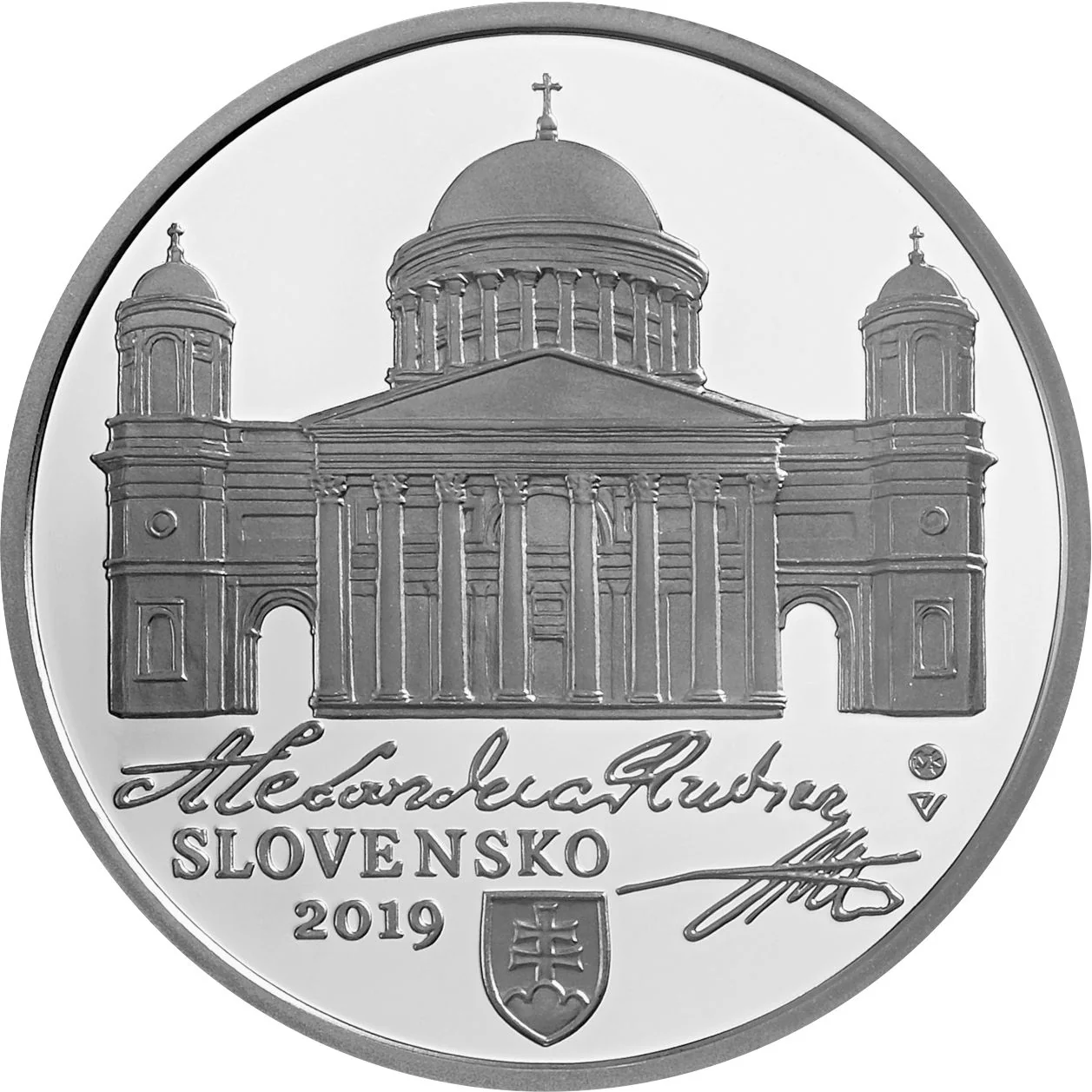
The obverse features Esztergom's Primatial Basilica. Below are Cardinal Rudnay's facsimile signature, the Slovak coat of arms, and the year '2019'. Near the edge are the Kremnica Mint mark ('MK' between dies) and the designer's initials 'PV' for Peter Valach.
Inscription:
Alexander Rudnay
SLOVENSKO
2019
SLOVENSKO
2019
Translation:
Alexander Rudnay
SLOVAKIA
2019
SLOVAKIA
2019
Script: Latin
Engraver: Dalibor Schmidt
Reverse
Description:
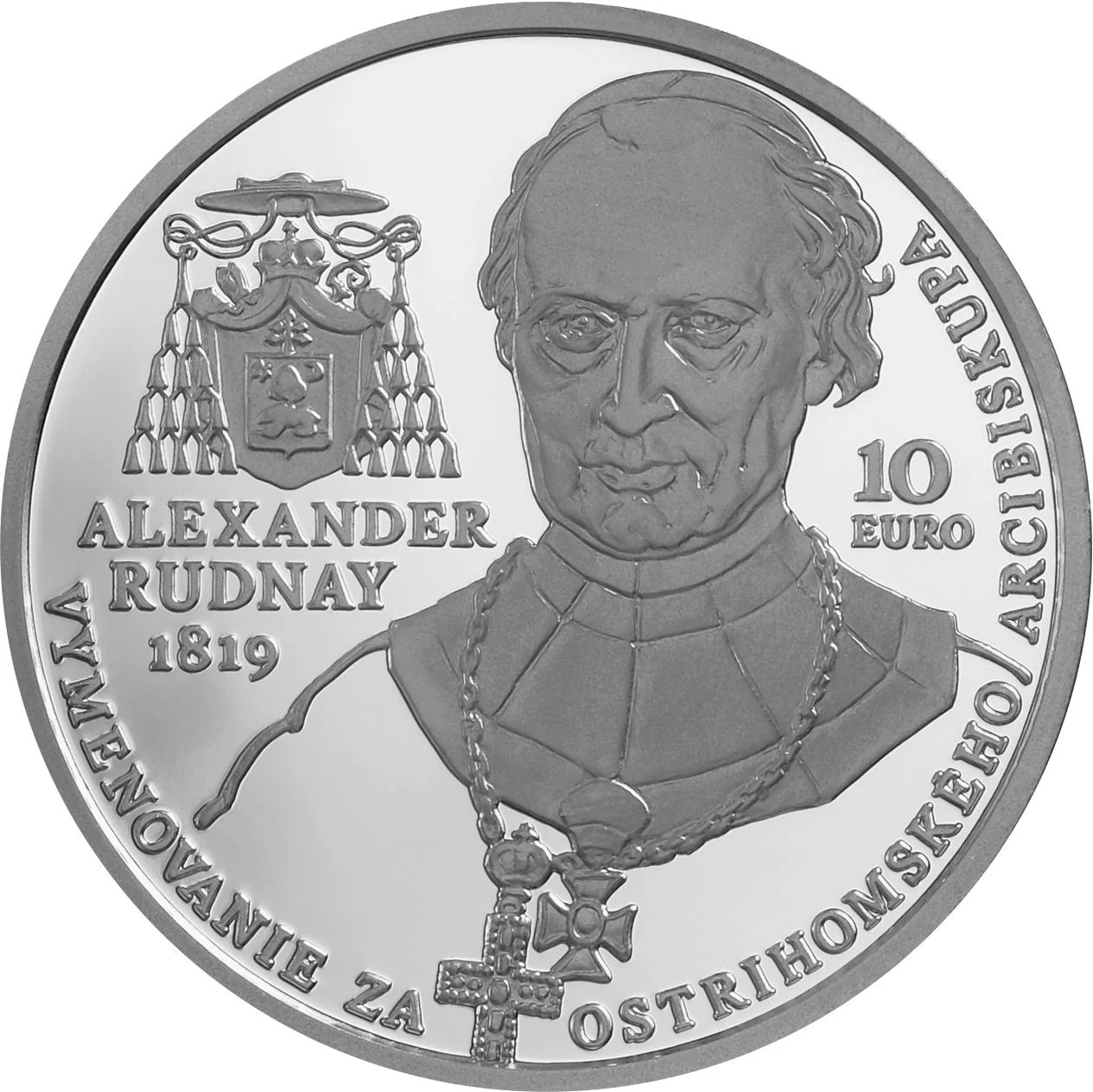
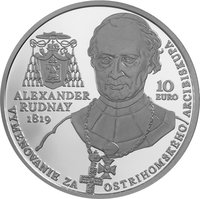
The reverse features a portrait of Cardinal Rudnay, with his coat of arms to the left. Below the arms are 'ALEXANDER', 'RUDNAY', and '1819'. To the right are '10' and 'EURO'. The inscription 'VYMENOVANIE ZA OSTRIHOMSKÉHO ARCIBISKUPA' arcs around the upper edge.
Inscription:
ALEXANDER RUDNAY
1819
10 EURO
VYMENOVANIE ZA OSTRIHOMSKÉHO ARCIBISKUPA
1819
10 EURO
VYMENOVANIE ZA OSTRIHOMSKÉHO ARCIBISKUPA
Translation:
Appointment of the Archbishop of Ostrihom
Script: Latin
Engraver: Dalibor Schmidt
Categories
| Symbols> Coat of Arms |
| Building> Religious building |
| Person> Religious figure |
| Symbol> Cross |
Mints
| Name | Mark |
|---|---|
| Kremnica | — |
Mintings
| Year | Mint Mark | Mintage | Quality | Collection |
|---|---|---|---|---|
| 2019 | — | 3,000 | ||
| 2019 | — | 6,660 | Proof |
Historical background
In 2019, Slovakia was a stable member of the Eurozone, having adopted the euro as its official currency a decade earlier in 2009. The country's monetary policy was therefore set by the European Central Bank (ECB), with the primary goals of maintaining price stability and controlling inflation within the broader Euro area. This framework provided Slovakia with significant benefits, including eliminated exchange rate risk with its key European trading partners, lower transaction costs, and enhanced economic integration. The Slovak economy was performing robustly in 2019, with strong GDP growth, low unemployment, and rising wages, all underpinned by its role as a major automotive manufacturing hub.
Despite the overall stability, the euro's monetary policy was not tailored to Slovakia's specific cyclical position. In 2019, the ECB maintained an accommodative stance with historically low interest rates and continued asset purchase programs to stimulate the sluggish economies of core Eurozone nations. For a fast-growing economy like Slovakia's, this contributed to rising inflationary pressures, particularly in the housing market and services sector. Slovak inflation consistently exceeded the Eurozone average, prompting domestic discussions about the appropriateness of a "one-size-fits-all" monetary policy for economies at different stages of the business cycle.
Furthermore, 2019 saw the Slovak koruna cease to be legal tender in January, marking the final end of the dual-circulation period. Politically, the euro enjoyed broad public support as a symbol of Slovakia's European identity and economic maturity. There were no serious political movements advocating for a return to a national currency, as the perceived advantages of Eurozone membership—especially for a small, open, export-oriented economy—were widely acknowledged. Thus, the currency situation was characterized by successful integration, albeit with ongoing macroeconomic debates about the trade-offs inherent in a shared currency.
Despite the overall stability, the euro's monetary policy was not tailored to Slovakia's specific cyclical position. In 2019, the ECB maintained an accommodative stance with historically low interest rates and continued asset purchase programs to stimulate the sluggish economies of core Eurozone nations. For a fast-growing economy like Slovakia's, this contributed to rising inflationary pressures, particularly in the housing market and services sector. Slovak inflation consistently exceeded the Eurozone average, prompting domestic discussions about the appropriateness of a "one-size-fits-all" monetary policy for economies at different stages of the business cycle.
Furthermore, 2019 saw the Slovak koruna cease to be legal tender in January, marking the final end of the dual-circulation period. Politically, the euro enjoyed broad public support as a symbol of Slovakia's European identity and economic maturity. There were no serious political movements advocating for a return to a national currency, as the perceived advantages of Eurozone membership—especially for a small, open, export-oriented economy—were widely acknowledged. Thus, the currency situation was characterized by successful integration, albeit with ongoing macroeconomic debates about the trade-offs inherent in a shared currency.
💎 Very Rare