

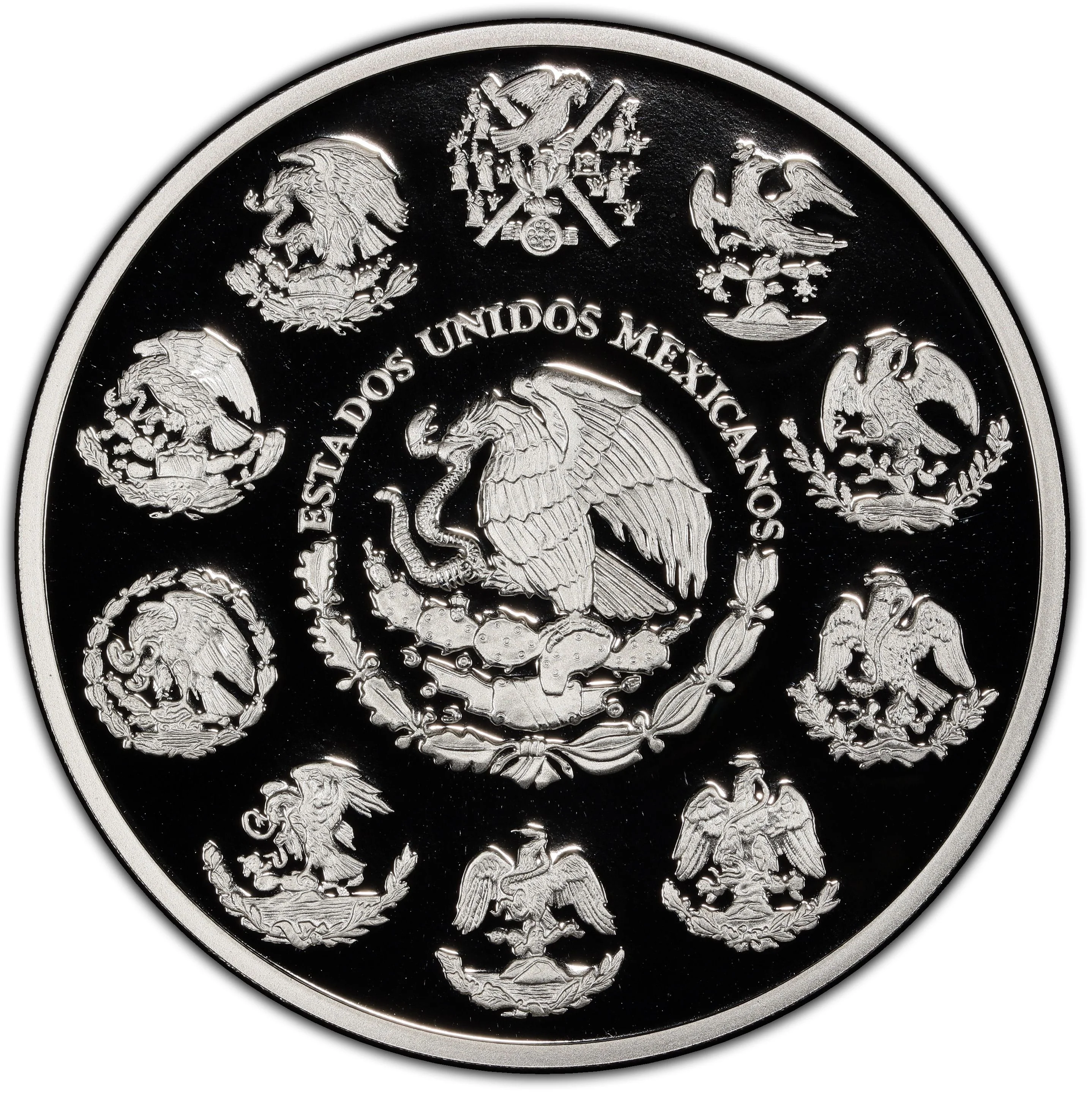
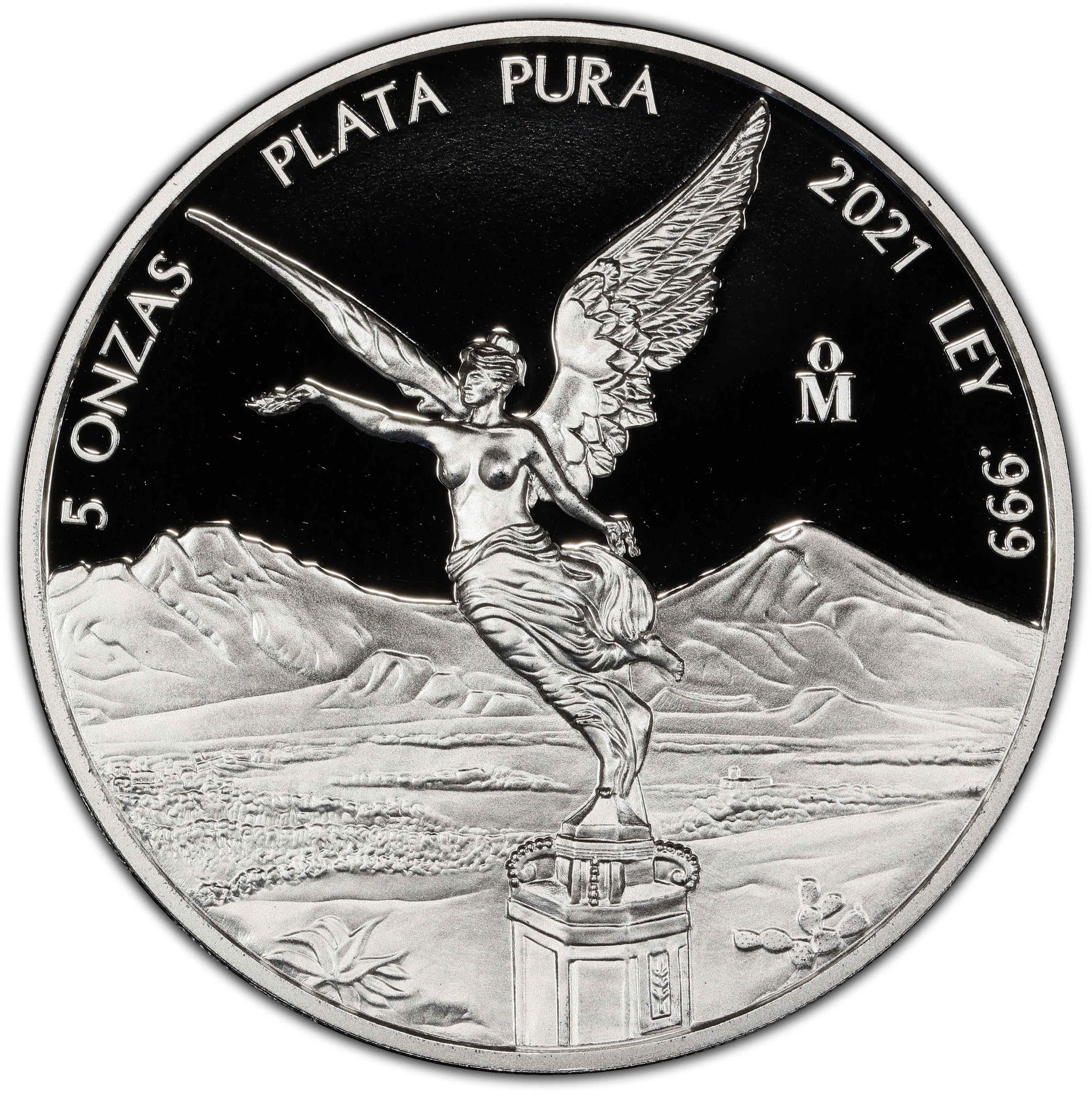
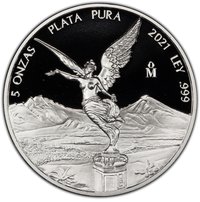
5 Onzas "Libertad" – Mexico
Mexico
Context
Material
Diameter: 65 mm
Weight: 155.52 g
Silver weight: 155.36 g
Shape: Round
Composition: 99.9% Silver
Standard: Silver 5 ounces
Magnetic: No
Technique: Milled
Alignment: Coin alignment
flip
References
KM: #Click to copy to clipboard615
Numista: #18806
Value
Bullion value: $451.42
Obverse
Reverse
Edge
Reeded
Categories
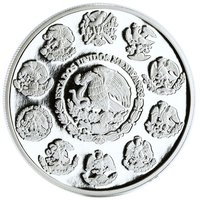
| Symbols> Coat of Arms |
| Geography> Mountain |
Mints
| Name | Mark |
|---|---|
| Mexican Mint | Mo |
Mintings
| Year | Mint Mark | Mintage | Quality | Collection |
|---|---|---|---|---|
| 1996 | Mo | 20,000 | ||
| 1996 | Mo | 1,200 | Proof | |
| 1997 | Mo | 10,000 | ||
| 1997 | Mo | 1,300 | Proof | |
| 1998 | Mo | 400 | Proof | |
| 1998 | Mo | 3,500 | ||
| 1999 | Mo | 2,800 | ||
| 1999 | Mo | 100 | Proof | |
| 2000 | Mo | 5,500 | ||
| 2000 | Mo | 500 | Proof | |
| 2001 | Mo | 4,000 | ||
| 2001 | Mo | 1,100 | Proof | |
| 2002 | Mo | 8,500 | ||
| 2002 | Mo | 1,000 | Proof | |
| 2003 | Mo | 5,500 | ||
| 2003 | Mo | 1,700 | Proof | |
| 2004 | Mo | 5,923 | ||
| 2004 | Mo | 600 | Proof | |
| 2005 | Mo | 3,000 | ||
| 2005 | Mo | 1,100 | Proof | |
| 2006 | Mo | 1,000 | Proof | |
| 2006 | Mo | 3,000 | ||
| 2007 | Mo | 3,000 | ||
| 2007 | Mo | 500 | Proof | |
| 2008 | Mo | 9,000 | ||
| 2008 | Mo | 900 | Proof | |
| 2009 | Mo | 21,000 | ||
| 2009 | Mo | 5,000 | Proof | |
| 2010 | Mo | 9,500 | ||
| 2010 | Mo | 2,000 | Proof | |
| 2011 | Mo | 10,000 | ||
| 2011 | Mo | 2,000 | Proof | |
| 2012 | Mo | 9,500 | ||
| 2013 | Mo | 10,400 | ||
| 2013 | Mo | 1,600 | Proof | |
| 2014 | Mo | 6,400 | ||
| 2014 | Mo | 800 | Proof | |
| 2015 | Mo | 9,500 | ||
| 2015 | Mo | 1,600 | Proof | |
| 2016 | Mo | 11,400 | ||
| 2016 | Mo | 2,750 | Proof | |
| 2017 | Mo | 2,350 | Proof | |
| 2017 | Mo | 5,050 | ||
| 2018 | Mo | 16,600 | ||
| 2018 | Mo | 5,000 | Proof | |
| 2019 | Mo | 18,000 | ||
| 2019 | Mo | 2,500 | Proof | |
| 2020 | Mo | 8,900 | ||
| 2020 | Mo | 2,950 | Proof | |
| 2021 | Mo | 6,050 | ||
| 2021 | Mo | 1,250 | Proof | |
| 2022 | Mo | 7,000 | ||
| 2022 | Mo | 1,700 | Proof | |
| 2023 | Mo | 25,000 | ||
| 2023 | Mo | 3,500 | Proof | |
| 2024 | Mo | — | ||
| 2024 | Mo | 5,300 | Proof |
Historical background
In 1996, Mexico was in a period of fragile but determined recovery from the devastating "Tequila Crisis" of 1994-1995. This crisis had begun with a sudden devaluation of the peso, triggering capital flight, a deep recession, soaring inflation, and a banking system bailout. To avert a total collapse, the government of President Ernesto Zedillo secured a historic $50 billion international financial rescue package, led by the United States and the International Monetary Fund (IMF). By 1996, the stringent austerity and stabilization measures attached to this bailout were in full effect, focusing on fiscal discipline, tight monetary policy, and a floating exchange rate regime adopted in late 1994.
The currency situation that year was characterized by a managed float of the peso, which had stabilized significantly from its chaotic free-fall. After plummeting from roughly 3.5 to over 7.5 pesos per U.S. dollar during the crisis, the exchange rate found relative equilibrium, trading in a band around 7.4 to 7.9 pesos per dollar for much of 1996. This stability was hard-won, achieved through high interest rates (which peaked at over 80% in early 1995) to curb inflation and attract foreign investment back into government treasury certificates (Cetes). While successful in stabilizing the currency, these high rates continued to stifle domestic economic activity and credit.
By the end of 1996, the macroeconomic sacrifices began to show results. Inflation, though still high at around 27%, was declining from its peak of over 50% in 1995. Economic growth returned, with GDP expanding by approximately 5%, marking the beginning of a strong rebound. The currency stability was crucial for restoring investor confidence and allowing the country to re-enter international capital markets. Thus, 1996 represented a critical turning point—a year of painful consolidation where Mexico moved from crisis management to laying the groundwork for sustained, though uneven, economic growth in the years that followed.
The currency situation that year was characterized by a managed float of the peso, which had stabilized significantly from its chaotic free-fall. After plummeting from roughly 3.5 to over 7.5 pesos per U.S. dollar during the crisis, the exchange rate found relative equilibrium, trading in a band around 7.4 to 7.9 pesos per dollar for much of 1996. This stability was hard-won, achieved through high interest rates (which peaked at over 80% in early 1995) to curb inflation and attract foreign investment back into government treasury certificates (Cetes). While successful in stabilizing the currency, these high rates continued to stifle domestic economic activity and credit.
By the end of 1996, the macroeconomic sacrifices began to show results. Inflation, though still high at around 27%, was declining from its peak of over 50% in 1995. Economic growth returned, with GDP expanding by approximately 5%, marking the beginning of a strong rebound. The currency stability was crucial for restoring investor confidence and allowing the country to re-enter international capital markets. Thus, 1996 represented a critical turning point—a year of painful consolidation where Mexico moved from crisis management to laying the groundwork for sustained, though uneven, economic growth in the years that followed.
🌟 Uncommon