



200 euro – France
Add to wishlist
Non-circulating coins
Commemoration: Mickey & Friends
France
Context
Material
Diameter: 37 mm
Weight: 31.1 g
Gold Weight:: 31.07 g
Shape: Round
Composition: 99.9% Gold
Standard: Silver ounce
Magnetic: No
Technique: Milled
Alignment: Medal alignment

flip

References
KM: #
Numista: #187547
Value
Exchange value: 200 EUR
Bullion value: $4837.01
Inflation-adjusted value: 243.30 EUR
Obverse
Description:
A full-length portrait of Mickey and Minnie Mouse in love, forming a heart with their hands. They appear to pop out from a painted background, within a series titled "Mickey & ses amis."
Inscription:
MICKEY & SES AMIS
RF
MICKEY & MINNIE
RF
MICKEY & MINNIE
Translation:
MICKEY & HIS FRIENDS
RF
MICKEY & MINNIE
RF
MICKEY & MINNIE
Script: Latin
Language: French
Reverse
Description:
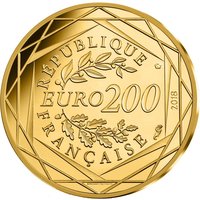
Polished Mickey winks mischievously against a starry Disney-patterned background. The face value is in his left ear, the date in his right.
Inscription:
200
EURO
2018
EURO
2018
Script: Latin
Edge
Plain
Mints
| Name | Mark |
|---|---|
| Monnaie de Paris | — |
Mintings
| Year | Mint Mark | Mintage | Quality | Collection |
|---|---|---|---|---|
| 2018 | — | 500 | Proof |
Historical background
In 2018, France remained a core member of the Eurozone, using the euro (€) as its sole legal tender, a status it had held since the currency's physical introduction in 2002. The broader monetary policy, including interest rates and money supply, was set by the European Central Bank (ECB) in Frankfurt, not by the French government. This meant that France's domestic economic challenges, such as persistently high unemployment and sluggish growth, could not be addressed through traditional national tools like devaluation or independent interest rate adjustments, a point of occasional political friction.
Domestically, the year was marked by the "Gilets Jaunes" (Yellow Vests) protest movement, which began in November 2018. While sparked by a proposed fuel tax hike, the protests rapidly expanded into a broader outcry against the rising cost of living and perceived economic injustice. A key grievance was the erosion of purchasing power, with protesters arguing that the euro and EU fiscal constraints were exacerbating financial pressures on low- and middle-income households. The crisis forced the government to abandon the fuel tax increase and announce emergency spending measures, testing the limits of France's budget deficit commitments under EU rules.
Financially, France's relationship with the euro was stable but under scrutiny. The government of President Emmanuel Macron was a staunch advocate for deeper Eurozone integration, proposing reforms like a common budget. However, France's own fiscal position was a concern, as it repeatedly breached the EU's deficit ceiling of 3% of GDP, a rule it was instrumental in creating. The European Commission ultimately recommended closing the excessive deficit procedure against France in 2018, acknowledging its efforts, but the tension between national spending pressures and European fiscal discipline remained a defining feature of the currency and economic landscape.
Domestically, the year was marked by the "Gilets Jaunes" (Yellow Vests) protest movement, which began in November 2018. While sparked by a proposed fuel tax hike, the protests rapidly expanded into a broader outcry against the rising cost of living and perceived economic injustice. A key grievance was the erosion of purchasing power, with protesters arguing that the euro and EU fiscal constraints were exacerbating financial pressures on low- and middle-income households. The crisis forced the government to abandon the fuel tax increase and announce emergency spending measures, testing the limits of France's budget deficit commitments under EU rules.
Financially, France's relationship with the euro was stable but under scrutiny. The government of President Emmanuel Macron was a staunch advocate for deeper Eurozone integration, proposing reforms like a common budget. However, France's own fiscal position was a concern, as it repeatedly breached the EU's deficit ceiling of 3% of GDP, a rule it was instrumental in creating. The European Commission ultimately recommended closing the excessive deficit procedure against France in 2018, acknowledging its efforts, but the tension between national spending pressures and European fiscal discipline remained a defining feature of the currency and economic landscape.



✨ Legendary