


100 lei (Establishment of the Court of Accounts of the Republic of Moldova) – Moldova
Add to wishlist
Non-circulating coins
Commemoration: 25 years since the establishment of the Court of Accounts of the Republic of Moldova
Moldova
Context
Material
Diameter: 37 mm
Weight: 31.1 g
Silver Weight:: 31.07 g
Shape: Round
Composition: 99.9% Silver
Standard: Silver ounce
Magnetic: No
Technique: Milled
References
KM: #
Numista: #187545
Value
Exchange value: 100 MDL
Bullion value: $75.61
Obverse
Reverse
Description:
Central: stylized balance sheet with an open book base.
Exergue: "25 DE ANI DE LA ÎNFIINȚAREA CURȚII DE CONTURI A REPUBLICII MOLDOVA".
Exergue: "25 DE ANI DE LA ÎNFIINȚAREA CURȚII DE CONTURI A REPUBLICII MOLDOVA".
Inscription:
25 DE ANI DE LA ÎNFIINȚAREA CURȚII DE CONTURI A REPUBLICII MOLDOVA
Translation:
25 Years Since the Establishment of the Court of Accounts of the Republic of Moldova
Script: Latin
Language: Romanian
Edge
Reeded
Categories
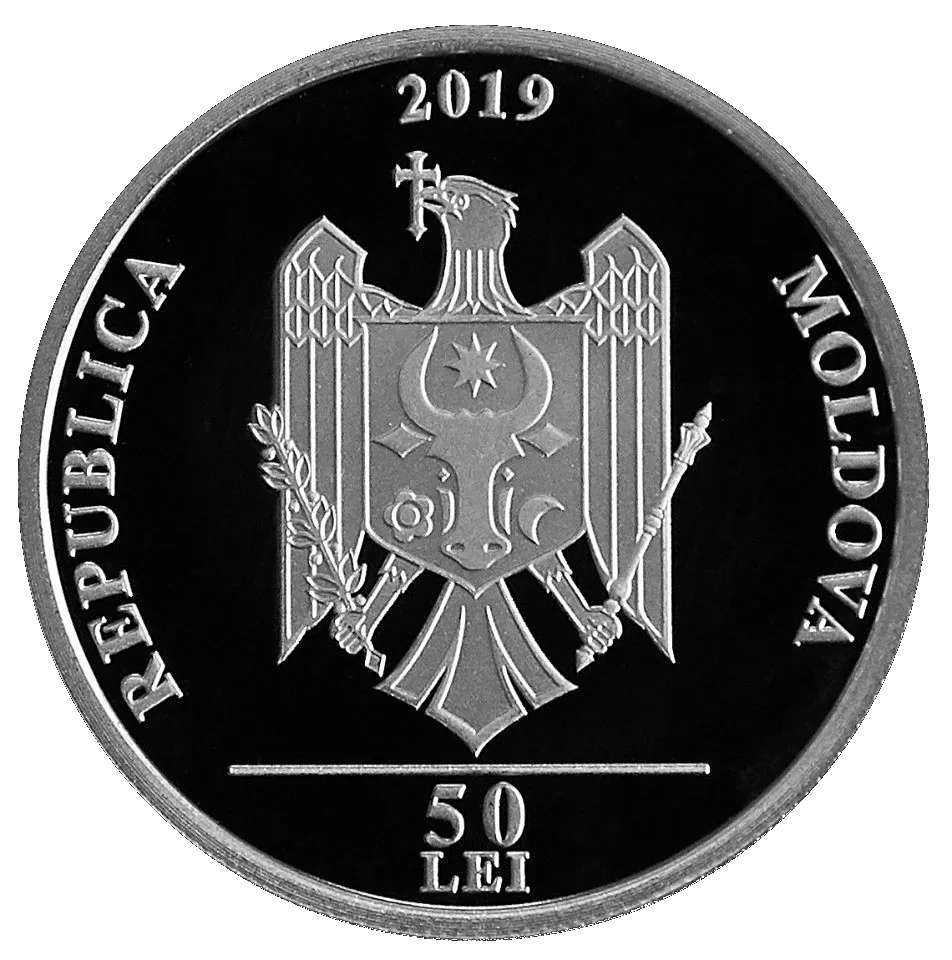
| Symbols> Coat of Arms |
Mintings
| Year | Mint Mark | Mintage | Quality | Collection |
|---|---|---|---|---|
| 2019 | — | 300 | Proof |
Historical background
In 2019, Moldova's currency, the leu (MDL), operated within a managed float regime under the supervision of the National Bank of Moldova (NBM). The year was characterized by relative stability in the foreign exchange market, a notable achievement following a period of significant volatility earlier in the decade triggered by the 2014 banking fraud scandal. The NBM's primary focus was on maintaining price stability and building foreign exchange reserves, which had been severely depleted. Throughout the year, the leu experienced mild fluctuations but remained broadly stable against major currencies like the euro and US dollar, aided by steady remittance inflows from the large diaspora and cautious monetary policy.
This stability, however, existed against a backdrop of ongoing political and economic fragility. The year was politically turbulent, featuring two different governments and protracted uncertainty following a constitutional crisis and contested parliamentary elections. Economically, Moldova remained one of Europe's poorest countries, with growth slowing and the economy vulnerable to external shocks. The NBM's interventions in the forex market were minimal in 2019, as it aimed to allow the exchange rate to act as a shock absorber while preventing excessive volatility, a balance it largely maintained.
Furthermore, Moldova's currency dynamics continued to reflect its geopolitical positioning between the European Union and Russia. Trade and remittance flows from both spheres influenced demand for the leu. A significant underlying theme was the ongoing process of de-dollarization within the domestic financial system. The NBM continued policies to reduce the economy's heavy reliance on foreign currency loans and deposits, a legacy of past instability, though the US dollar and euro still dominated significant portions of savings and credit. Thus, the 2019 currency situation presented a surface of achieved short-term stability, underpinned by cautious institutional management, yet remained exposed to deeper structural economic weaknesses and political unpredictability.
This stability, however, existed against a backdrop of ongoing political and economic fragility. The year was politically turbulent, featuring two different governments and protracted uncertainty following a constitutional crisis and contested parliamentary elections. Economically, Moldova remained one of Europe's poorest countries, with growth slowing and the economy vulnerable to external shocks. The NBM's interventions in the forex market were minimal in 2019, as it aimed to allow the exchange rate to act as a shock absorber while preventing excessive volatility, a balance it largely maintained.
Furthermore, Moldova's currency dynamics continued to reflect its geopolitical positioning between the European Union and Russia. Trade and remittance flows from both spheres influenced demand for the leu. A significant underlying theme was the ongoing process of de-dollarization within the domestic financial system. The NBM continued policies to reduce the economy's heavy reliance on foreign currency loans and deposits, a legacy of past instability, though the US dollar and euro still dominated significant portions of savings and credit. Thus, the 2019 currency situation presented a surface of achieved short-term stability, underpinned by cautious institutional management, yet remained exposed to deeper structural economic weaknesses and political unpredictability.


✨ Legendary