


500 Euro – France
Non-circulating coins
Commemoration: Historical Coins of France
France
Context

Material
Diameter: 50 mm
Weight: 155.5 g
Gold weight: 155.34 g
Shape: Round
Composition: 99.9% Gold
Standard: Silver 5 ounces
Magnetic: No
Technique: Milled
Alignment: Medal alignment

flip
References
KM: #Click to copy to clipboard2842
Numista: #187513
Value
Exchange value: 500 EUR = $590.70
Bullion value: $25953.10
Inflation-adjusted value: 597.20 EUR
Obverse
Reverse
Description:
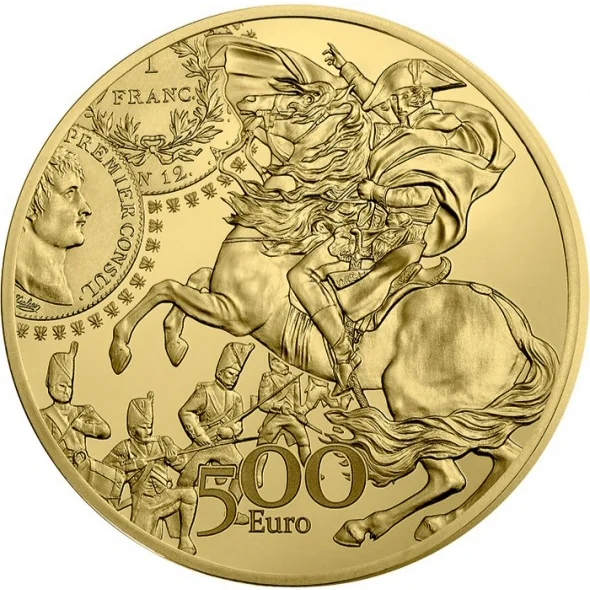
Evokes Napoleon's Consulate and First Empire, featuring the Germinal franc's obverse and reverse alongside symbols of the era: the Legion of Honour, the bee, and the laurel crown.
Inscription:
1
FRANC
N 12 .
PREMIER CONSUL·
500
Euro
FRANC
N 12 .
PREMIER CONSUL·
500
Euro
Script: Latin
Edge
Categories
| Animal> Horse |
| Animal> Insect |
| Object> Firearms |
| Art> Painting |
| Object> Hat |
| Person> Monarch |
| Currency> Coin depiction |
Mints
| Name | Mark |
|---|---|
| Monnaie de Paris | — |
Mintings
| Year | Mint Mark | Mintage | Quality | Collection |
|---|---|---|---|---|
| 2019 | — | 99 | Proof |
Historical background
In 2019, France's currency situation was firmly anchored within the Eurozone framework, using the euro (€) as its sole legal tender. The broader monetary policy, including interest rates and quantitative easing, was set by the European Central Bank (ECB) under the presidency of Mario Draghi (and later Christine Lagarde). Domestically, the focus was less on currency sovereignty and more on managing economic performance within the single currency. Key concerns included persistently low inflation, which remained below the ECB's target, and the need for structural reforms to boost competitiveness, a point of frequent contention between Paris and Brussels.
The year saw significant domestic economic debates with currency implications. The "Gilets Jaunes" (Yellow Vests) protest movement, which began in late 2018, continued into 2019 and centered on purchasing power and economic inequality. While not a direct attack on the euro, the protests highlighted frustrations with the cost of living, which some critics linked to the constraints of Eurozone membership. Simultaneously, President Emmanuel Macron advocated for deeper Eurozone integration, including a common budget, to strengthen the currency union's resilience—a vision that faced resistance from more fiscally conservative member states like Germany.
Furthermore, 2019 was marked by underlying discussions about the euro's international role. Against the backdrop of growing geopolitical tensions and the Trump administration's policies, France, alongside Germany, renewed calls to bolster the euro as a strategic tool to reduce European dependence on the US dollar in energy and financial transactions. This push for "strategic autonomy" in currency affairs aimed to shield the EU from external financial shocks and sanctions, setting a longer-term agenda for the currency's future beyond the immediate economic indicators of the year.
The year saw significant domestic economic debates with currency implications. The "Gilets Jaunes" (Yellow Vests) protest movement, which began in late 2018, continued into 2019 and centered on purchasing power and economic inequality. While not a direct attack on the euro, the protests highlighted frustrations with the cost of living, which some critics linked to the constraints of Eurozone membership. Simultaneously, President Emmanuel Macron advocated for deeper Eurozone integration, including a common budget, to strengthen the currency union's resilience—a vision that faced resistance from more fiscally conservative member states like Germany.
Furthermore, 2019 was marked by underlying discussions about the euro's international role. Against the backdrop of growing geopolitical tensions and the Trump administration's policies, France, alongside Germany, renewed calls to bolster the euro as a strategic tool to reduce European dependence on the US dollar in energy and financial transactions. This push for "strategic autonomy" in currency affairs aimed to shield the EU from external financial shocks and sanctions, setting a longer-term agenda for the currency's future beyond the immediate economic indicators of the year.



✨ Legendary