

1000 lire – San Marino
Add to wishlist
Non-circulating coins
Commemoration: 1996 Olympics
San Marino
Context
Year: 1995
Issuer: San Marino
Period:
(since 301)
Currency:
(1864—2001)
Demonetization: 1 March 2002
Total mintage: 50,000
Material
References
KM: #
Numista: #18749
Value
Exchange value: 1000 SML
Bullion value: $30.43
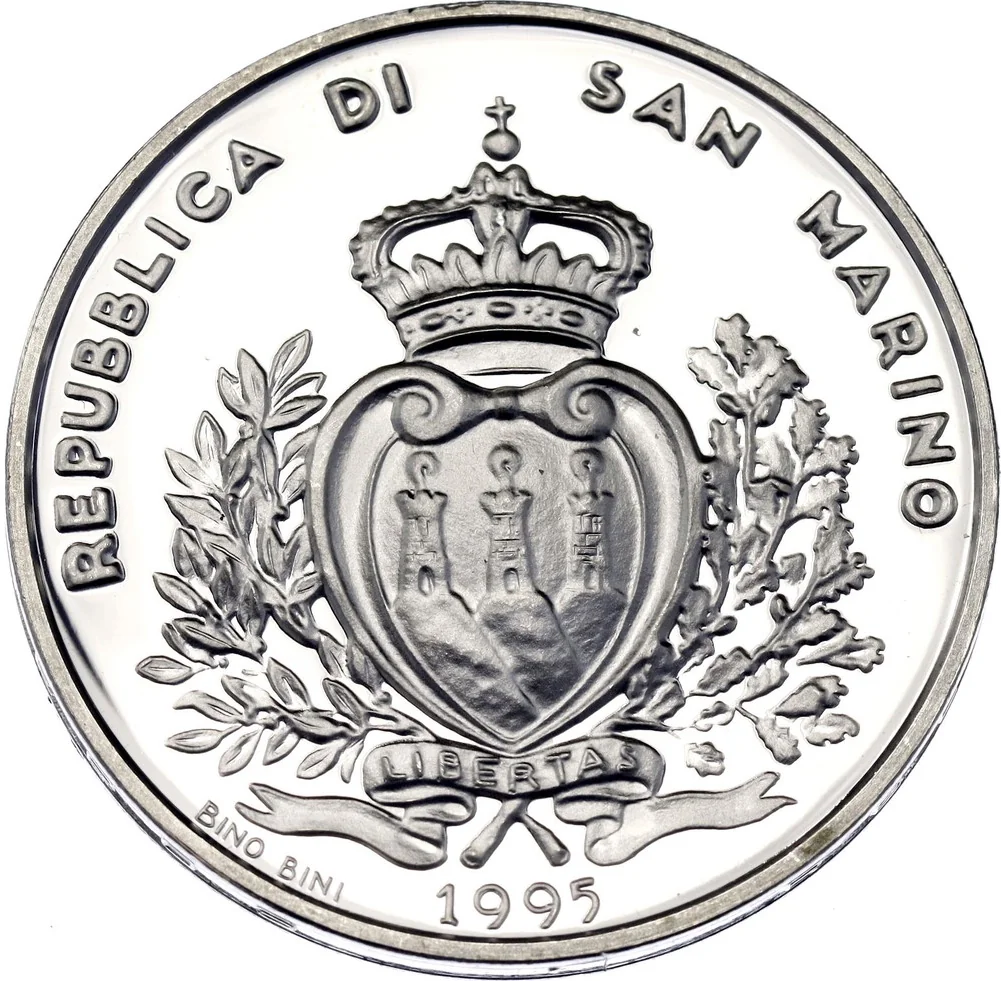
Obverse
Reverse
Description:
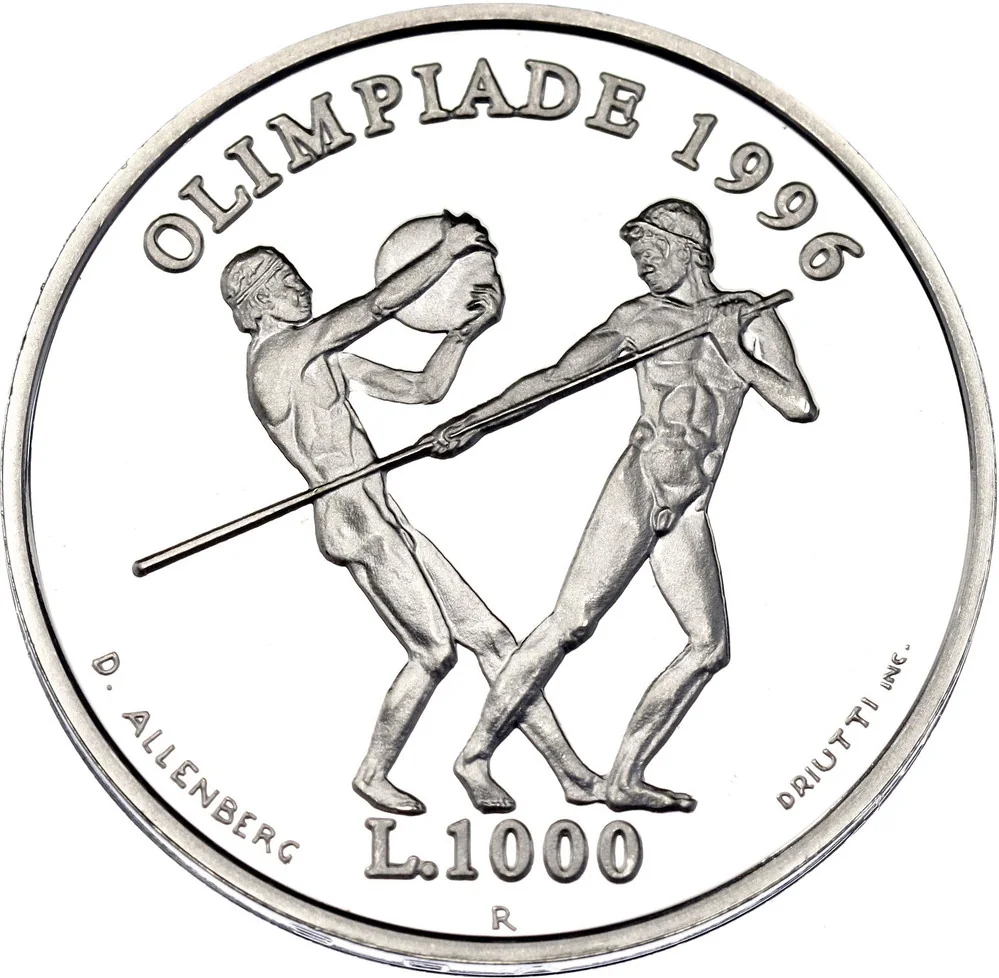
Two nude Greek athletes.
Inscription:
OLIMPIADE 1996
L. 1000
D.ALLENBERG
DRIUTTI INC.
L. 1000
D.ALLENBERG
DRIUTTI INC.
Script: Latin
Engravers: Eugenio Driutti, D. Allenberg
Edge
Categories
| Sport> Summer Olympic Games |
Mints
| Name | Mark |
|---|---|
| Rome | R |
Mintings
| Year | Mint Mark | Mintage | Quality | Collection |
|---|---|---|---|---|
| 1995 | R | 50,000 | Proof |
Historical background
In 1995, San Marino's currency situation was fundamentally defined by its longstanding and intricate monetary relationship with Italy, formalized in a series of Conventions. The Republic used the Italian lira as its official legal tender, and the Central Bank of the Republic of San Marino (then the Istituto di Credito Sammarinese) issued its own limited series of Sammarinese lire. These were minted as coins and printed as banknotes, but they were not an independent currency; they were pegged at a perfect 1:1 parity with the Italian lira and were legally valid only within San Marino's borders. This system meant the country had effectively ceded its monetary sovereignty, with its economy and money supply directly tied to the policies set by the Bank of Italy.
The arrangement provided significant stability for the small republic, insulating it from exchange rate risk and simplifying cross-border transactions with its encircling neighbor, which accounted for the vast majority of its trade. However, it also meant San Marino had no direct control over monetary policy tools like interest rates, which were set in Rome according to Italy's domestic needs, often during a period of significant lira volatility in the European Monetary System. Furthermore, while Sammarinese coins circulated locally, Italian currency was overwhelmingly dominant in daily use, limiting the symbolic and practical reach of the national issues.
This framework was already under a long-term shadow in 1995 due to the advancing European Economic and Monetary Union (EMU). With Italy working to meet the Maastricht Treaty criteria to adopt the future euro, San Marino was compelled to negotiate a new monetary agreement with the Italian government, and by extension, the European Community. The year 1995 was thus part of a transitional period, where the old lira-based system functioned normally, but discussions were underway to secure a future where San Marino could continue to issue its own coinage—this time denominated in euros—under a revised, EU-sanctioned agreement, which was ultimately concluded in 2000.
The arrangement provided significant stability for the small republic, insulating it from exchange rate risk and simplifying cross-border transactions with its encircling neighbor, which accounted for the vast majority of its trade. However, it also meant San Marino had no direct control over monetary policy tools like interest rates, which were set in Rome according to Italy's domestic needs, often during a period of significant lira volatility in the European Monetary System. Furthermore, while Sammarinese coins circulated locally, Italian currency was overwhelmingly dominant in daily use, limiting the symbolic and practical reach of the national issues.
This framework was already under a long-term shadow in 1995 due to the advancing European Economic and Monetary Union (EMU). With Italy working to meet the Maastricht Treaty criteria to adopt the future euro, San Marino was compelled to negotiate a new monetary agreement with the Italian government, and by extension, the European Community. The year 1995 was thus part of a transitional period, where the old lira-based system functioned normally, but discussions were underway to secure a future where San Marino could continue to issue its own coinage—this time denominated in euros—under a revised, EU-sanctioned agreement, which was ultimately concluded in 2000.
🌟 Limited