

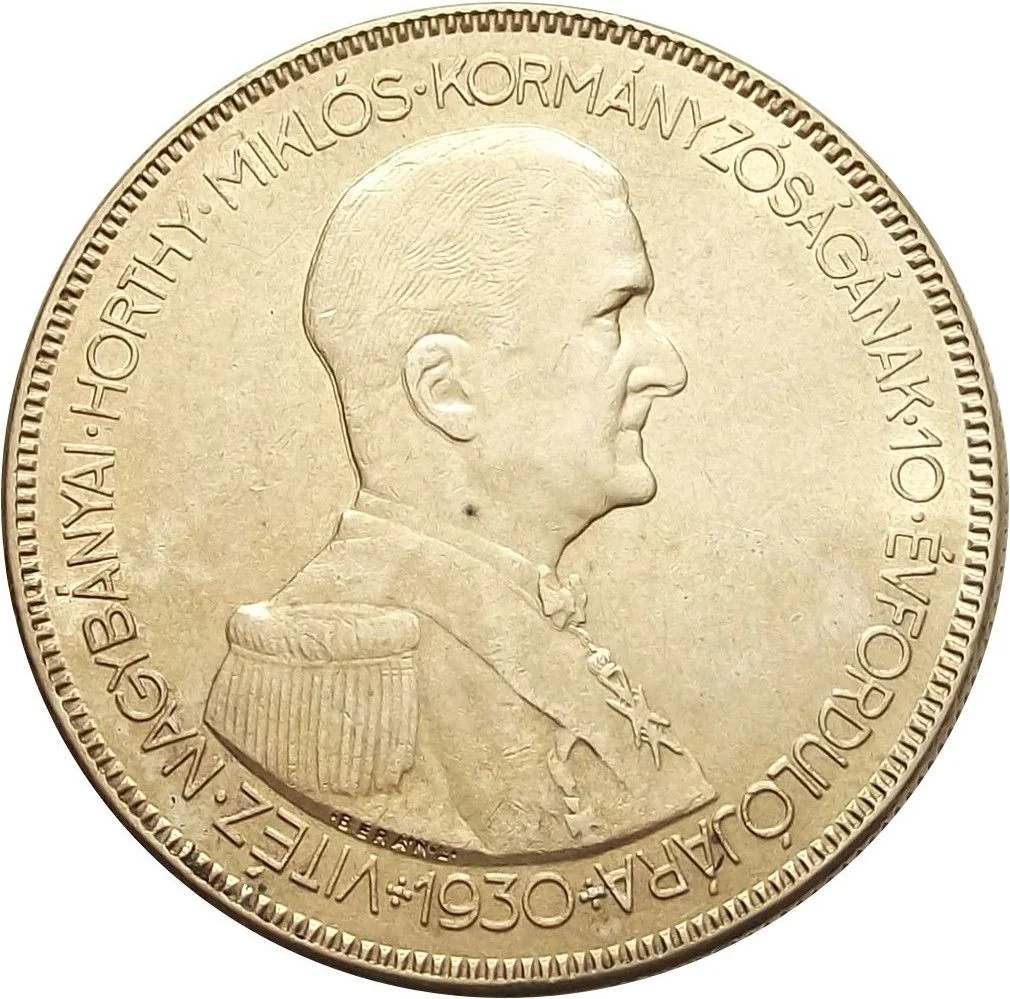
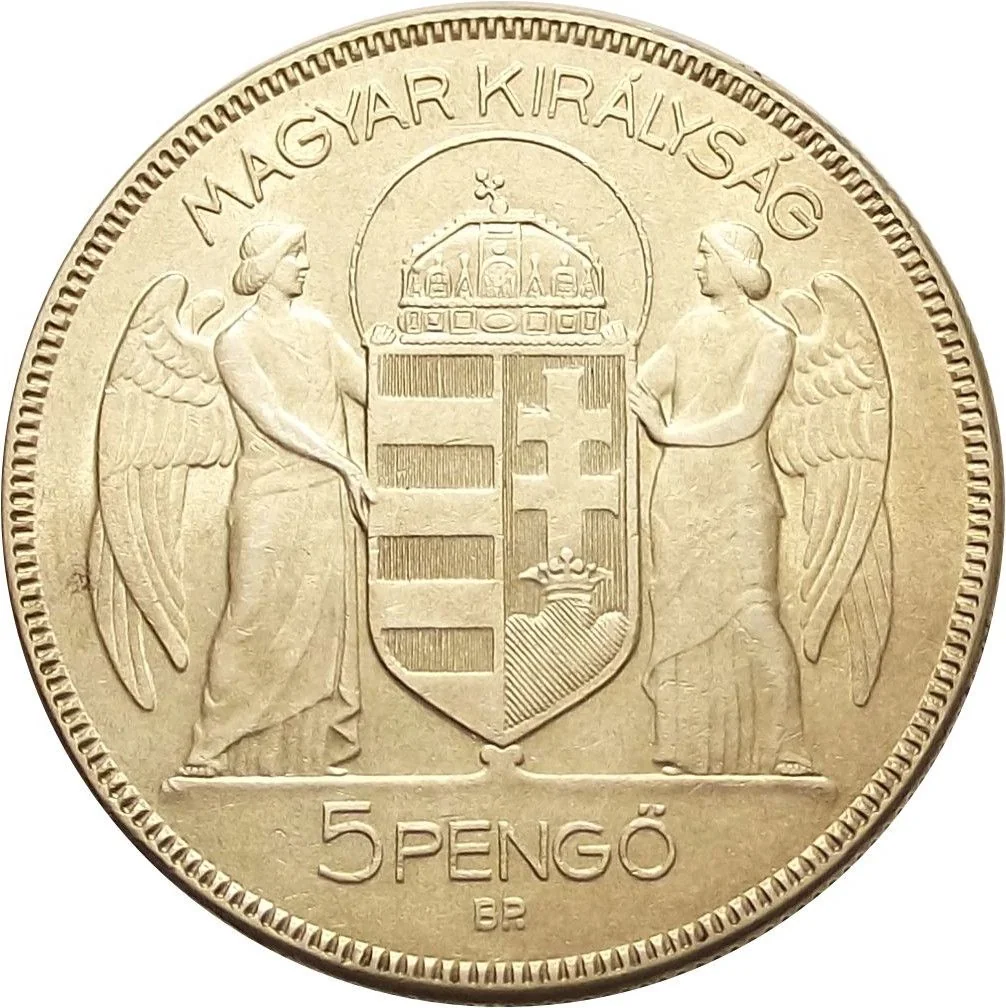
5 pengos (Regency of Admiral Horthy) – Hungary
Add to wishlist
Circulating commemorative coins
Commemoration: 10th Anniversary - Regency of Admiral Horthy
Hungary
Context
Year: 1930
Issuer: Hungary
Ruler: Nicolas Horthy
Currency:
(1927—1946)
Demonetization: 31 October 1945
Total mintage: 3,650,000
Material
References
KM: #
Numista: #18692
Value
Bullion value: $41.03
Obverse
Description:
Shield with angel supporters, crowned.
Inscription:
MAGYAR KIRÁLYSÁG
5 PENGŐ
BP.
5 PENGŐ
BP.
Translation:
Kingdom of Hungary
5 Pengő
Budapest
5 Pengő
Budapest
Script: Latin
Language: Hungarian
Engraver: Lajos Berán
Reverse
Description:
Get in. Let's go.
Inscription:
VITÉZ NAGYBÁNYAI HORTHY MIKLÓS KORMÁNYZÓSÁGÁNAK 10. ÉVFORDULÓJÁRA 1930
Translation:
To the 10th Anniversary of the Governorship of Vitéz Miklós Horthy of Nagybánya 1930
Script: Latin
Language: Hungarian
Engraver: Lajos Berán
Edge
Reeded
Mints
| Name | Mark |
|---|---|
| Hungarian mint | — |
Mintings
| Year | Mint Mark | Mintage | Quality | Collection |
|---|---|---|---|---|
| 1930 | — | — | Proof | |
| 1930 | BP | 3,650,000 |
Historical background
In the 1930s, Hungary’s currency situation was defined by the severe economic and political legacy of the post-World War I period. The country, having lost two-thirds of its territory and population under the 1920 Treaty of Trianon, struggled with economic dislocation and a heavy burden of war reparations. To stabilize the economy, the Hungarian korona was replaced in 1927 by the pengő, introduced at a fixed parity to gold and managed by the newly established, independent Hungarian National Bank. This reform initially brought a period of monetary stability and attracted foreign loans, primarily from the League of Nations, which were crucial for budgetary balance.
However, the onset of the Great Depression in 1929 catastrophically reversed these gains. As global credit dried up and agricultural prices collapsed—devastating Hungary’s primary export sector—the country faced a severe balance of payments crisis and a massive outflow of gold and foreign currency reserves. By 1931, Hungary was unable to service its foreign debts, leading to a sovereign default. The government was forced to abandon the gold standard and the pengő’s fixed parity, imposing strict foreign exchange controls and moving to a managed, devalued currency to conserve scarce reserves and protect the domestic economy.
Consequently, the 1930s saw Hungary operate under a system of financial autarchy. The pengő, now inconvertible, was managed through a complex regime of exchange controls and bilateral clearing agreements, primarily with Nazi Germany, which became Hungary’s dominant trading partner. This insulated the currency from international markets but tied the economy ever closer to the German sphere of influence. While averting hyperinflation, this controlled environment masked underlying economic weaknesses and set the stage for the catastrophic currency collapse and record-breaking hyperinflation that would engulf Hungary immediately after World War II.
However, the onset of the Great Depression in 1929 catastrophically reversed these gains. As global credit dried up and agricultural prices collapsed—devastating Hungary’s primary export sector—the country faced a severe balance of payments crisis and a massive outflow of gold and foreign currency reserves. By 1931, Hungary was unable to service its foreign debts, leading to a sovereign default. The government was forced to abandon the gold standard and the pengő’s fixed parity, imposing strict foreign exchange controls and moving to a managed, devalued currency to conserve scarce reserves and protect the domestic economy.
Consequently, the 1930s saw Hungary operate under a system of financial autarchy. The pengő, now inconvertible, was managed through a complex regime of exchange controls and bilateral clearing agreements, primarily with Nazi Germany, which became Hungary’s dominant trading partner. This insulated the currency from international markets but tied the economy ever closer to the German sphere of influence. While averting hyperinflation, this controlled environment masked underlying economic weaknesses and set the stage for the catastrophic currency collapse and record-breaking hyperinflation that would engulf Hungary immediately after World War II.
🌱 Common