

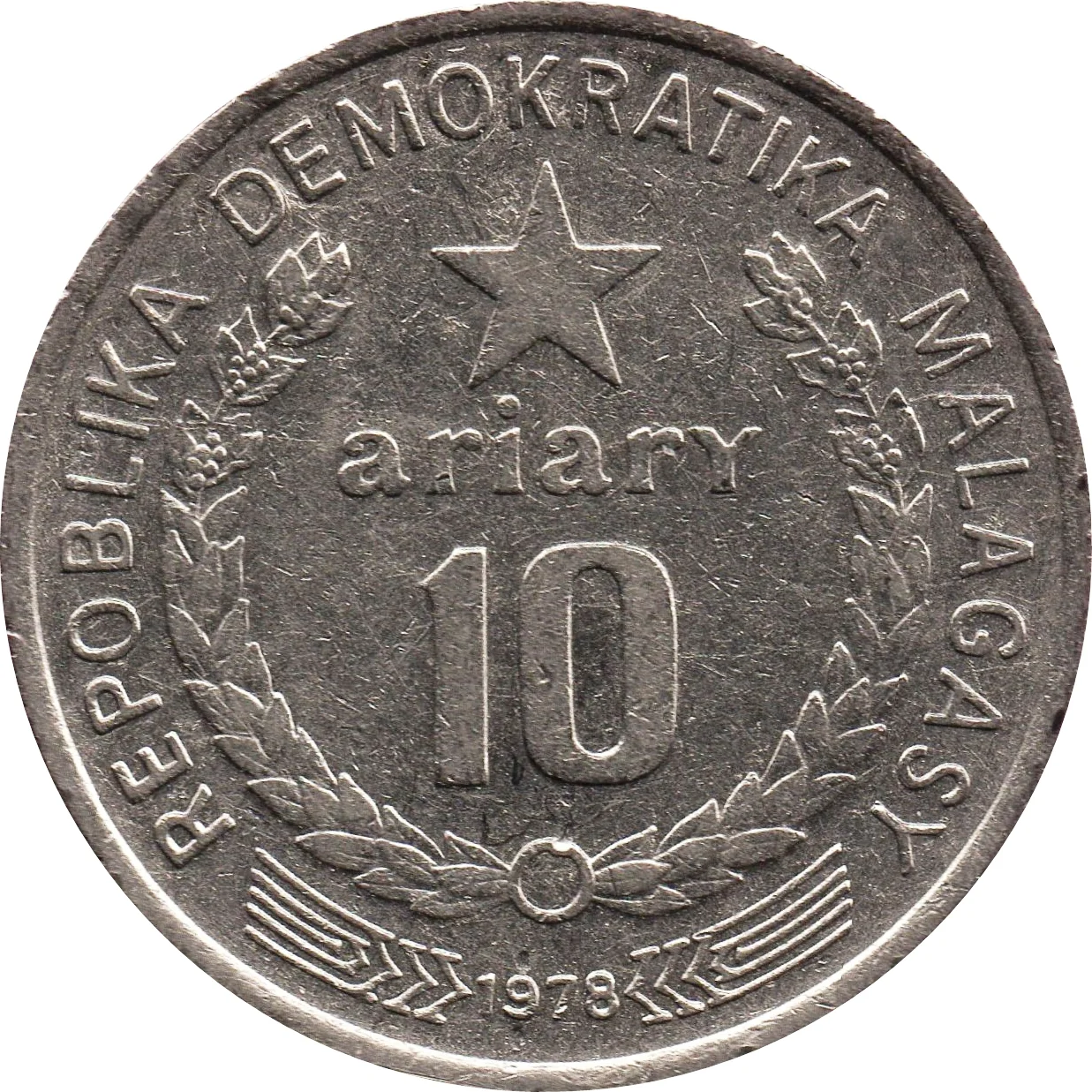
10 ariary – Madagascar
Add to wishlist
Circulating commemorative coins
Commemoration: F.A.O.
Madagascar
Context
Year: 1978
Issuer: Madagascar
Period:
(1975—1992)
Currency:
(1963—2004)
Demonetized: Yes
Total mintage: 8,001,000
Material
References
KM: #
Numista: #1858
Value
Exchange value: 10 MGF
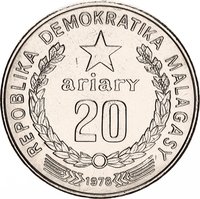
Obverse
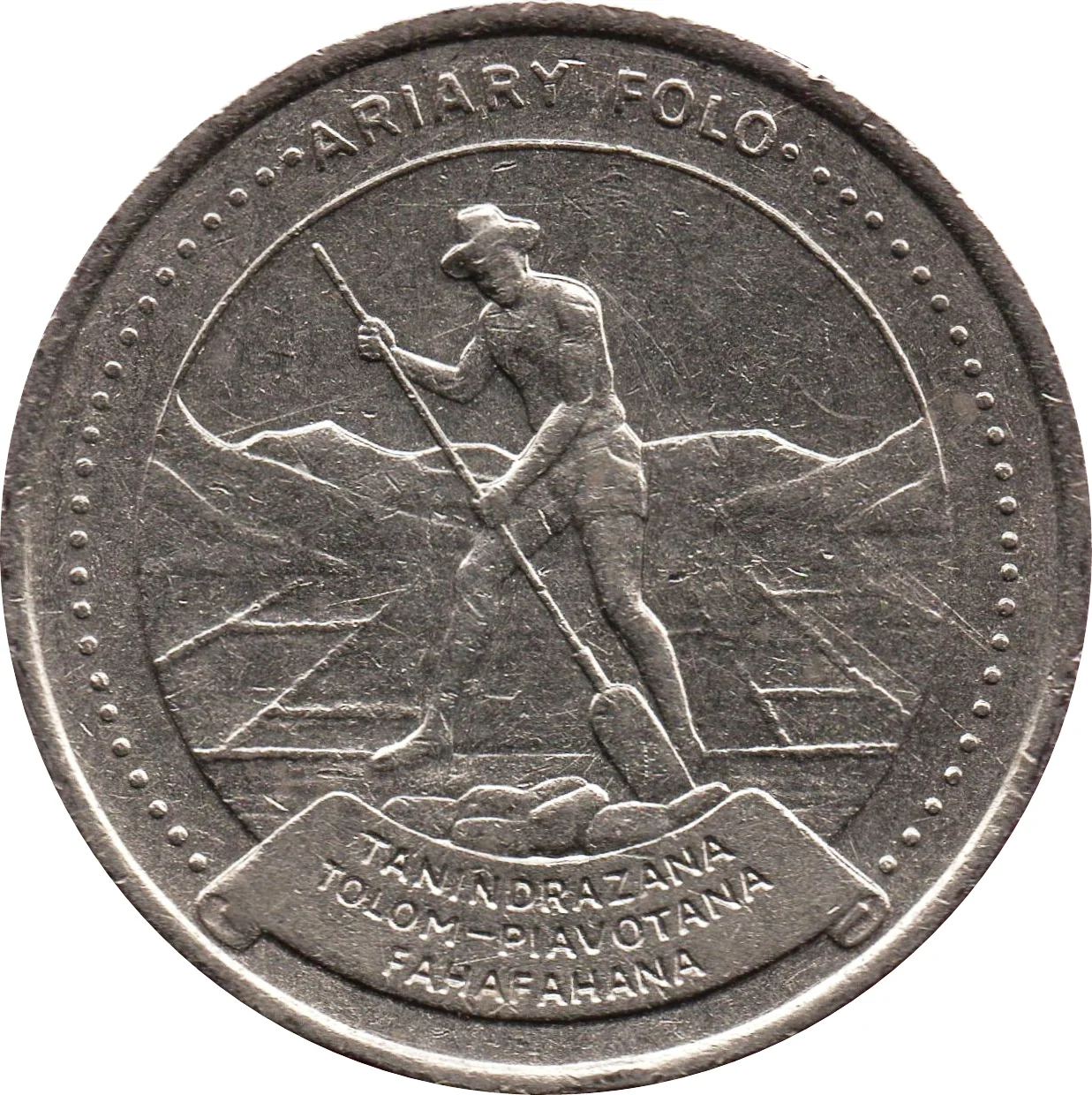
Reverse
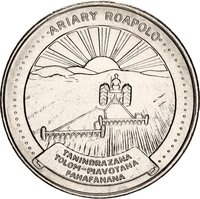
Description:
Man cutting peat in a circle.
Inscription:
ARIARY FOLO
TANINDRAZANA
TOLOM - PIAVOTANA
FAHAFAHANA
TANINDRAZANA
TOLOM - PIAVOTANA
FAHAFAHANA
Translation:
Homeland
Justice - Development
Liberty
Justice - Development
Liberty
Script: Latin
Language: Malagasy
Engraver: Mike Hibbit
Edge
Reeded
Categories
| Agriculture |
| Organization> FAO |
Mints
| Name | Mark |
|---|---|
| Royal Mint | — |
Mintings
| Year | Mint Mark | Mintage | Quality | Collection |
|---|---|---|---|---|
| 1978 | — | 8,001,000 |
Historical background
In 1978, Madagascar's currency situation was characterized by the continued use of the Malagasy franc (MGF), which operated within a tightly controlled and struggling post-colonial economy. The currency was pegged to a basket of currencies, with a heavy weighting toward the French franc, reflecting the nation's enduring economic ties to its former colonial power. This peg, managed by the Central Bank of the Malagasy Republic, aimed to provide stability but often failed to reflect the country's domestic economic realities, leading to periodic official devaluations.
The broader economic context was one of significant distress, severely impacting the currency's stability and value. Following a shift to a socialist-Marxist model under President Didier Ratsiraka in 1975, the economy faced declining agricultural production, crumbling infrastructure, and a severe shortage of foreign exchange. A mounting debt burden and a deteriorating trade balance meant the country had limited reserves to defend its currency, creating persistent pressure on the fixed exchange rate and contributing to the growth of a black market for foreign currency.
Consequently, the official exchange rate existed alongside a thriving parallel market where the Malagasy franc traded at a significant discount. This disparity highlighted the lack of confidence in the official monetary policy and the scarcity of hard currency needed for essential imports. The situation in 1978 was thus a precursor to more severe economic crises in the following decade, underscoring the fundamental mismatch between the government's managed currency regime and the weakening productive capacity of the national economy.
The broader economic context was one of significant distress, severely impacting the currency's stability and value. Following a shift to a socialist-Marxist model under President Didier Ratsiraka in 1975, the economy faced declining agricultural production, crumbling infrastructure, and a severe shortage of foreign exchange. A mounting debt burden and a deteriorating trade balance meant the country had limited reserves to defend its currency, creating persistent pressure on the fixed exchange rate and contributing to the growth of a black market for foreign currency.
Consequently, the official exchange rate existed alongside a thriving parallel market where the Malagasy franc traded at a significant discount. This disparity highlighted the lack of confidence in the official monetary policy and the scarcity of hard currency needed for essential imports. The situation in 1978 was thus a precursor to more severe economic crises in the following decade, underscoring the fundamental mismatch between the government's managed currency regime and the weakening productive capacity of the national economy.
🌱 Common