Logo Title
obverse
reverse
Auktionen Frühwald
Context
Year: 1806
Currency:
Demonetized: Yes
Material
Diameter: 40 mm
Weight: 28.06 g
Silver weight: 23.37 g
Shape: Round
Composition: 83.3% Silver
Magnetic: No
Technique: Milled
References
KM: #Click to copy to clipboard499
Numista: #185696
Value
Bullion value: $65.12

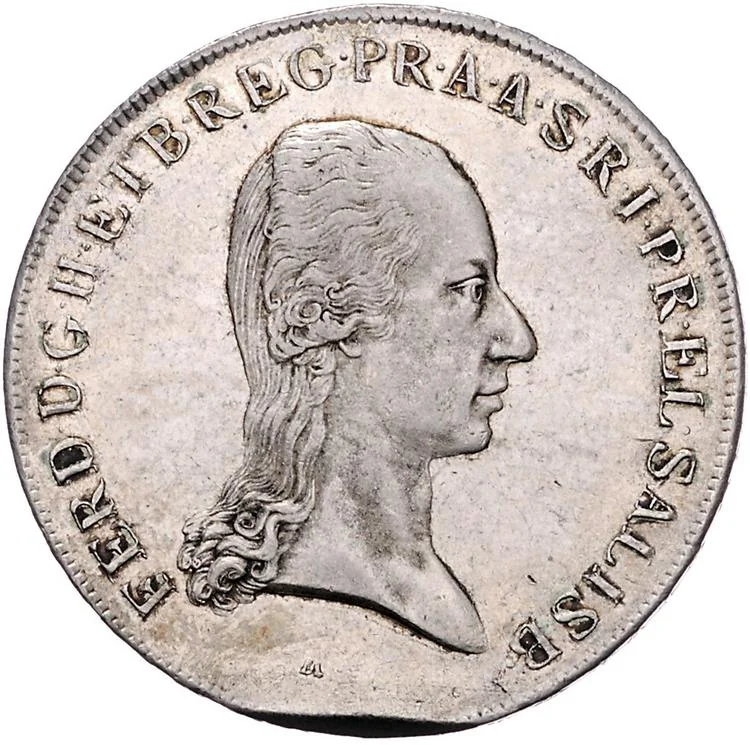
Obverse

Description:
Portrait of Ferdinand III of Austria-Tuscany, facing right.
Inscription:
FERD D G H ET B REG PR A A S R I PR EL SALISB

M
Translation:
Ferdinand, by the Grace of God, Emperor of Austria, Apostolic King of Hungary, Bohemia, etc., King of Lombardy and Venice, Dalmatia, Croatia, Slavonia, Galicia and Lodomeria, and Illyria; Archduke of Austria, etc., etc., Grand Prince of Transylvania, Margrave of Moravia, etc., Duke of Salzburg.
Script: Latin
Languages: Latin, German

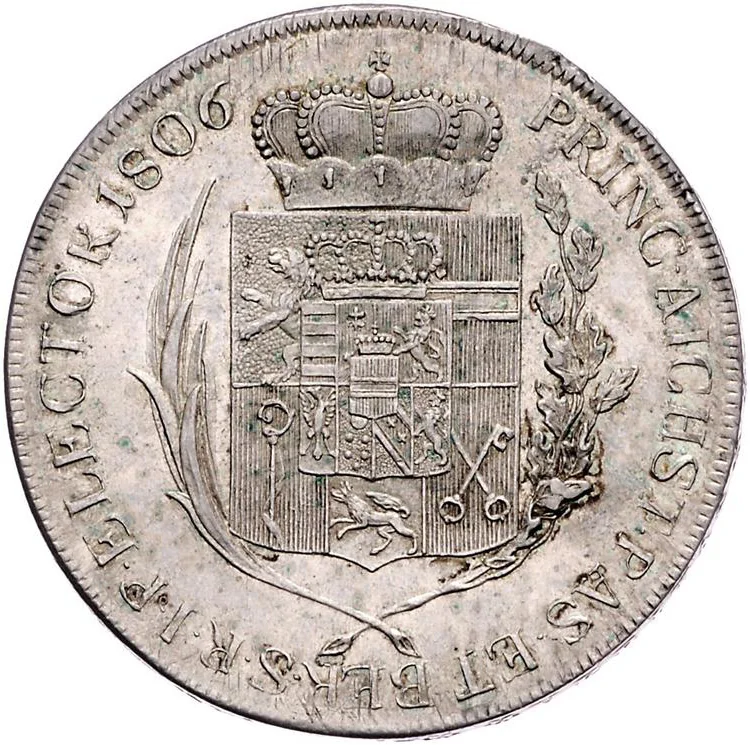
Reverse

Description:
Crowned coat of arms within a wreath, encircled by legend (starting at 1 o'clock).
Inscription:
PRINC AICHST PAS ET BER S R I P ELECTOR 1806
Script: Latin

Edge
Categories

Symbols> Coat of Arms

Mintings

YearMint MarkMintageQualityCollection
1806

Historical background

In 1806, the currency situation in the Bishopric of Salzburg was one of profound transition and uncertainty, directly tied to its dramatic political upheaval. For centuries, the Prince-Archbishops had minted their own coins, most notably the Salzburg Gulden and Kreuzer, which circulated alongside a complex array of regional and imperial currencies from the Holy Roman Empire. However, this sovereign monetary authority ended abruptly in late 1805 and early 1806. Following Napoleon's victory at Austerlitz and the Peace of Pressburg, Salzburg was secularized, its archbishop deposed, and the territory was transferred to the Austrian Habsburgs in 1805, before being ceded to the Electorate of Bavaria in 1806 through the Treaty of Pressburg.

Under new Bavarian administration, a formal currency transition began, aiming to replace the old Salzburg coinage with the Bavarian Gulden system. This process, however, was gradual and often chaotic. The population had to navigate a mixed circulation of not yet withdrawn Salzburg coins, new Bavarian issues, and older Habsburg Thalers and Kreutzer, leading to confusion in trade and daily transactions. The fixed exchange rates between these systems were often unfavourable, causing economic hardship and resentment among Salzburg's citizens, who saw the currency change as a symbol of lost independence and foreign imposition.

Therefore, by the end of 1806, Salzburg was no longer a sovereign ecclesiastical state with its own mint but a Bavarian province in a state of monetary integration. The complete standardization to the Bavarian currency system would take several more years to realize fully. This period marked the definitive end of Salzburg's numismatic autonomy, a process mirrored across the German lands as the Holy Roman Empire was dissolved and the region was reorganized under Napoleonic influence.
Legendary