

20 francs – Madagascar
Add to wishlist
Madagascar
Context
Years: 1970–1989
Issuer: Madagascar
Period:
(1958—1975)
Currency:
(1963—2004)
Subdivision: 20 francs = 4 Ariary
Total mintage: 33,900,000
Material
References
KM: #
Numista: #1852
Value
Exchange value: 4 MGF
Obverse
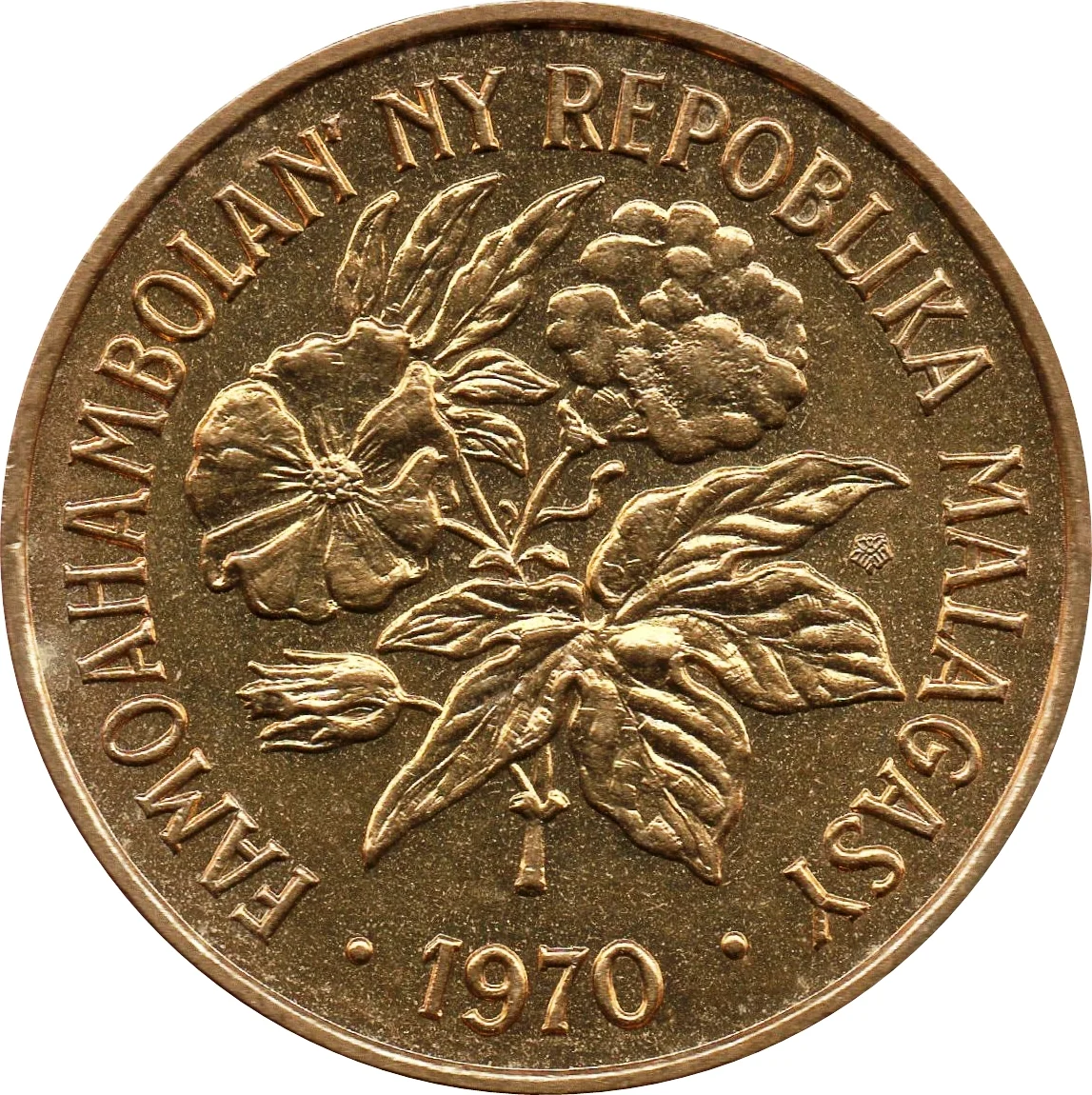
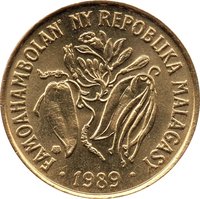
Description:
Cotton plant.
Inscription:
FAMOAHAMBOLAN' NY REPOBLIKA MALAGASY
1970
1970
Translation:
GUARDIAN OF THE REPUBLIC OF MADAGASCAR
1970
1970
Script: Latin
Language: Malagasy
Engraver: B. Ramjato
Reverse
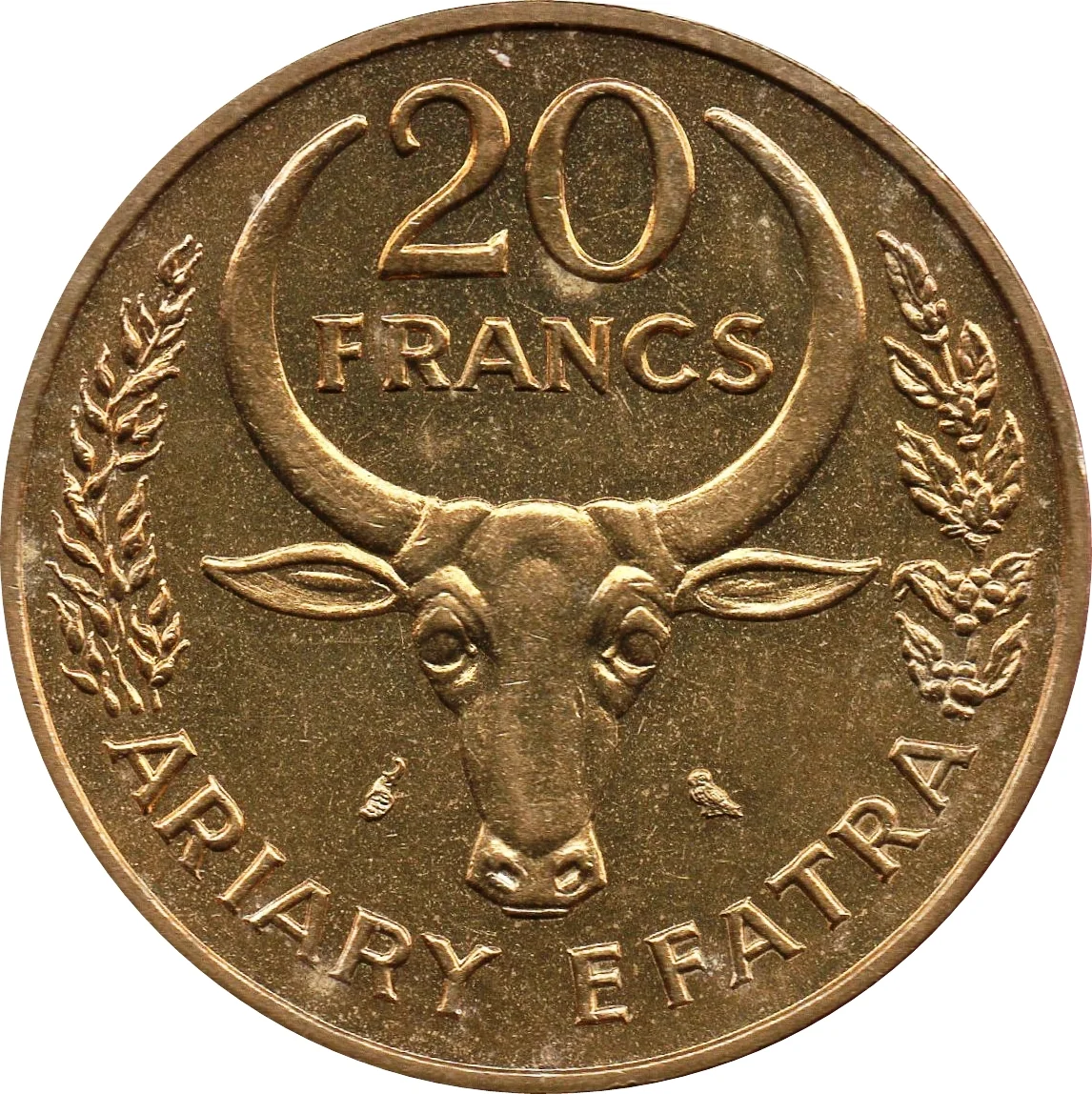
Description:
Zebu head above sprigs and marks.
Inscription:
20
FRANCS
ARIARY EFATRA
FRANCS
ARIARY EFATRA
Translation:
Twenty Francs
Four Ariary
Four Ariary
Script: Latin
Engraver: Raymond Joly
Edge
Plain
Categories
| Animal> Cow |
| Organization> FAO |
Mints
| Name | Mark |
|---|---|
| Monnaie de Paris | — |
| Royal Canadian Mint of Winnipeg | — |
Mintings
| Year | Mint Mark | Mintage | Quality | Collection |
|---|---|---|---|---|
| 1970 | — | 4,000,000 | ||
| 1971 | — | 6,000,000 | ||
| 1972 | — | 2,000,000 | ||
| 1973 | — | 3,000,000 | ||
| 1974 | — | — | ||
| 1975 | — | — | ||
| 1976 | — | 2,700,000 | ||
| 1977 | — | 600,000 | ||
| 1978 | — | — | ||
| 1979 | — | 1,600,000 | ||
| 1980 | — | 1,600,000 | ||
| 1981 | — | 2,200,000 | ||
| 1982 | — | 1,800,000 | ||
| 1983 | — | 2,400,000 | ||
| 1984 | — | 1,200,000 | ||
| 1986 | — | 2,400,000 | ||
| 1987 | — | 1,200,000 | ||
| 1988 | — | 1,200,000 | ||
| 1989 | — | — |
Historical background
In 1970, Madagascar's currency situation was defined by its membership in the Franc Zone and its use of the CFA franc, specifically the Malagasy Franc (FMG). This arrangement, a legacy of French colonial rule, pegged the FMG to the French franc at a fixed and guaranteed exchange rate. This provided significant monetary stability, controlled inflation, and facilitated predictable trade and investment flows with France and other CFA zone members. The system was managed by the Institut d’Emission Malgache, which operated under the umbrella of the French Treasury, ensuring convertibility and foreign reserve backing.
However, this stability came with trade-offs. The fixed peg limited Madagascar's independent monetary policy, preventing the government from devaluing its currency to boost exports or adjust to domestic economic conditions. The economy was primarily agricultural, relying on exports like coffee, vanilla, and cloves, making it vulnerable to commodity price swings. While the currency regime provided external stability, it did not directly address internal structural challenges such as rural poverty, infrastructure deficits, and the need for industrial diversification.
Politically, this period followed the socialist-leaning First Republic of Philibert Tsiranana, who maintained close ties with France. The currency system was a tangible symbol of this continued economic dependence. By 1970, social discontent with this neo-colonial relationship was growing, foreshadowing the political upheaval of 1972 that would lead to Tsiranana's fall and a move toward more nationalist and socialist economic policies, though a formal break from the CFA franc would not occur until later in the decade.
However, this stability came with trade-offs. The fixed peg limited Madagascar's independent monetary policy, preventing the government from devaluing its currency to boost exports or adjust to domestic economic conditions. The economy was primarily agricultural, relying on exports like coffee, vanilla, and cloves, making it vulnerable to commodity price swings. While the currency regime provided external stability, it did not directly address internal structural challenges such as rural poverty, infrastructure deficits, and the need for industrial diversification.
Politically, this period followed the socialist-leaning First Republic of Philibert Tsiranana, who maintained close ties with France. The currency system was a tangible symbol of this continued economic dependence. By 1970, social discontent with this neo-colonial relationship was growing, foreshadowing the political upheaval of 1972 that would lead to Tsiranana's fall and a move toward more nationalist and socialist economic policies, though a formal break from the CFA franc would not occur until later in the decade.

🌱 Very Common