


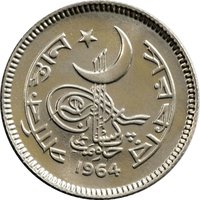
Obverse
Description:
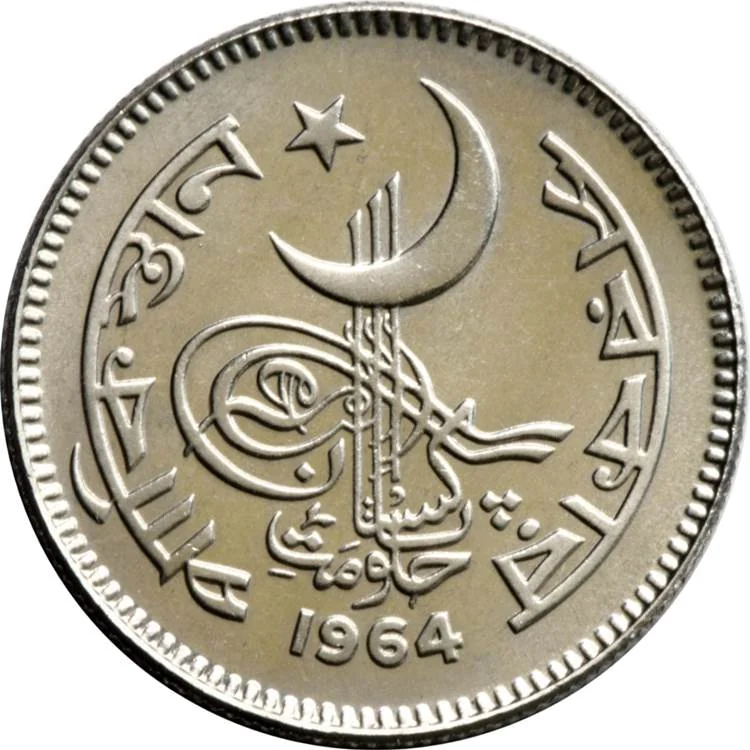
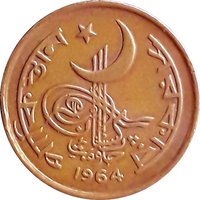
Crescent, star, toughra, and date.
Inscription:
পাকিস্তান ☪ সরকার
ﭘﺎﻛﺴﺘﺎﻥ
حکومت
1964
ﭘﺎﻛﺴﺘﺎﻥ
حکومت
1964
Translation:
Government of Pakistan
Pakistan
1964
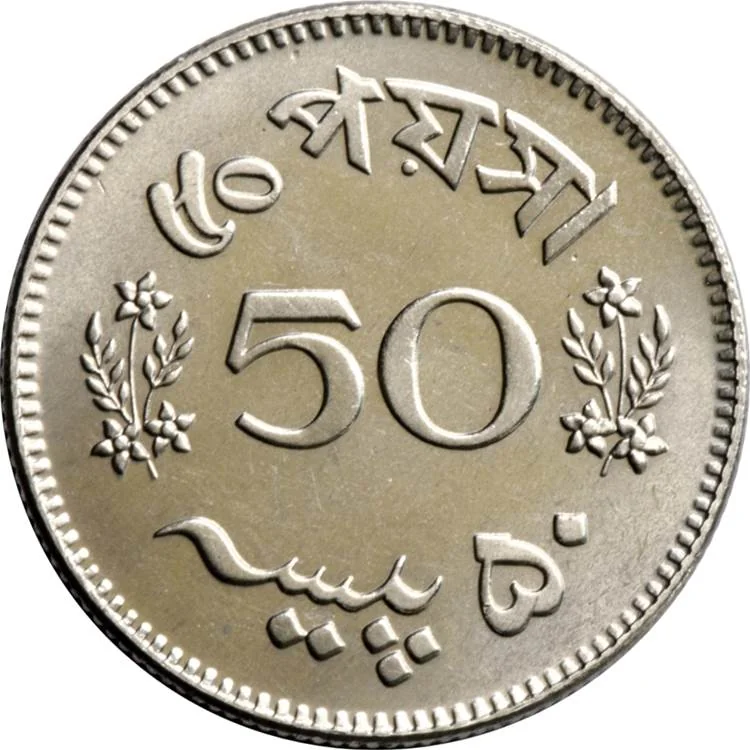
Pakistan
1964
Languages: Urdu/Arabic, Bengali
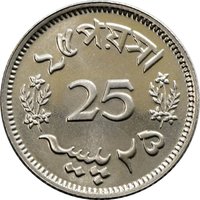
Reverse
Edge
Reeded
Mints
| Name | Mark |
|---|---|
| Lahore | — |
Mintings
| Year | Mint Mark | Mintage | Quality | Collection |
|---|---|---|---|---|
| 1963 | — | 8,110,000 | ||
| 1964 | — | — | ||
| 1965 | — | 8,980,000 | ||
| 1966 | — | 2,860,000 | ||
| 1968 | — | 2,252,000 | ||
| 1969 | — | 2,300,000 |
Historical background
In 1963, Pakistan's currency situation was characterized by stability and relative strength, operating under a fixed exchange rate system pegged to the British Pound Sterling within the broader framework of the Bretton Woods system. The Pakistani rupee was officially valued at 4.76 rupees to one U.S. dollar, a parity established in 1955 and maintained throughout this period. This stability was underpinned by conservative fiscal management during President Ayub Khan's era, a period often referred to as the "decade of development," which saw consistent economic growth and disciplined monetary policy from the State Bank of Pakistan.
The country's external accounts were in a manageable position, supported by healthy exports of primary commodities like jute, cotton, and leather. Furthermore, Pakistan was a significant recipient of foreign aid and loans from Western allies, particularly the United States, due to its membership in anti-communist pacts like CENTO and SEATO. This influx of capital helped bolster foreign exchange reserves and supported the fixed parity. There was no parallel black market for foreign currency of significant scale, as the official rate was generally viewed as credible and the exchange controls, while present, were not overly restrictive for legitimate trade.
However, this apparent stability masked underlying structural weaknesses. The economy remained largely agrarian and dependent on a few cash crops, making it vulnerable to terms of trade shocks. The industrial base, though growing, was nascent and protected by high tariffs. While the currency regime was stable in 1963, the pressures of financing development and a gradual shift in trade patterns would later challenge the fixed exchange rate, leading to a devaluation to 11.00 rupees per pound sterling (approximately 4.76 to the dollar was maintained) later in the decade in 1972, after the East Pakistan crisis. Thus, 1963 represents a point of calm before the economic and political storms that would reshape Pakistan's monetary landscape in the following years.
The country's external accounts were in a manageable position, supported by healthy exports of primary commodities like jute, cotton, and leather. Furthermore, Pakistan was a significant recipient of foreign aid and loans from Western allies, particularly the United States, due to its membership in anti-communist pacts like CENTO and SEATO. This influx of capital helped bolster foreign exchange reserves and supported the fixed parity. There was no parallel black market for foreign currency of significant scale, as the official rate was generally viewed as credible and the exchange controls, while present, were not overly restrictive for legitimate trade.
However, this apparent stability masked underlying structural weaknesses. The economy remained largely agrarian and dependent on a few cash crops, making it vulnerable to terms of trade shocks. The industrial base, though growing, was nascent and protected by high tariffs. While the currency regime was stable in 1963, the pressures of financing development and a gradual shift in trade patterns would later challenge the fixed exchange rate, leading to a devaluation to 11.00 rupees per pound sterling (approximately 4.76 to the dollar was maintained) later in the decade in 1972, after the East Pakistan crisis. Thus, 1963 represents a point of calm before the economic and political storms that would reshape Pakistan's monetary landscape in the following years.
🌱 Common