

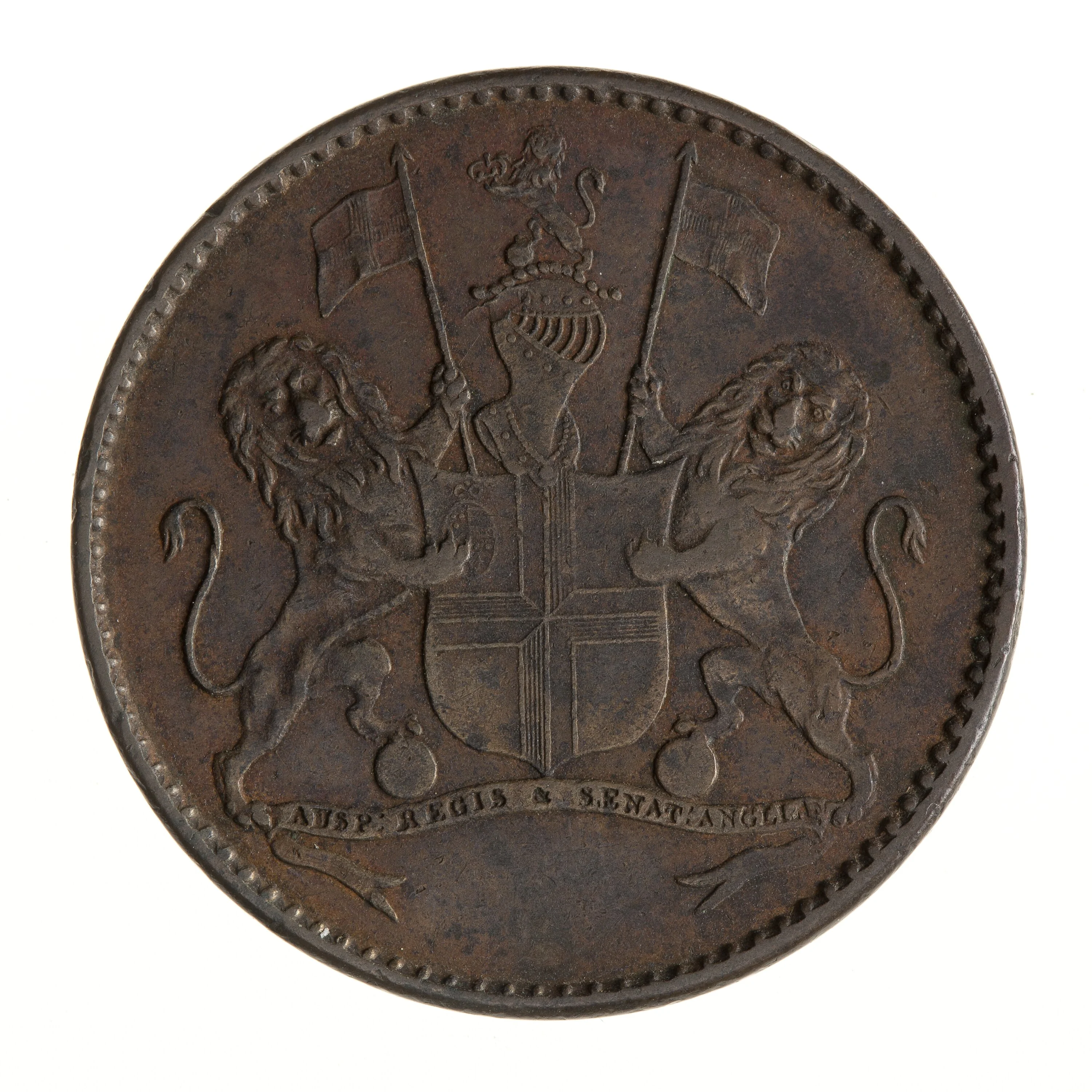
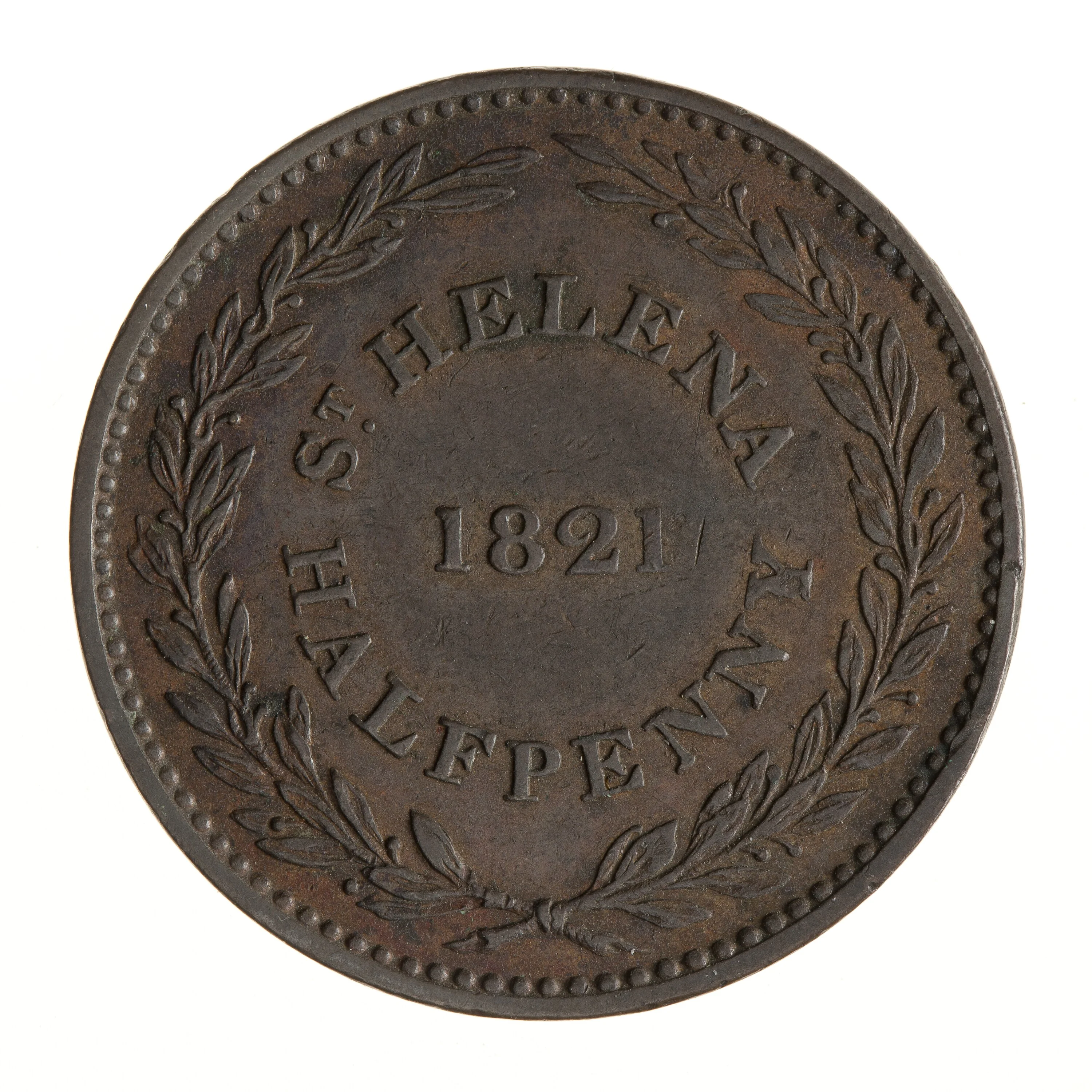
½ Penny – Saint Helena
United Kingdom
Context
Year: 1821
Country: United Kingdom 
Issuer: Saint Helena 
Ruler: George IV
Currency:
(1821—1970)
Demonetized: Yes
Material
References
KM: #Click to copy to clipboardA4
Numista: #18419
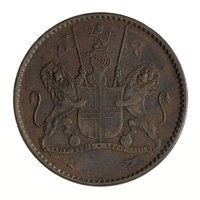
Obverse
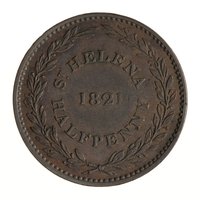
Reverse
Edge
Plain
Mints
| Name | Mark |
|---|---|
| Soho Mint | — |
Mintings
| Year | Mint Mark | Mintage | Quality | Collection |
|---|---|---|---|---|
| 1821 | — | — | ||
| 1821 | — | — | Proof |
Historical background
In 1821, Saint Helena, a remote British island in the South Atlantic, operated under a complex and often inadequate currency system typical of many imperial outposts. The island's economy, heavily reliant on the provisioning of ships, particularly those of the British East India Company which administered it, suffered from a chronic shortage of official coinage. While British pounds, shillings, and pence constituted the official currency, the physical supply of coins was insufficient for local trade. This scarcity was exacerbated by the island's isolation and the fact that much coinage was constantly drained away by departing ships and traders.
To fill this void, a variety of substitute currencies circulated alongside and sometimes in place of sterling. The most prominent was the Spanish dollar (or piece of eight), a silver coin that was a global trade currency in the 18th and early 19th centuries. These were often physically cut into smaller "bits" to make change. Furthermore, the East India Company issued its own paper notes and tokens for local use, and private promissory notes from reputable merchants also function as a medium of exchange. This created a messy monetary environment where transactions required constant calculation between different coin values and paper promises.
The situation was further complicated in 1821 by a significant historical event: the death of Napoleon Bonaparte, who had been exiled on the island since 1815. His presence from 1815 onward had temporarily injected money into the local economy through the expenditure of the British garrison guarding him and his small court. With his death in May 1821, this economic stimulus ceased, likely heightening the local sensitivity to currency shortages as the island returned to its normal, quieter state. Thus, the currency landscape of 1821 was one of transition, marked by an unreliable mix of imperial sterling, foreign coinage, and local paper, all set against the backdrop of a major shift in the island's economic circumstances.
To fill this void, a variety of substitute currencies circulated alongside and sometimes in place of sterling. The most prominent was the Spanish dollar (or piece of eight), a silver coin that was a global trade currency in the 18th and early 19th centuries. These were often physically cut into smaller "bits" to make change. Furthermore, the East India Company issued its own paper notes and tokens for local use, and private promissory notes from reputable merchants also function as a medium of exchange. This created a messy monetary environment where transactions required constant calculation between different coin values and paper promises.
The situation was further complicated in 1821 by a significant historical event: the death of Napoleon Bonaparte, who had been exiled on the island since 1815. His presence from 1815 onward had temporarily injected money into the local economy through the expenditure of the British garrison guarding him and his small court. With his death in May 1821, this economic stimulus ceased, likely heightening the local sensitivity to currency shortages as the island returned to its normal, quieter state. Thus, the currency landscape of 1821 was one of transition, marked by an unreliable mix of imperial sterling, foreign coinage, and local paper, all set against the backdrop of a major shift in the island's economic circumstances.
🌱 Fairly Common