

1 fen – People's Republic of China
Add to wishlist
China
Context
Years: 1955–2018
Country: China
Issuer: People's Republic of China
Period:
(since 1949)
Currency:
(since 1955)
Total mintage: 6,450,485
Material
References
KM: #
Numista: #1005
Value
Exchange value: 0.01 CNY
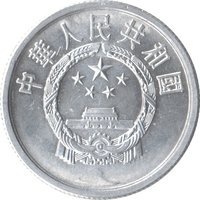
Obverse
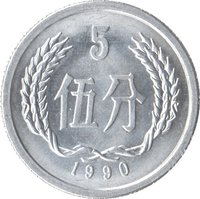
Reverse
Edge
Reeded
Mintings
| Year | Mint Mark | Mintage | Quality | Collection |
|---|---|---|---|---|
| 1955 | — | — | ||
| 1956 | — | — | ||
| 1957 | — | — | ||
| 1958 | — | — | ||
| 1959 | — | — | ||
| 1961 | — | — | ||
| 1963 | — | — | ||
| 1964 | — | — | ||
| 1971 | — | — | ||
| 1972 | — | — | ||
| 1973 | — | — | ||
| 1974 | — | — | ||
| 1975 | — | 500,000 | ||
| 1976 | — | — | ||
| 1977 | — | — | ||
| 1978 | — | — | ||
| 1979 | — | — | ||
| 1980 | — | — | ||
| 1980 | — | 10,000 | Proof | |
| 1981 | — | — | ||
| 1981 | — | 10,000 | Proof | |
| 1982 | — | — | ||
| 1982 | — | 10,000 | Proof | |
| 1983 | — | 2,412,000 | ||
| 1983 | — | 10,000 | Proof | |
| 1984 | — | 3,283,000 | ||
| 1984 | — | 10,000 | Proof | |
| 1985 | — | — | ||
| 1985 | — | 4,825 | Proof | |
| 1986 | — | — | ||
| 1986 | — | 660 | Proof | |
| 1987 | — | — | ||
| 1991 | — | — | ||
| 1991 | — | 20,000 | Proof | |
| 1992 | — | — | ||
| 1992 | — | 20,000 | Proof | |
| 1993 | — | — | In sets | |
| 1993 | — | 20,000 | Proof | |
| 1994 | — | — | In sets | |
| 1994 | — | 20,000 | Proof | |
| 1995 | — | — | In sets | |
| 1995 | — | 20,000 | Proof | |
| 1996 | — | — | In sets | |
| 1996 | — | 20,000 | Proof | |
| 1997 | — | — | ||
| 1997 | — | 20,000 | Proof | |
| 1998 | — | — | ||
| 1998 | — | 20,000 | Proof | |
| 1999 | — | 20,000 | Proof | |
| 1999 | — | — | ||
| 2000 | — | — | ||
| 2000 | — | 20,000 | Proof | |
| 2005 | — | — | ||
| 2006 | — | — | ||
| 2007 | — | — | ||
| 2008 | — | — | ||
| 2009 | — | — | ||
| 2010 | — | — | ||
| 2011 | — | — | ||
| 2012 | — | — | ||
| 2013 | — | — | ||
| 2015 | — | — | ||
| 2017 | — | — | ||
| 2018 | — | — |
Historical background
In 1955, the People's Republic of China enacted a critical monetary reform to stabilize its economy and consolidate the new socialist state. Following the civil war and the early years of Communist rule, the currency system was chaotic, with hyperinflation inherited from the Kuomintang era still lingering. The first renminbi (or "People's Currency"), issued in 1948, had faced severe devaluation, and prices were often calculated in tens of thousands of yuan for basic goods, undermining public confidence and economic planning.
The reform, announced on February 21, 1955, introduced a new renminbi at an exchange rate of 1:10,000, replacing the old currency. This re-denomination effectively removed four zeros from prices, simplifying transactions and accounting. The primary objectives were to halt inflation, unify the monetary system across the nation (replacing various local and regional notes still in circulation), and strengthen the central government's control over the financial system as part of the broader First Five-Year Plan's push for centralized economic management.
This successful currency swap, completed with minimal disruption, was a foundational step in establishing monetary stability for China's planned economy. It restored public trust in the national currency, facilitated state control over wages and prices, and provided a stable unit of account for the industrialization drive. The 1955 reform created the basic decimal structure of the renminbi (with the yuan as the primary unit) that endures today, marking the end of the post-war inflationary period and aligning the monetary system with the needs of the socialist state.
The reform, announced on February 21, 1955, introduced a new renminbi at an exchange rate of 1:10,000, replacing the old currency. This re-denomination effectively removed four zeros from prices, simplifying transactions and accounting. The primary objectives were to halt inflation, unify the monetary system across the nation (replacing various local and regional notes still in circulation), and strengthen the central government's control over the financial system as part of the broader First Five-Year Plan's push for centralized economic management.
This successful currency swap, completed with minimal disruption, was a foundational step in establishing monetary stability for China's planned economy. It restored public trust in the national currency, facilitated state control over wages and prices, and provided a stable unit of account for the industrialization drive. The 1955 reform created the basic decimal structure of the renminbi (with the yuan as the primary unit) that endures today, marking the end of the post-war inflationary period and aligning the monetary system with the needs of the socialist state.
🌱 Very Common