

100 Kuna (Zagreb Diocese and the City of Zagreb) – Croatia
Non-circulating coins
Commemoration: 900th Anniversary of the Zagreb Diocese and the City of Zagreb
Croatia
Context
Material
References
KM: #Click to copy to clipboard25.1
Numista: #100482
Value
Exchange value: 100 HRK
Bullion value: $43.43
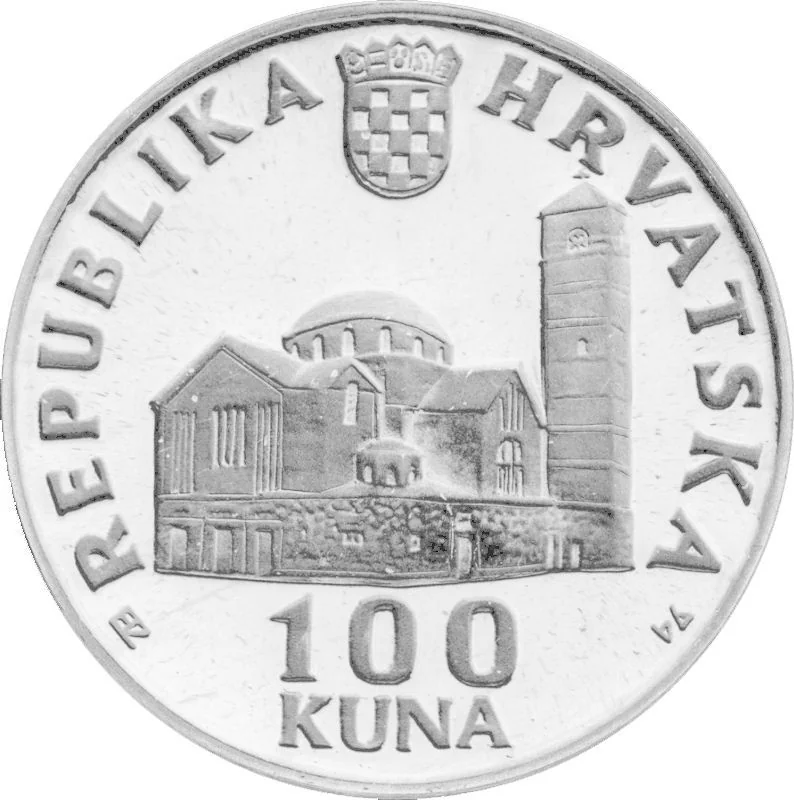
Obverse
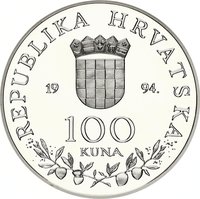
Description:
Saint Blaise Church: centrally located, split by affiliation and denomination.
Inscription:
REPUBLIKA HRVATSKA
100
KUNA
100
KUNA
Translation:
REPUBLIC OF CROATIA
100
KUNAS
100
KUNAS
Script: Latin
Language: Croatian
Designer: Zdravko Brkić
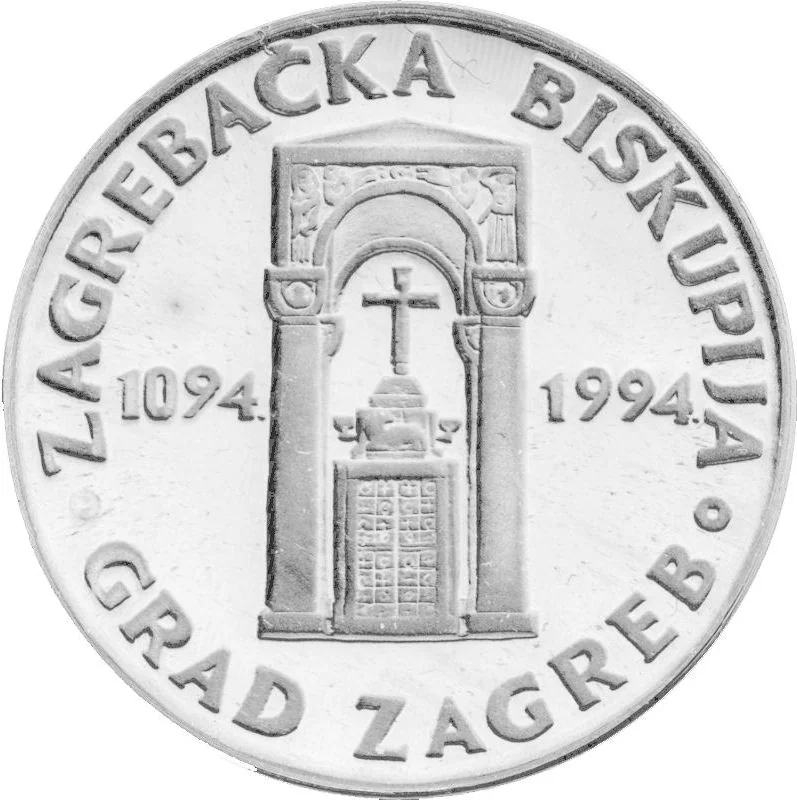
Reverse
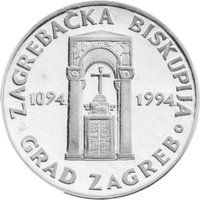
Description:
Altar dividing dates in Saint Blaise Church.
Inscription:
ZAGREBAČKA BISKUPIJA
1094. 1994.
GRAD ZAGREB
1094. 1994.
GRAD ZAGREB
Translation:
Zagreb Bishopric
1094. 1994.
City of Zagreb
1094. 1994.
City of Zagreb
Script: Latin
Designer: Zdravko Brkić
Edge
Reeded
Categories
| Building> Religious building |
Mintings
| Year | Mint Mark | Mintage | Quality | Collection |
|---|---|---|---|---|
| 1994 | — | 3,000 | Proof |
Historical background
In 1994, Croatia was in the midst of a complex and turbulent currency situation, deeply shaped by the aftermath of the Homeland War and the collapse of the Yugoslav monetary system. The country had introduced the Croatian dinar as a transitional currency in 1991, but it suffered from severe instability. Hyperinflation, a legacy from the former Yugoslavia, reached catastrophic levels, eroding savings and destabilizing the economy. This period was characterized by a reliance on the Deutsche Mark as a de facto parallel currency for savings and large transactions, highlighting a profound lack of confidence in the domestic monetary unit.
Recognizing the crisis, the government under Prime Minister Nikica Valentić launched a pivotal stabilization program on October 3, 1994. The cornerstone of this program was the introduction of a new, strong currency—the kuna—named after a historic Croatian unit, though its official launch was set for 1995. As an immediate interim step, the Croatian dinar was sharply revalued, with one new dinar declared equal to 1,000 old dinars. This drastic move, coupled with tight fiscal and monetary policies, was designed to halt hyperinflation in its tracks and restore basic monetary control.
The 1994 reforms were a decisive turning point, setting the stage for the successful introduction of the kuna in May 1995. The stabilization program, though initially causing a sharp recession, successfully anchored prices and ended the hyperinflationary spiral. By establishing a credible path toward a permanent national currency, the government laid the essential groundwork for Croatia's subsequent economic recovery and integration into the European financial system, a process that would ultimately lead to the adoption of the euro in 2023.
Recognizing the crisis, the government under Prime Minister Nikica Valentić launched a pivotal stabilization program on October 3, 1994. The cornerstone of this program was the introduction of a new, strong currency—the kuna—named after a historic Croatian unit, though its official launch was set for 1995. As an immediate interim step, the Croatian dinar was sharply revalued, with one new dinar declared equal to 1,000 old dinars. This drastic move, coupled with tight fiscal and monetary policies, was designed to halt hyperinflation in its tracks and restore basic monetary control.
The 1994 reforms were a decisive turning point, setting the stage for the successful introduction of the kuna in May 1995. The stabilization program, though initially causing a sharp recession, successfully anchored prices and ended the hyperinflationary spiral. By establishing a credible path toward a permanent national currency, the government laid the essential groundwork for Croatia's subsequent economic recovery and integration into the European financial system, a process that would ultimately lead to the adoption of the euro in 2023.
✨ Legendary