

10 Cents – Mauritius
Mauritius
Context
Years: 1954–1978
Issuer: Mauritius 
Ruler: Elizabeth II
Currency:
(since 1835)
Demonetized: Yes
Total mintage: 22,290,018
Material
Diameter: 23.5 mm
Weight: 5.15 g
Thickness: 1.5 mm
Shape: Scalloped
Composition: Copper-nickel
Technique: Milled
Alignment: Medal alignment
flip
References
KM: #Click to copy to clipboard33
Numista: #1833
Value
Exchange value: 0.10 MUR
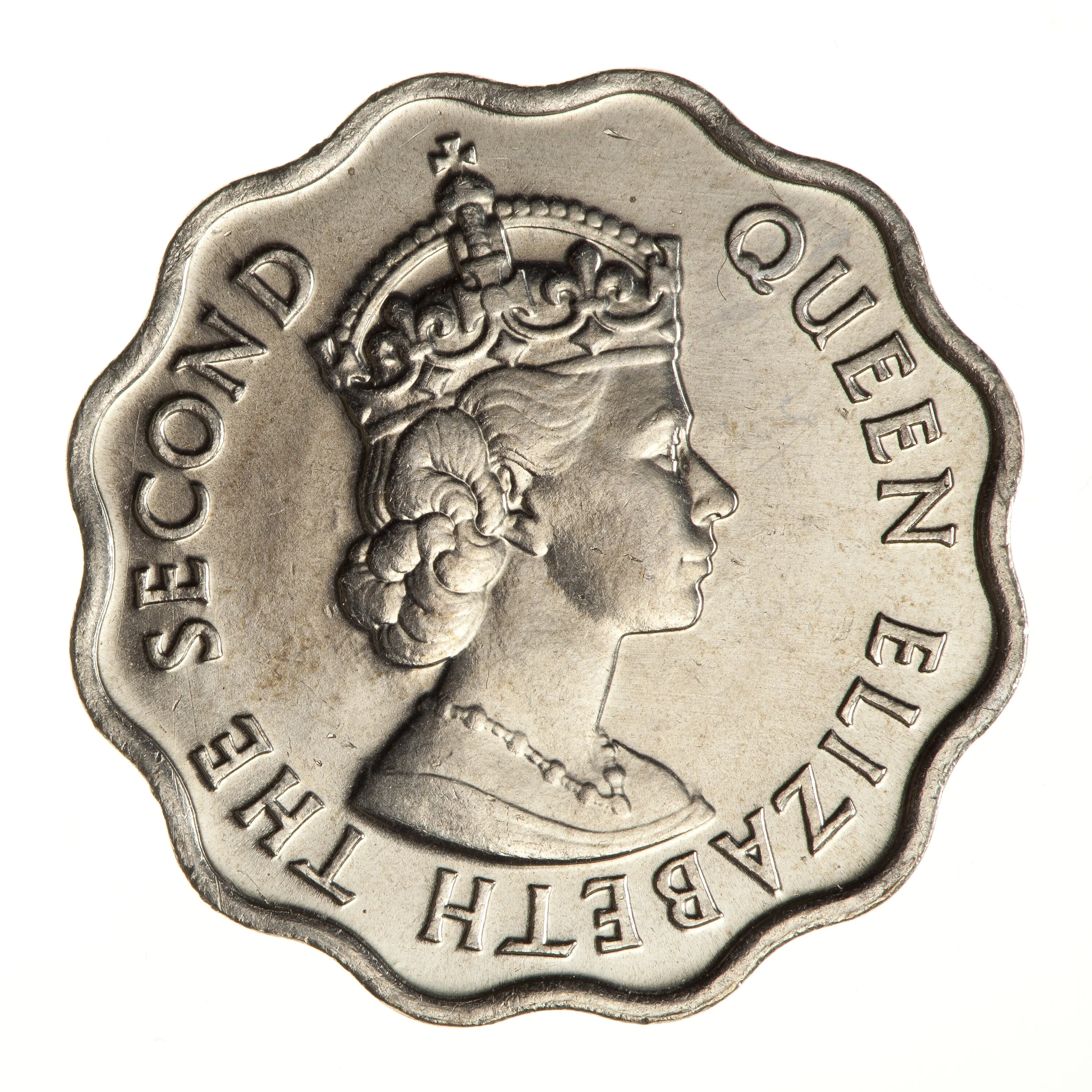
Obverse
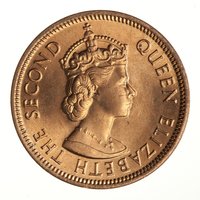
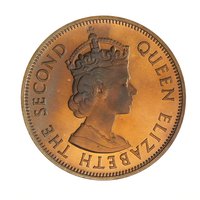
Description:
Crowned head facing right.
Inscription:
QUEEN ELIZABETH THE SECOND
Script: Latin
Engraver: Cecil Thomas
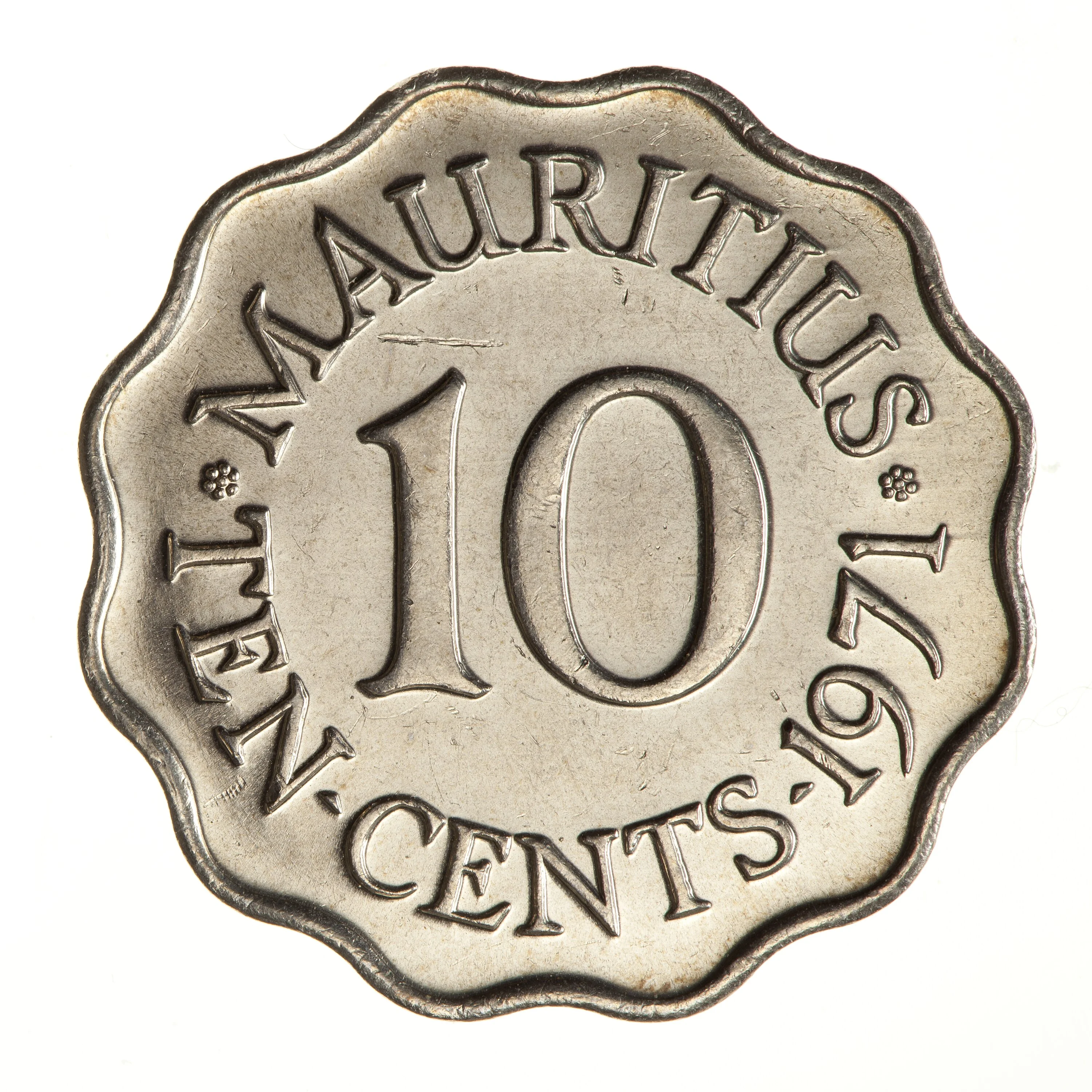
Reverse
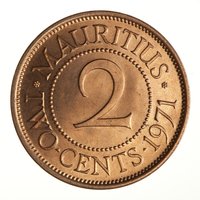
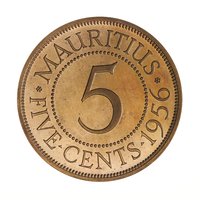
Description:
Lettering encircles the central value.
Inscription:
*MAURITIUS*
10
TEN·CENTS·1975
10
TEN·CENTS·1975
Script: Latin
Edge
Plain
Mints
| Name | Mark |
|---|---|
| Royal Mint (Tower Hill) | — |
| Royal Mint | — |
Mintings
| Year | Mint Mark | Mintage | Quality | Collection |
|---|---|---|---|---|
| 1954 | — | 252,000 | ||
| 1954 | — | — | Proof | |
| 1957 | — | 250,000 | ||
| 1959 | — | — | Proof | |
| 1959 | — | 253,000 | ||
| 1960 | — | 50,000 | ||
| 1960 | — | — | Proof | |
| 1963 | — | 200,000 | ||
| 1963 | — | — | Proof | |
| 1964 | — | 200,000 | ||
| 1965 | — | 200,000 | ||
| 1966 | — | 200,000 | ||
| 1969 | — | 200,000 | ||
| 1970 | — | 500,000 | ||
| 1971 | — | 750 | Proof | |
| 1971 | — | 300,000 | ||
| 1975 | — | 6,675,000 | ||
| 1978 | — | 13,000,000 | ||
| 1978 | — | 9,268 | Proof |
Historical background
In 1954, the currency situation in Mauritius was defined by its colonial status and a dual-system of legal tender. The island was a British Crown Colony, and its official currency was the Mauritian Rupee (MUR), which was pegged to and managed in relation to the British Pound Sterling. This peg provided monetary stability and facilitated trade with the United Kingdom, the dominant economic partner. However, alongside the Mauritian Rupee, the Indian Rupee (INR) also circulated widely and was accepted as legal tender for domestic transactions, a legacy of the large Indian indentured labourer population and strong commercial ties with India.
This dual-currency system reflected the island's socio-economic composition and trade patterns. The Indian Rupee's prevalence was particularly strong in rural areas and among the sugar estate workers, who comprised a significant portion of the population. The coexistence of two currencies, however, introduced complexities for accounting, pricing, and banking. The exchange rate between the two rupees was not fixed by law but was determined by market forces and the relative stability of their respective anchor currencies (Sterling for the MUR, and Sterling's own relationship with the INR).
The year 1954 fell within a period of gradual transition towards a unified and independent monetary system. Pressure was building to resolve the practical inefficiencies of the dual system. This would culminate, just a few years later in 1959, with the demonetization of the Indian Rupee in Mauritius, making the Mauritian Rupee the sole legal tender. This move was a crucial step in asserting the colony's distinct financial identity and simplifying its economy on the eve of the political independence that would follow in 1968.
This dual-currency system reflected the island's socio-economic composition and trade patterns. The Indian Rupee's prevalence was particularly strong in rural areas and among the sugar estate workers, who comprised a significant portion of the population. The coexistence of two currencies, however, introduced complexities for accounting, pricing, and banking. The exchange rate between the two rupees was not fixed by law but was determined by market forces and the relative stability of their respective anchor currencies (Sterling for the MUR, and Sterling's own relationship with the INR).
The year 1954 fell within a period of gradual transition towards a unified and independent monetary system. Pressure was building to resolve the practical inefficiencies of the dual system. This would culminate, just a few years later in 1959, with the demonetization of the Indian Rupee in Mauritius, making the Mauritian Rupee the sole legal tender. This move was a crucial step in asserting the colony's distinct financial identity and simplifying its economy on the eve of the political independence that would follow in 1968.
🌱 Very Common