

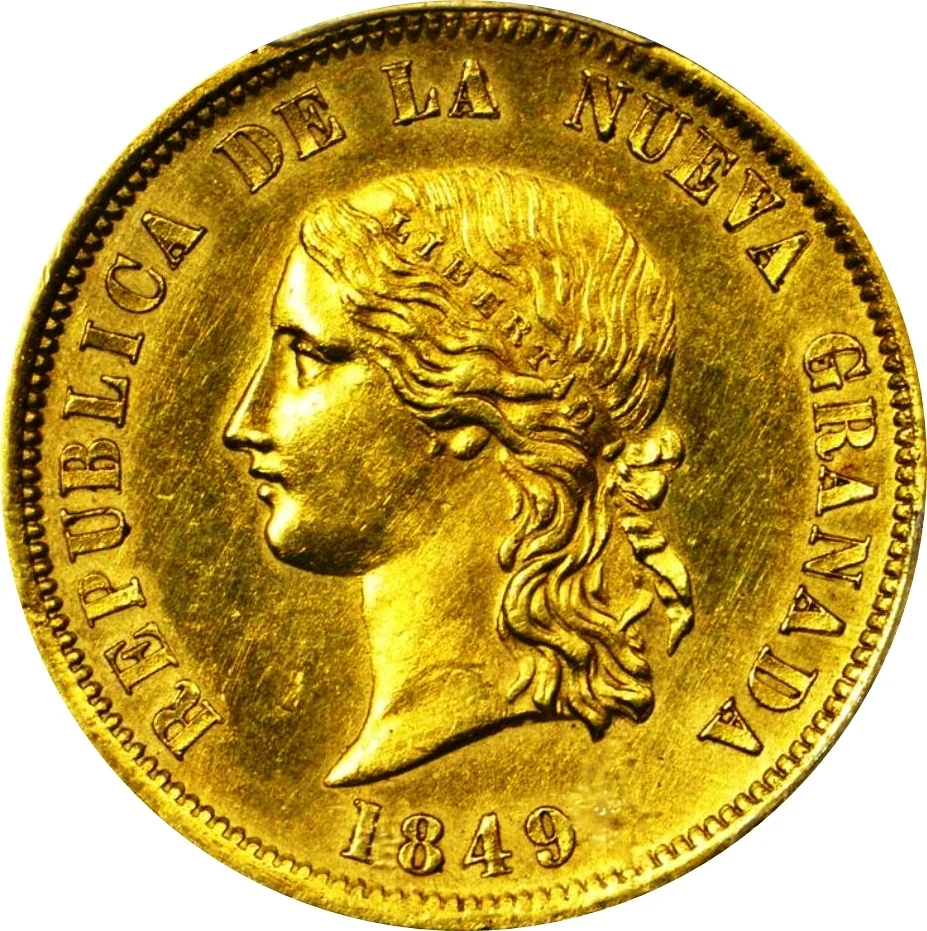
Obverse
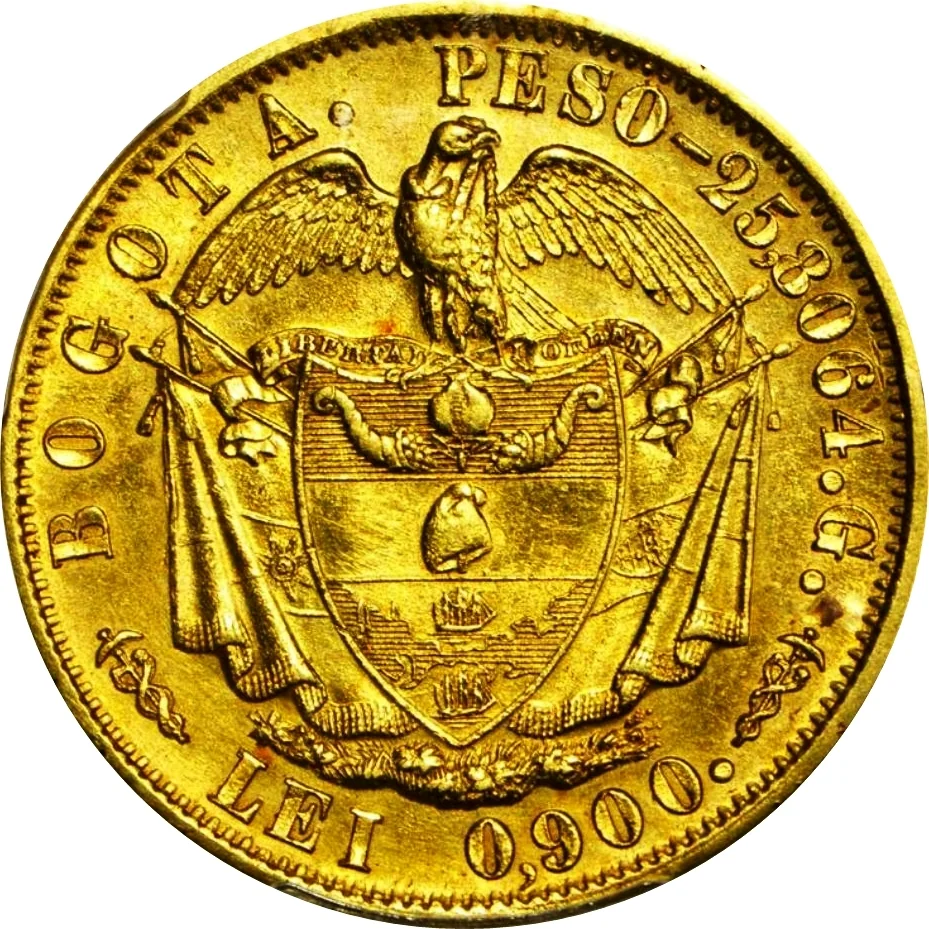
Reverse
Description:
Shield held by a condor, flanked by flags.
Inscription:
BOGOTA. PESO-25,8064.G.
LEI 0,900
LEI 0,900
Script: Latin
Edge
Categories
| Symbol> Allegory |
| Symbols> Coat of Arms |
Mintings
| Year | Mint Mark | Mintage | Quality | Collection |
|---|---|---|---|---|
| 1848 | — | — | ||
| 1849 | — | — | ||
| 1850 | — | — | ||
| 1851 | — | — | ||
| 1852 | — | — | ||
| 1853 | — | — |
Historical background
In 1848, Colombia was navigating a complex and fragmented monetary landscape as the Republic of New Granada. Following the dissolution of Gran Colombia in 1831, the nation inherited a chaotic currency system characterized by a severe shortage of circulating coinage. The economy relied on a confusing mix of foreign coins—primarily British sovereigns, French francs, and Spanish colonial reales—alongside a limited supply of domestically minted silver and gold coins. This lack of a uniform, state-controlled currency stifled commerce and state finances, as transactions required constant calculation of exchange rates between various metallic contents and origins.
The administration of President Tomás Cipriano de Mosquera (1845-1849) recognized this instability as a major obstacle to economic modernization and national cohesion. His liberal government sought to assert central authority and promote export-led growth, which demanded a more reliable monetary system. Consequently, a significant reform was enacted in 1847 with the establishment of the Banco de la Nueva Granada, the country's first official bank, granted the privilege to issue paper money. This marked a pivotal shift, introducing banknotes intended to supplement and streamline the scarce metallic circulation.
However, the currency situation in 1848 remained one of transition and public skepticism. The new paper pesos, while a revolutionary step, were not yet legal tender and circulated alongside the pre-existing mosaic of foreign and domestic coins. Public trust in this novel fiat money was limited, and its acceptance was largely confined to major commercial centers like Bogotá. Thus, 1848 represents a critical juncture where Colombia's leaders actively confronted monetary disorder with modern banking tools, yet the practical reality for most citizens was still one of a heterogeneous and imperfect monetary system awaiting full integration and acceptance.
The administration of President Tomás Cipriano de Mosquera (1845-1849) recognized this instability as a major obstacle to economic modernization and national cohesion. His liberal government sought to assert central authority and promote export-led growth, which demanded a more reliable monetary system. Consequently, a significant reform was enacted in 1847 with the establishment of the Banco de la Nueva Granada, the country's first official bank, granted the privilege to issue paper money. This marked a pivotal shift, introducing banknotes intended to supplement and streamline the scarce metallic circulation.
However, the currency situation in 1848 remained one of transition and public skepticism. The new paper pesos, while a revolutionary step, were not yet legal tender and circulated alongside the pre-existing mosaic of foreign and domestic coins. Public trust in this novel fiat money was limited, and its acceptance was largely confined to major commercial centers like Bogotá. Thus, 1848 represents a critical juncture where Colombia's leaders actively confronted monetary disorder with modern banking tools, yet the practical reality for most citizens was still one of a heterogeneous and imperfect monetary system awaiting full integration and acceptance.
✨ Legendary