

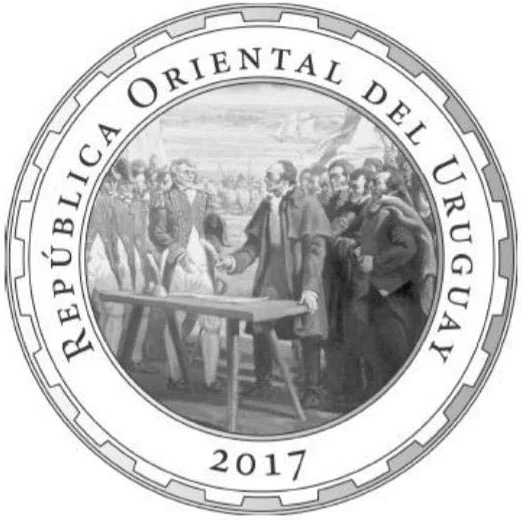
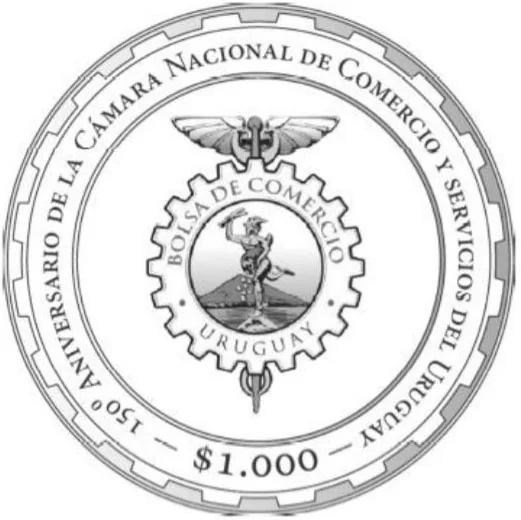
1000 pesos uruguayos (Chamber of Commerce) – Uruguay
Add to wishlist
Circulating commemorative coins
Commemoration: 150th. Anniversary of Chamber of Commerce
Uruguay
Obverse
Reverse
Description:
Central logo, encircled by event details, with value beneath.
Inscription:
150º Aniversario de la Cámara Nacional de Comercio y Servicios del Uruguay
BOLSA DE COMERCIO
URUGUAY
$ 1.000
BOLSA DE COMERCIO
URUGUAY
$ 1.000
Translation:
150th Anniversary of the National Chamber of Commerce and Services of Uruguay
STOCK EXCHANGE
URUGUAY
$ 1,000
STOCK EXCHANGE
URUGUAY
$ 1,000
Script: Latin
Language: Spanish
Edge
Plain
Categories
| Art> Painting |
| Person> Politician |
| Commerce |
Mints
| Name | Mark |
|---|---|
| Mint of Poland | — |
Mintings
| Year | Mint Mark | Mintage | Quality | Collection |
|---|---|---|---|---|
| 2017 | — | 1,500 | Proof |
Historical background
In 2017, Uruguay's currency situation was characterized by a period of relative stability and moderate depreciation of the Uruguayan peso (UYU) against the US dollar, following a period of significant volatility in the preceding years. The exchange rate closed the year at approximately 28.7 pesos per dollar, representing a gradual depreciation of about 8% over the course of the year. This controlled weakening was largely managed by the Central Bank of Uruguay (BCU), which had moved away from direct intervention in the foreign exchange market and instead utilized interest rate policy as its primary tool to influence currency flows and contain inflationary pressures.
The economic context for this stability was mixed. While the country continued to face challenges such as a fiscal deficit and inflation persistently above the target range (ending the year at 6.2%), key export sectors like beef, soy, and cellulose remained strong, providing a steady inflow of US dollars. Furthermore, the BCU maintained a substantial level of international reserves, which provided a crucial buffer against external shocks and helped bolster confidence in the peso. This environment allowed the "crawling peg" exchange rate regime to function without major disruptions, permitting a predictable, gradual adjustment.
Overall, 2017 was a year of consolidation for Uruguay's currency, marked by the absence of the sharp swings seen earlier in the decade. The managed depreciation helped maintain the competitiveness of exports, which was vital for the small, open economy. However, underlying structural issues, including the fiscal imbalance and above-target inflation, continued to pose longer-term challenges for monetary and exchange rate policy, setting the stage for ongoing policy debates in the years that followed.
The economic context for this stability was mixed. While the country continued to face challenges such as a fiscal deficit and inflation persistently above the target range (ending the year at 6.2%), key export sectors like beef, soy, and cellulose remained strong, providing a steady inflow of US dollars. Furthermore, the BCU maintained a substantial level of international reserves, which provided a crucial buffer against external shocks and helped bolster confidence in the peso. This environment allowed the "crawling peg" exchange rate regime to function without major disruptions, permitting a predictable, gradual adjustment.
Overall, 2017 was a year of consolidation for Uruguay's currency, marked by the absence of the sharp swings seen earlier in the decade. The managed depreciation helped maintain the competitiveness of exports, which was vital for the small, open economy. However, underlying structural issues, including the fiscal imbalance and above-target inflation, continued to pose longer-term challenges for monetary and exchange rate policy, setting the stage for ongoing policy debates in the years that followed.
💎 Extremely Rare