

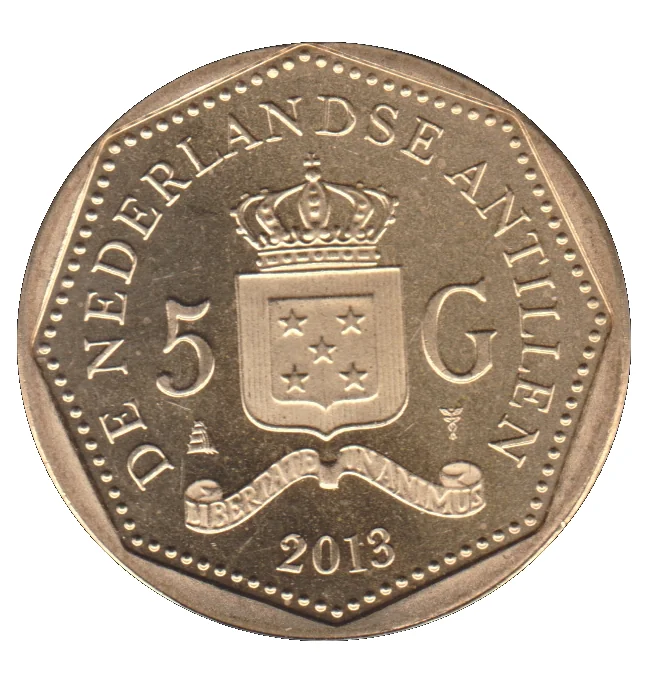
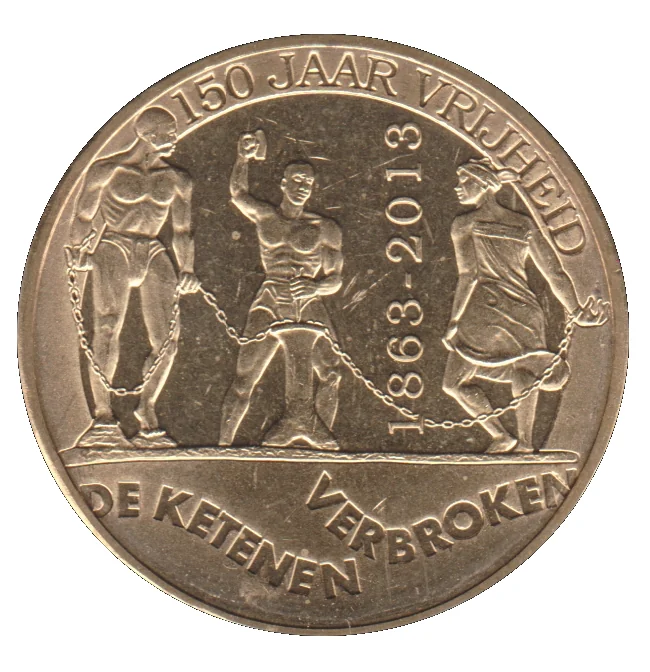
5 gulden (Abolition of Slavery and Freedom in the former Dutch West-Indies) – Netherlands Antilles
Add to wishlist
Circulating commemorative coins
Commemoration: 150 years Abolition of Slavery and 150 years Freedom in the former Dutch West-Indies
Netherlands
Context
Year: 2013
Country: Netherlands
Issuer: Netherlands Antilles
Ruler: Beatrix
Currency:
(since 1828)
Demonetization: 31 March 2025
Total mintage: 25,000
Material
References
Numista: #182490
Value
Exchange value: 5 ANG
Inflation-adjusted value: 6.73 ANG
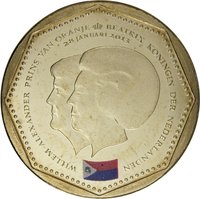
Obverse
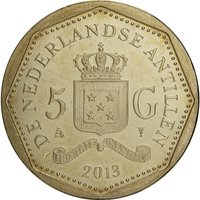
Reverse
Edge
Mints
| Name | Mark |
|---|---|
| Royal Dutch Mint | — |
Mintings
| Year | Mint Mark | Mintage | Quality | Collection |
|---|---|---|---|---|
| 2013 | — | 25,000 |
Historical background
In 2013, the currency situation in the Netherlands Antilles was defined by transition and duality. Following the dissolution of the Netherlands Antilles as a unified country in 2010, the islands of Curaçao and Sint Maarten became autonomous countries within the Kingdom of the Netherlands, while Bonaire, Saba, and Sint Eustatius became special municipalities of the Netherlands. Despite this political change, the currency union established in 1940 remained formally intact for the time being. All five islands continued to use the Netherlands Antillean guilder (ANG), which was pegged to the US dollar at a fixed rate of 1.79 ANG = 1 USD, a peg that had provided notable monetary stability for decades.
However, the post-2010 constitutional structure created a fundamental divergence in monetary policy trajectories. Curaçao and Sint Maarten, as autonomous countries, were obligated under the Charter of the Kingdom to introduce a new common currency, the Caribbean guilder, to replace the ANG. This process was repeatedly delayed, with 2013 being another year where the target date was pushed back due to technical and legislative complexities. Meanwhile, the Caribbean Netherlands islands (Bonaire, Saba, and Sint Eustatius) had officially adopted the US dollar as their legal tender in 2011, completing their transition away from the ANG.
Thus, throughout 2013, the currency landscape was characterized by a waiting game. Curaçao and Sint Maarten operated under the existing ANG system while preparing for an uncertain future switch, and the Caribbean Netherlands functioned fully on the US dollar. This period highlighted the practical challenges of unwinding a long-standing currency union and set the stage for the continued delays that would see the Netherlands Antillean guilder remain in use in Curaçao and Sint Maarten for years beyond 2013.
However, the post-2010 constitutional structure created a fundamental divergence in monetary policy trajectories. Curaçao and Sint Maarten, as autonomous countries, were obligated under the Charter of the Kingdom to introduce a new common currency, the Caribbean guilder, to replace the ANG. This process was repeatedly delayed, with 2013 being another year where the target date was pushed back due to technical and legislative complexities. Meanwhile, the Caribbean Netherlands islands (Bonaire, Saba, and Sint Eustatius) had officially adopted the US dollar as their legal tender in 2011, completing their transition away from the ANG.
Thus, throughout 2013, the currency landscape was characterized by a waiting game. Curaçao and Sint Maarten operated under the existing ANG system while preparing for an uncertain future switch, and the Caribbean Netherlands functioned fully on the US dollar. This period highlighted the practical challenges of unwinding a long-standing currency union and set the stage for the continued delays that would see the Netherlands Antillean guilder remain in use in Curaçao and Sint Maarten for years beyond 2013.
⭐ Rare