

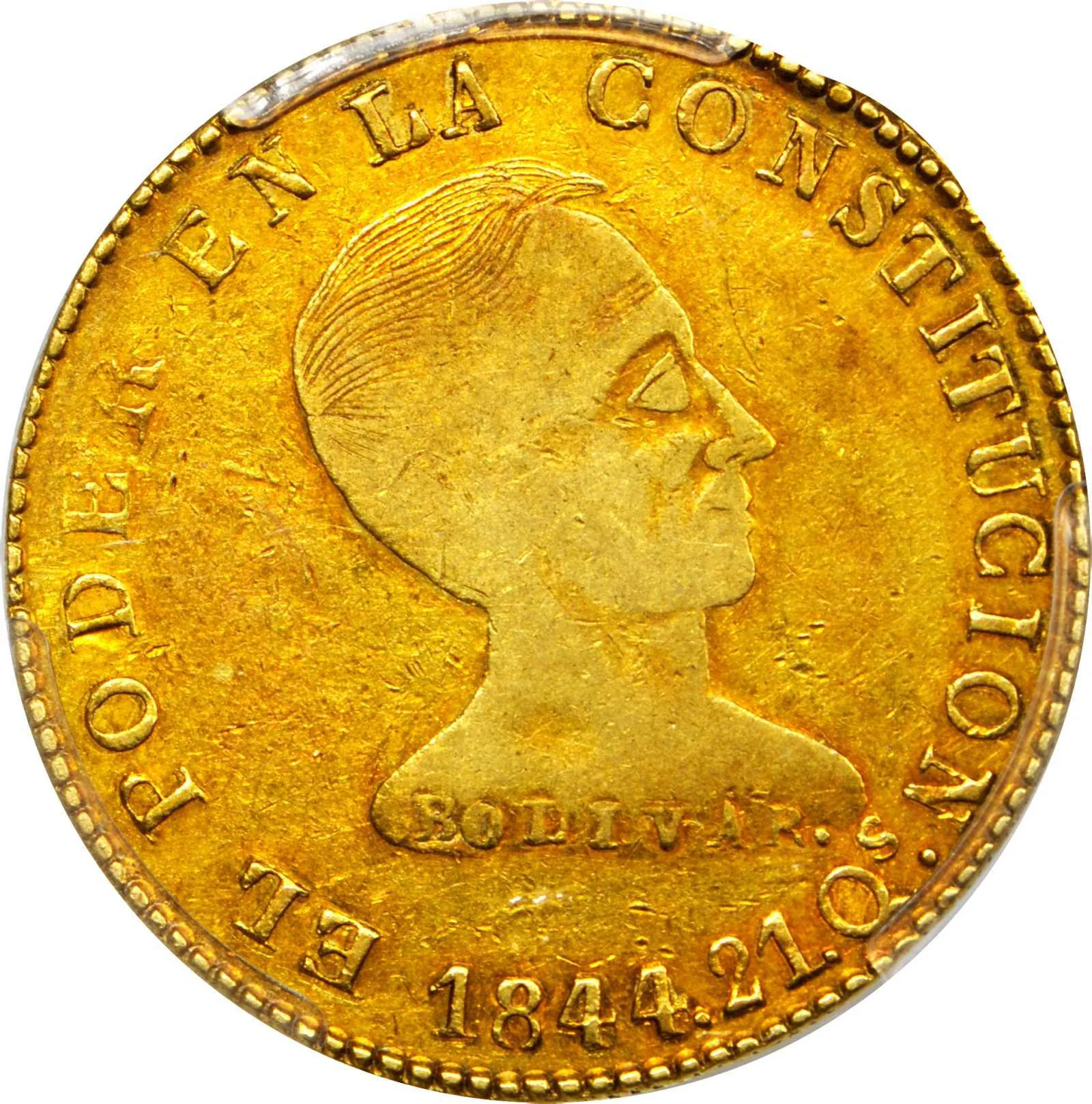
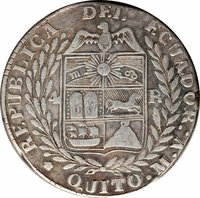
Obverse
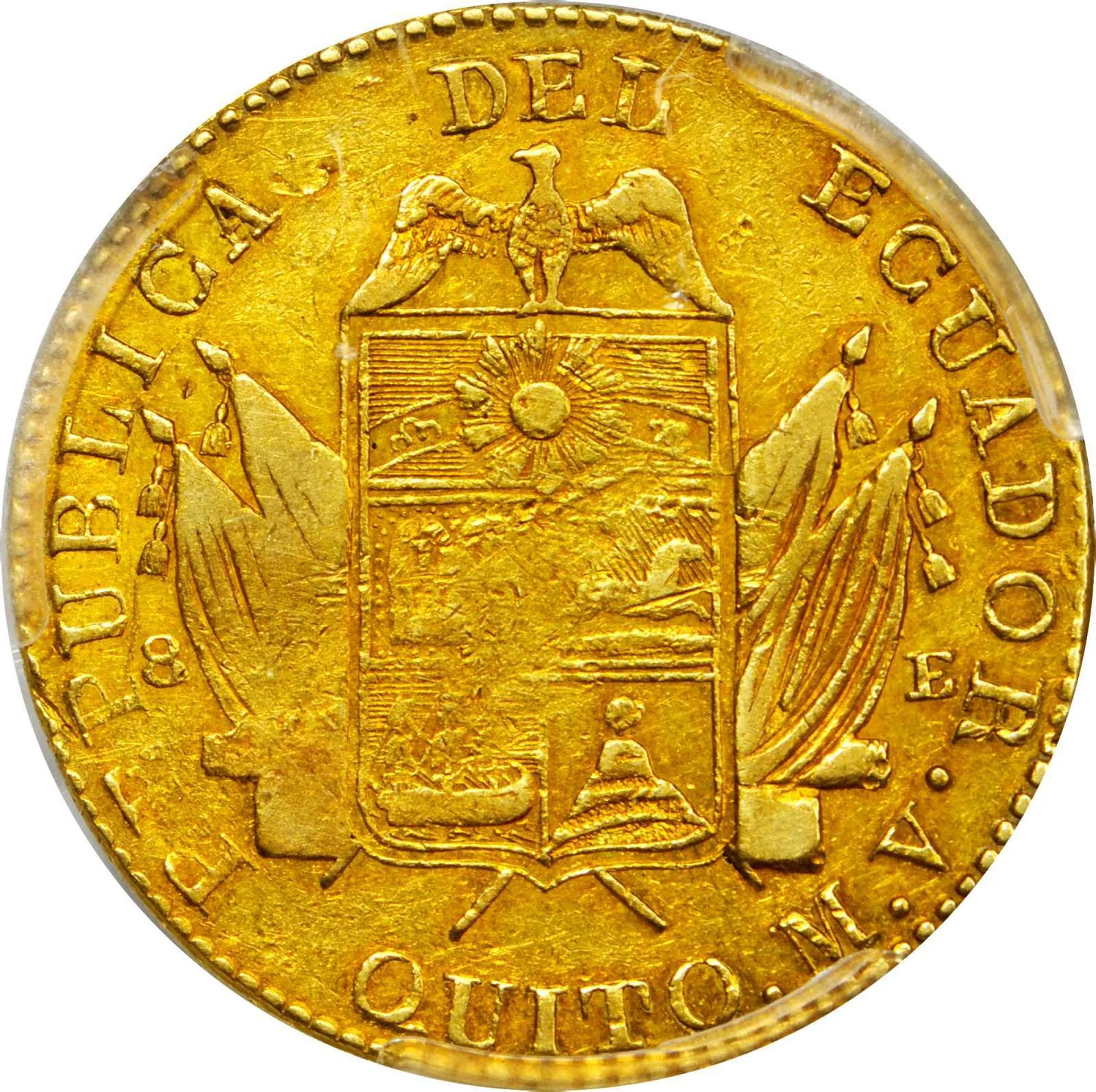
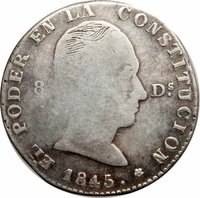
Reverse
Edge
Mintings
| Year | Mint Mark | Mintage | Quality | Collection |
|---|---|---|---|---|
| 1844 | 8E | — |
Historical background
In 1844, Ecuador's currency situation was a direct and chaotic legacy of its recent independence and the collapse of Spanish colonial monetary authority. The nation lacked a unified, state-issued currency. Instead, the economy operated on a complex and unreliable system of multiple coinages, primarily consisting of clipped and worn Spanish colonial silver reales and a limited circulation of gold escudos. The most significant and problematic foreign coin in circulation was the Colombian peso, a debased silver coin from the dissolved Gran Colombia federation (1822-1830), which continued to circulate widely at a value higher than its intrinsic metal content, distorting trade and causing public distrust.
This monetary anarchy created severe economic instability. The coexistence of coins of varying weight, purity, and origin facilitated widespread fraud, such as clipping and counterfeiting. Furthermore, the government's chronic fiscal deficits, driven by internal conflicts and a weak administrative structure, led it to repeatedly manipulate the official valuation (tasa) of these coins by decree in a desperate attempt to raise seigniorage revenue. These arbitrary revaluations, rather than stabilizing the system, only generated more confusion, market disruption, and loss of confidence, as the legal value of a coin could change suddenly and without economic basis.
Consequently, the year 1844 fell within a prolonged period of monetary disorder that stifled economic development and complicated both domestic and international commerce. The fundamental issues—the absence of a sovereign mint, reliance on debased foreign coin, and the use of monetary policy as a short-term fiscal tool—remained unresolved. This unstable environment would persist until the government of President Gabriel García Moreno finally established a national mint (the Casa de la Moneda de Quito) and introduced a decimal-based national currency, the sucre, in 1856, imposing a much-needed order on the financial system.
This monetary anarchy created severe economic instability. The coexistence of coins of varying weight, purity, and origin facilitated widespread fraud, such as clipping and counterfeiting. Furthermore, the government's chronic fiscal deficits, driven by internal conflicts and a weak administrative structure, led it to repeatedly manipulate the official valuation (tasa) of these coins by decree in a desperate attempt to raise seigniorage revenue. These arbitrary revaluations, rather than stabilizing the system, only generated more confusion, market disruption, and loss of confidence, as the legal value of a coin could change suddenly and without economic basis.
Consequently, the year 1844 fell within a prolonged period of monetary disorder that stifled economic development and complicated both domestic and international commerce. The fundamental issues—the absence of a sovereign mint, reliance on debased foreign coin, and the use of monetary policy as a short-term fiscal tool—remained unresolved. This unstable environment would persist until the government of President Gabriel García Moreno finally established a national mint (the Casa de la Moneda de Quito) and introduced a decimal-based national currency, the sucre, in 1856, imposing a much-needed order on the financial system.
✨ Legendary