

5 shillings – Uganda
Add to wishlist
Circulating commemorative coins
Commemoration: FAO
Uganda
Context
Year: 1968
Issuer: Uganda
Issuing organization: Bank of Uganda
Period:
(since 1962)
Currency:
(1966—1987)
Demonetized: Yes
Total mintage: 105,000
Material
References
KM: #
Numista: #10037
Value
Exchange value: 5 UGS
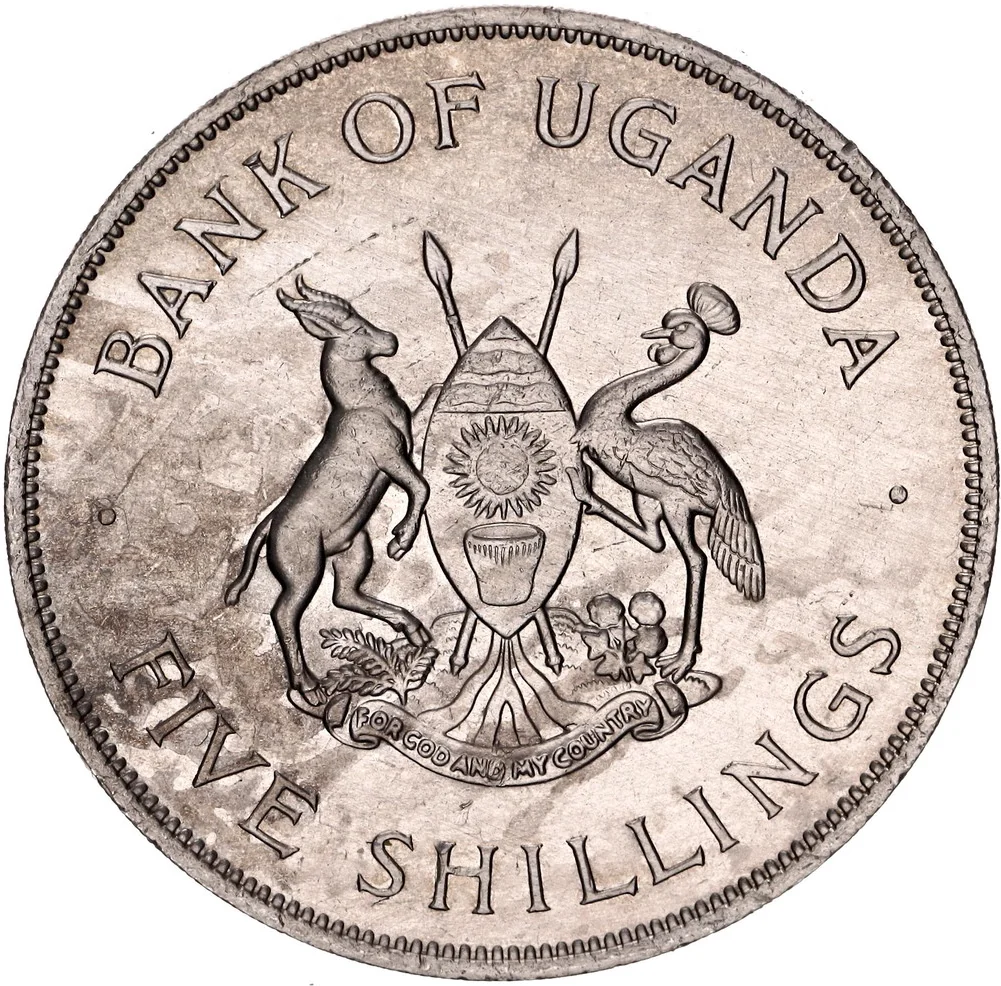
Obverse
Reverse
Description:
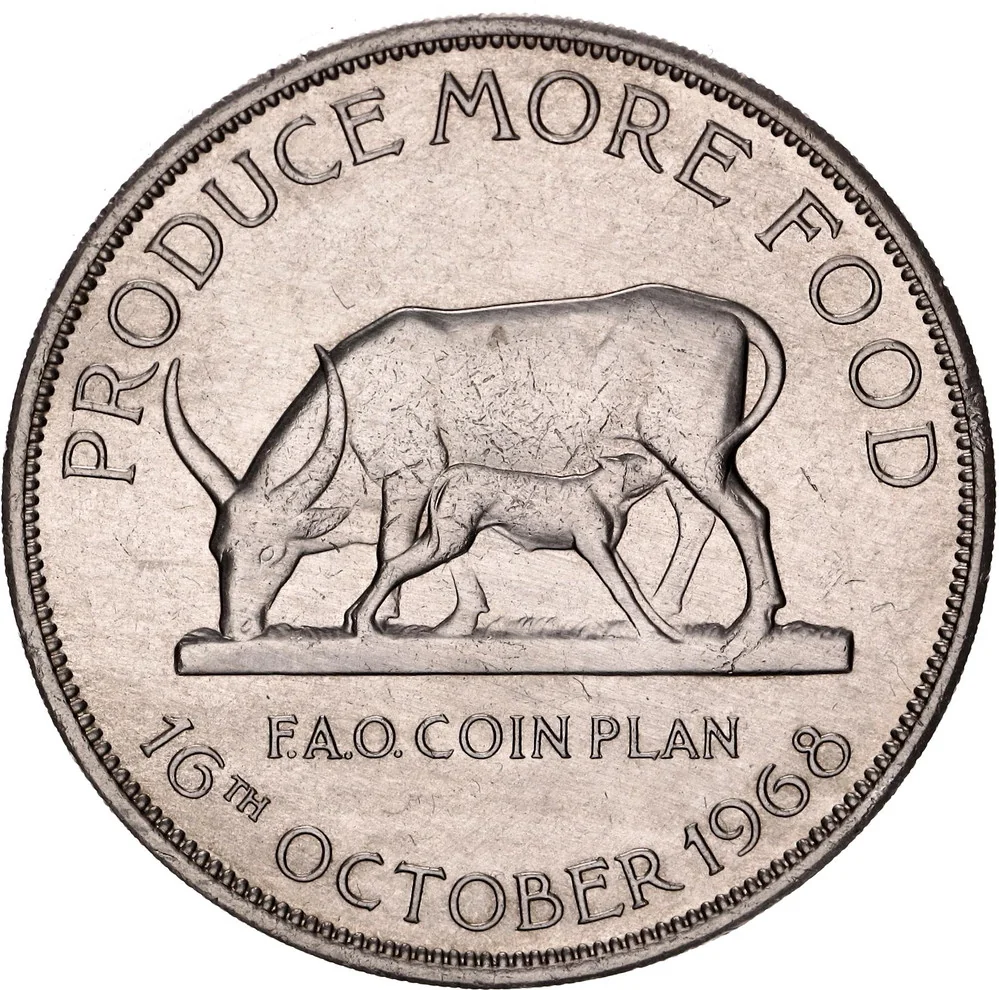
Cow and calf drinking, facing left.
Inscription:
PRODUCE MORE FOOD
F·A·O· COIN PLAN
16th OCTOBER 1968
F·A·O· COIN PLAN
16th OCTOBER 1968
Script: Latin
Engraver: Paul Vincze
Edge
Reeded
Categories
| Animal> Cow |
| Symbols> Coat of Arms |
| Organization> FAO |
Mints
| Name | Mark |
|---|---|
| Royal Mint (Tower Hill) | — |
Mintings
| Year | Mint Mark | Mintage | Quality | Collection |
|---|---|---|---|---|
| 1968 | — | 5,000 | Proof | |
| 1968 | — | 100,000 |
Historical background
In 1968, Uganda's currency situation was defined by its recent transition to an independent monetary system following the break-up of the East African Currency Board (EACB). For decades, the EACB had issued a common shilling for Kenya, Tanzania, and Uganda. However, after independence, political and economic tensions led to its dissolution. Uganda introduced its own national currency, the Ugandan shilling, in 1966, and by 1968 the new notes and coins were fully in circulation, symbolizing a key pillar of national sovereignty under President Milton Obote's government.
Economically, the period was one of cautious management but underlying strain. The new Uganda shilling was initially pegged at par with the old East African shilling and to the British pound sterling, aiming for stability. The Bank of Uganda, established in 1966, had assumed central banking functions, controlling issue and foreign reserves. However, the economy faced pressures from falling global commodity prices for its main exports, coffee and cotton, while government expenditure was rising. This created a delicate balance, with authorities working to maintain confidence in the fledgling currency without resorting to drastic devaluation.
Politically, the currency was a tool in Obote's "Move to the Left" policy, which sought greater state control over the economy. The government emphasized self-reliance and viewed an independent central bank as crucial for directing credit towards national development projects. However, this period of relative stability in 1968 was precarious. Within three years, the political turmoil of Idi Amin's 1971 coup would severely destabilize the economy, leading to fiscal indiscipline, plummeting foreign reserves, and the eventual collapse of the currency's value—a stark contrast to the managed, if fragile, system of the late 1960s.
Economically, the period was one of cautious management but underlying strain. The new Uganda shilling was initially pegged at par with the old East African shilling and to the British pound sterling, aiming for stability. The Bank of Uganda, established in 1966, had assumed central banking functions, controlling issue and foreign reserves. However, the economy faced pressures from falling global commodity prices for its main exports, coffee and cotton, while government expenditure was rising. This created a delicate balance, with authorities working to maintain confidence in the fledgling currency without resorting to drastic devaluation.
Politically, the currency was a tool in Obote's "Move to the Left" policy, which sought greater state control over the economy. The government emphasized self-reliance and viewed an independent central bank as crucial for directing credit towards national development projects. However, this period of relative stability in 1968 was precarious. Within three years, the political turmoil of Idi Amin's 1971 coup would severely destabilize the economy, leading to fiscal indiscipline, plummeting foreign reserves, and the eventual collapse of the currency's value—a stark contrast to the managed, if fragile, system of the late 1960s.
🌱 Common