

12 Ducats (Carol II's reign) – Romania
Non-circulating coins
Commemoration: 10th anniversary of Carol II's reign
Romania

Obverse
Description:
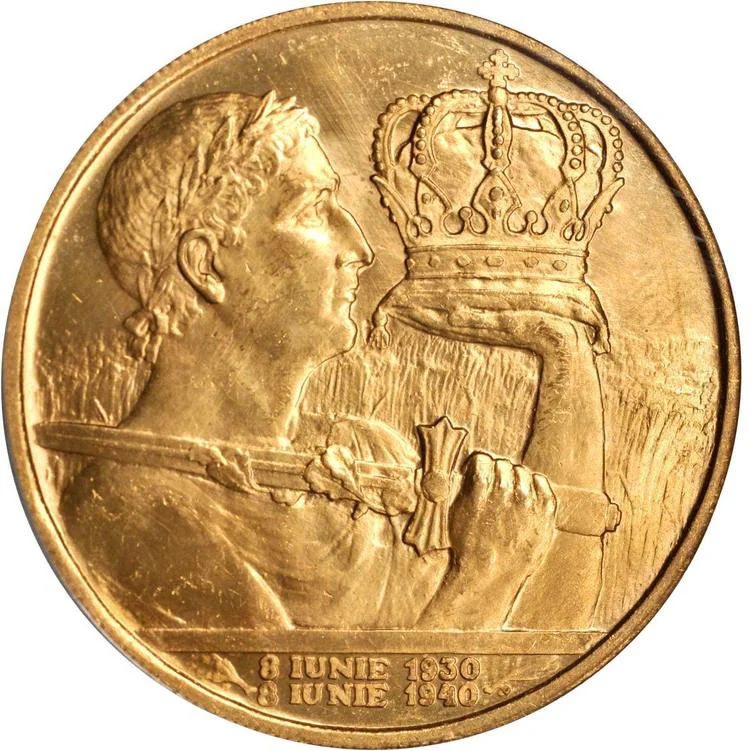
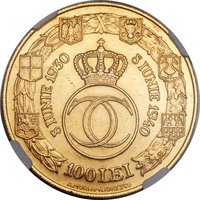
Bust of Emperor Trajan with laurel wreath, holding Romania's steel crown and a sword wreathed in oak leaves. Wheat field in background. Inscription: 8 IUNIE 1930 / 8 IUNIE 1940. No face value.
Inscription:
8 IUNIE 1930
8 IUNIE 1940
8 IUNIE 1940
Translation:
8 June 1930
8 June 1940
8 June 1940
Script: Latin
Language: Romanian
Designer: Emil Wilhelm Becker
Reverse
Description:
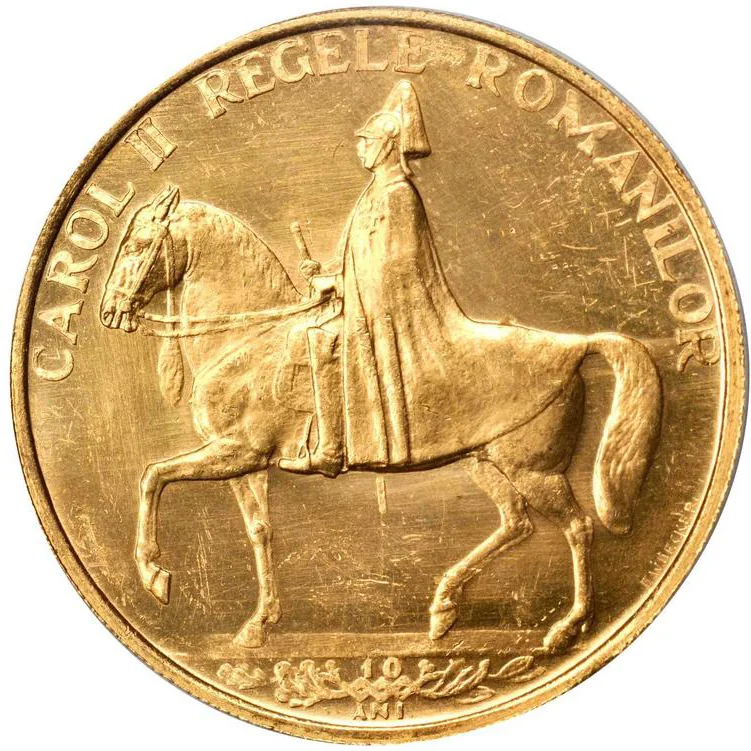
King on horseback left, in royal guard uniform and Order of Michael the Brave cloak, holding a marshal's baton. Exergue with branches and "10 ANI". Engraver E.W. BECKER at bottom left edge.
Inscription:
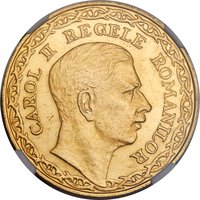
CAROL II REGELE ROMANILOR
10
ANI
E.W.BECKER
10
ANI
E.W.BECKER
Translation:
CAROL II KING OF THE ROMANIANS
10
YEARS
E.W.BECKER
10
YEARS
E.W.BECKER
Script: Latin
Designer: Emil Wilhelm Becker
Edge
Mints
| Name | Mark |
|---|---|
| State Mint | — |
Mintings
| Year | Mint Mark | Mintage | Quality | Collection |
|---|---|---|---|---|
| 1940 | — | 348 |
Historical background
In 1940, Romania's currency situation was deeply unstable, reflecting the nation's profound political and territorial crises. The year began with the Romanian leu still nominally tied to the gold standard, but its value was eroding due to massive military expenditures, the loss of key export markets at the outbreak of World War II, and severe capital flight. The National Bank of Romania struggled to maintain confidence, but its reserves were being depleted to support the currency and finance the state's growing deficit, creating an inflationary undercurrent.
This financial strain was catastrophically exacerbated by the territorial dismemberment of Romania in the summer of 1940. Under immense pressure from the Soviet Union, Germany, and Hungary, Romania ceded Bessarabia and Northern Bukovina, Northern Transylvania, and Southern Dobruja. These losses stripped the country of vital agricultural and industrial resources, shattered economic stability, and triggered a collapse in public confidence. The leu went into freefall, and prices began to spiral, marking the start of a hyperinflation that would fully erupt in the subsequent war years.
Furthermore, the currency situation became subordinated to German geopolitical aims. Following King Carol II's abdication in September, the fascist Iron Guard-led National Legionary State, and later Ion Antonescu's dictatorship, firmly aligned Romania with the Axis. The economy was forcibly reoriented to serve the Nazi war machine, with the leu being artificially pegged to the Reichsmark at a favourable rate for Germany. This exploitative relationship facilitated the plundering of Romanian oil and grain, further draining the economy and ensuring that monetary policy was dictated by wartime exigencies rather than national stability, setting the stage for a devastating monetary collapse.
This financial strain was catastrophically exacerbated by the territorial dismemberment of Romania in the summer of 1940. Under immense pressure from the Soviet Union, Germany, and Hungary, Romania ceded Bessarabia and Northern Bukovina, Northern Transylvania, and Southern Dobruja. These losses stripped the country of vital agricultural and industrial resources, shattered economic stability, and triggered a collapse in public confidence. The leu went into freefall, and prices began to spiral, marking the start of a hyperinflation that would fully erupt in the subsequent war years.
Furthermore, the currency situation became subordinated to German geopolitical aims. Following King Carol II's abdication in September, the fascist Iron Guard-led National Legionary State, and later Ion Antonescu's dictatorship, firmly aligned Romania with the Axis. The economy was forcibly reoriented to serve the Nazi war machine, with the leu being artificially pegged to the Reichsmark at a favourable rate for Germany. This exploitative relationship facilitated the plundering of Romanian oil and grain, further draining the economy and ensuring that monetary policy was dictated by wartime exigencies rather than national stability, setting the stage for a devastating monetary collapse.
✨ Legendary