

100 Francs – France
France

Obverse
Description:
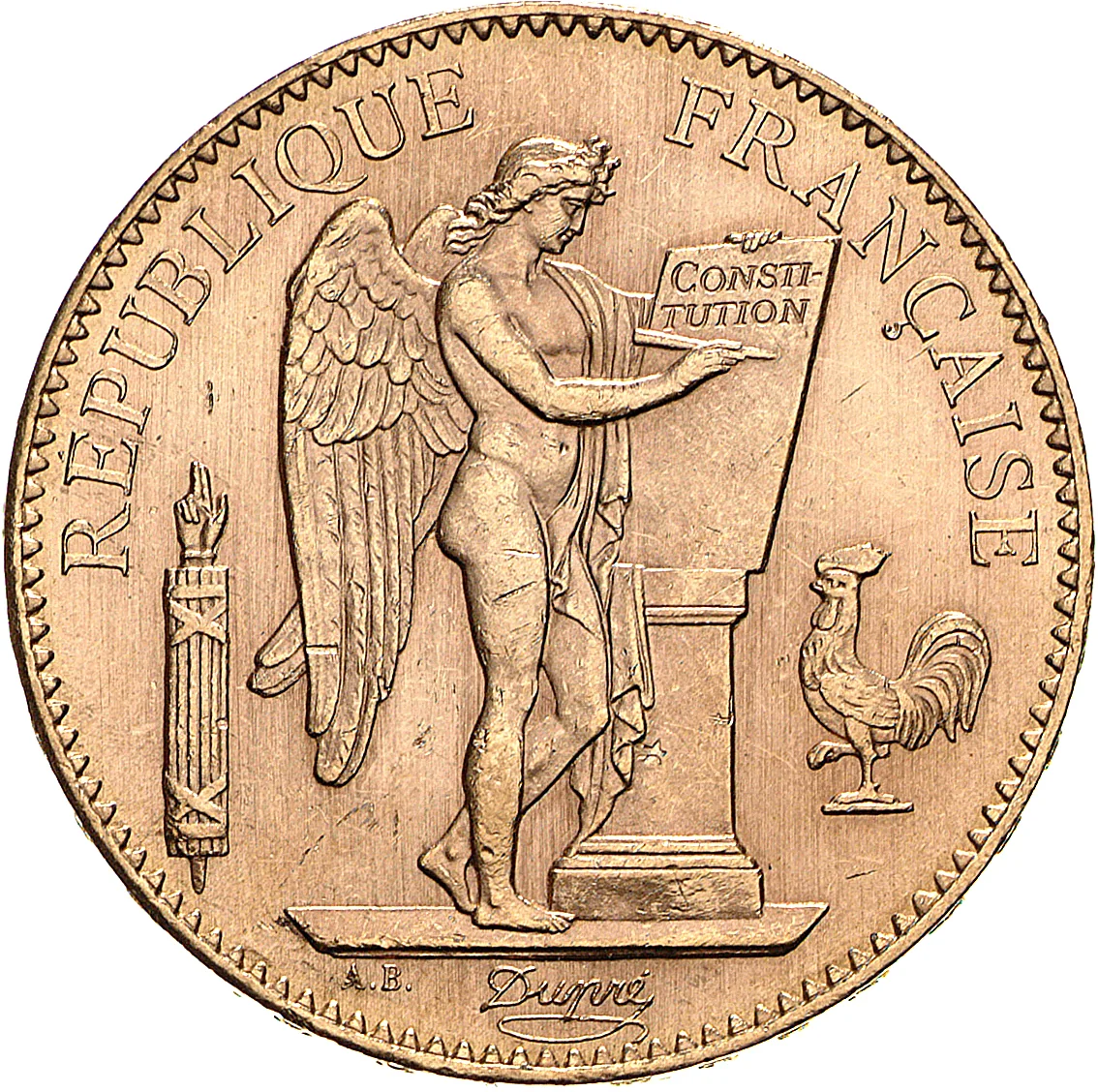
Genius of the Republic engraving a tablet, flanked by a justice-handled beam and a rooster; signed Dupré.
Inscription:
REPUBLIQUE FRANÇAISE
Translation:
FRENCH REPUBLIC
Script: Latin
Language: French
Engraver: Augustin Dupré
Reverse
Description:
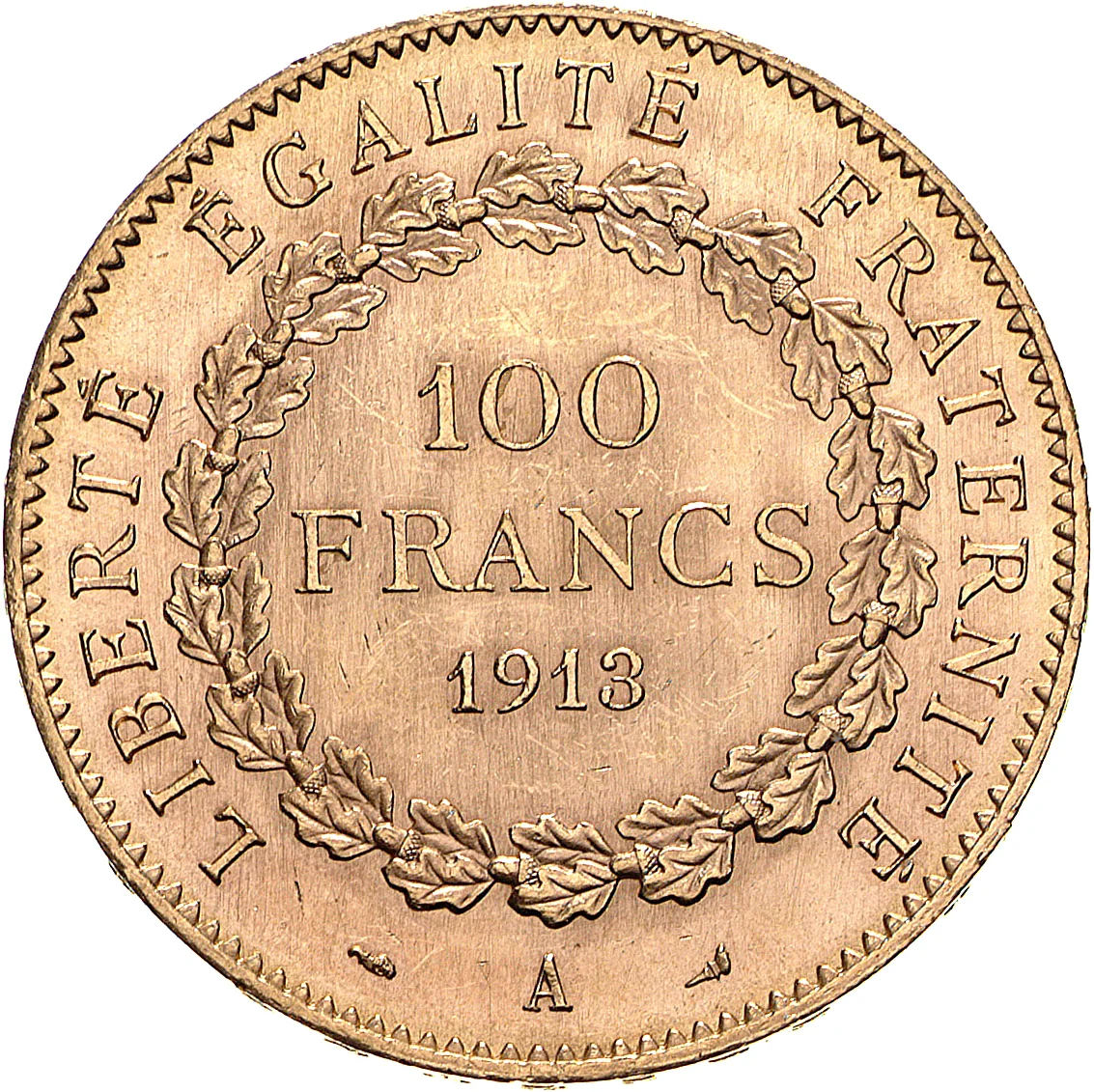
Face value encircled by an oak wreath.
Inscription:
LIBERTÉ ÉGALITÉ FRATERNITÉ
100
FRANCS
1911
A
100
FRANCS
1911
A
Translation:
LIBERTY EQUALITY FRATERNITY
100
FRANCS
1911
A
100
FRANCS
1911
A
Script: Latin
Language: French
Engraver: Augustin Dupré
Edge
In relief
Legend:
** LIBERTE * EGALITE * FRATERNITE
Mints
| Name | Mark |
|---|---|
| Monnaie de Paris | (A) |
Mintings
| Year | Mint Mark | Mintage | Quality | Collection |
|---|---|---|---|---|
| 1907 | A | 20,000 | ||
| 1908 | A | 23,038 | ||
| 1909 | A | 20,000 | ||
| 1910 | A | 20,058 | ||
| 1911 | A | 30,067 | ||
| 1912 | A | 20,045 | ||
| 1913 | A | 30,184 | ||
| 1914 | A | — |
Historical background
In 1907, France operated under the gold standard, a system that pegged the value of the franc to a specific quantity of gold. This framework, established in the late 19th century, provided significant monetary stability and international credibility, anchoring the franc as one of the world's premier currencies. However, this stability came with inherent rigidities. The money supply was directly tied to the nation's gold reserves, limiting the Banque de France's ability to respond flexibly to domestic economic conditions, such as the mild recession and agricultural crises of the period.
The era was also marked by a notable scarcity of physical currency in daily circulation, particularly small-denomination coins. While large transactions and international trade were facilitated by gold, the public and businesses frequently faced a shortage of "monnaie divisionnaire" (divisionary coinage)—the silver and bronze coins needed for everyday purchases. This chronic shortage caused significant inconvenience in markets and shops, leading to public frustration and occasional use of private tokens or postage stamps as makeshift change, a situation repeatedly criticized in the press and parliament.
Politically, the monetary system was a point of contention. The "Republican Defense" government of Prime Minister Georges Clemenceau, facing social unrest from winemakers and workers, had little appetite for radical monetary reform. The dominant economic orthodoxy, championed by the Banque de France, fiercely defended the gold standard as a bulwark against inflation and financial disorder. Thus, while the structural limitations and practical inconveniences of the currency system were widely acknowledged in 1907, the political will to move away from hard money and the stability it symbolized did not yet exist.
The era was also marked by a notable scarcity of physical currency in daily circulation, particularly small-denomination coins. While large transactions and international trade were facilitated by gold, the public and businesses frequently faced a shortage of "monnaie divisionnaire" (divisionary coinage)—the silver and bronze coins needed for everyday purchases. This chronic shortage caused significant inconvenience in markets and shops, leading to public frustration and occasional use of private tokens or postage stamps as makeshift change, a situation repeatedly criticized in the press and parliament.
Politically, the monetary system was a point of contention. The "Republican Defense" government of Prime Minister Georges Clemenceau, facing social unrest from winemakers and workers, had little appetite for radical monetary reform. The dominant economic orthodoxy, championed by the Banque de France, fiercely defended the gold standard as a bulwark against inflation and financial disorder. Thus, while the structural limitations and practical inconveniences of the currency system were widely acknowledged in 1907, the political will to move away from hard money and the stability it symbolized did not yet exist.
⭐ Somewhat Rare