

5 rupees (Upasampada Rite) – Sri Lanka
Add to wishlist
Circulating commemorative coins
Commemoration: 250th Anniversary of the “Upasampada” Rite
Sri Lanka
Context
Material
Diameter: 23.4 mm
Weight: 9.52 g
Shape: Round
Composition: Aluminium bronze
Magnetic: No
Technique: Milled
Alignment: Medal alignment
flip
References
KM: #
Numista: #18076
Value
Exchange value: 5 LKR
Obverse
Description:
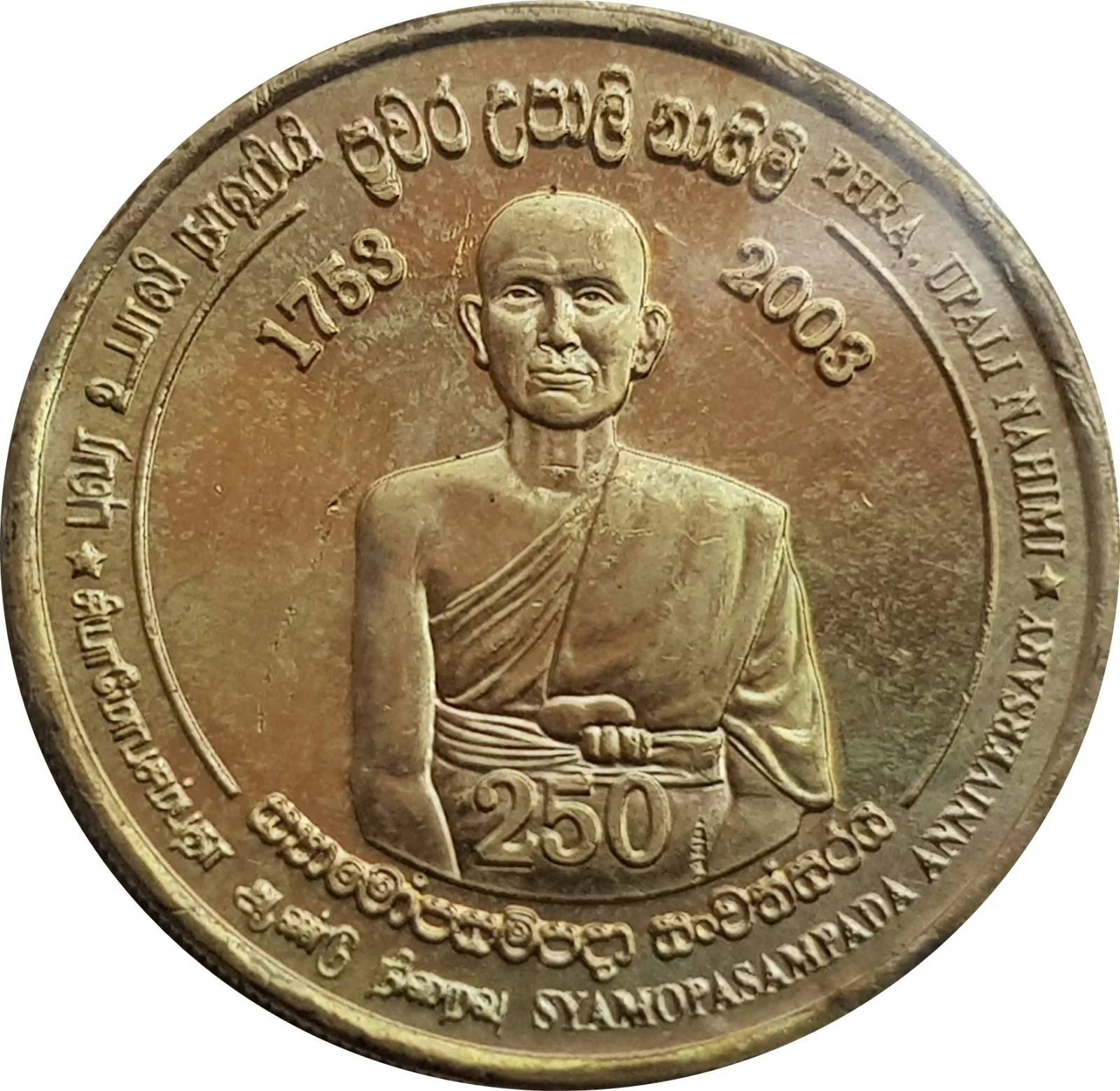
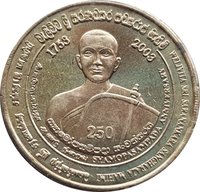
Portrait of Phra Upali Nahimi within a broken circle, flanked by the dates 1753 and 2003, with "250" below. "PHRA. UPALI NAHIMI" appears above in Sinhala, Tamil, and English. "SYAMOPASAMPADA ANNIVERSARY" bridges the circle's gap in Sinhala, with Tamil and English versions below, separated by stars.
Inscription:
PHRA. UPALI NAHIMI
புவர உபாலி நாஹிமி
1753 2003
250
SYAMOPASAMPADA ANNIVERSARY
சியாமோபசம்பதா ஆண்டு நிறைவு
புவர உபாலி நாஹிமி
1753 2003
250
SYAMOPASAMPADA ANNIVERSARY
சியாமோபசம்பதா ஆண்டு நிறைவு
Translation:
Phra Upali Nihimi
1753 2003
250
SYAMOPASAMPADA ANNIVERSARY
1753 2003
250
SYAMOPASAMPADA ANNIVERSARY
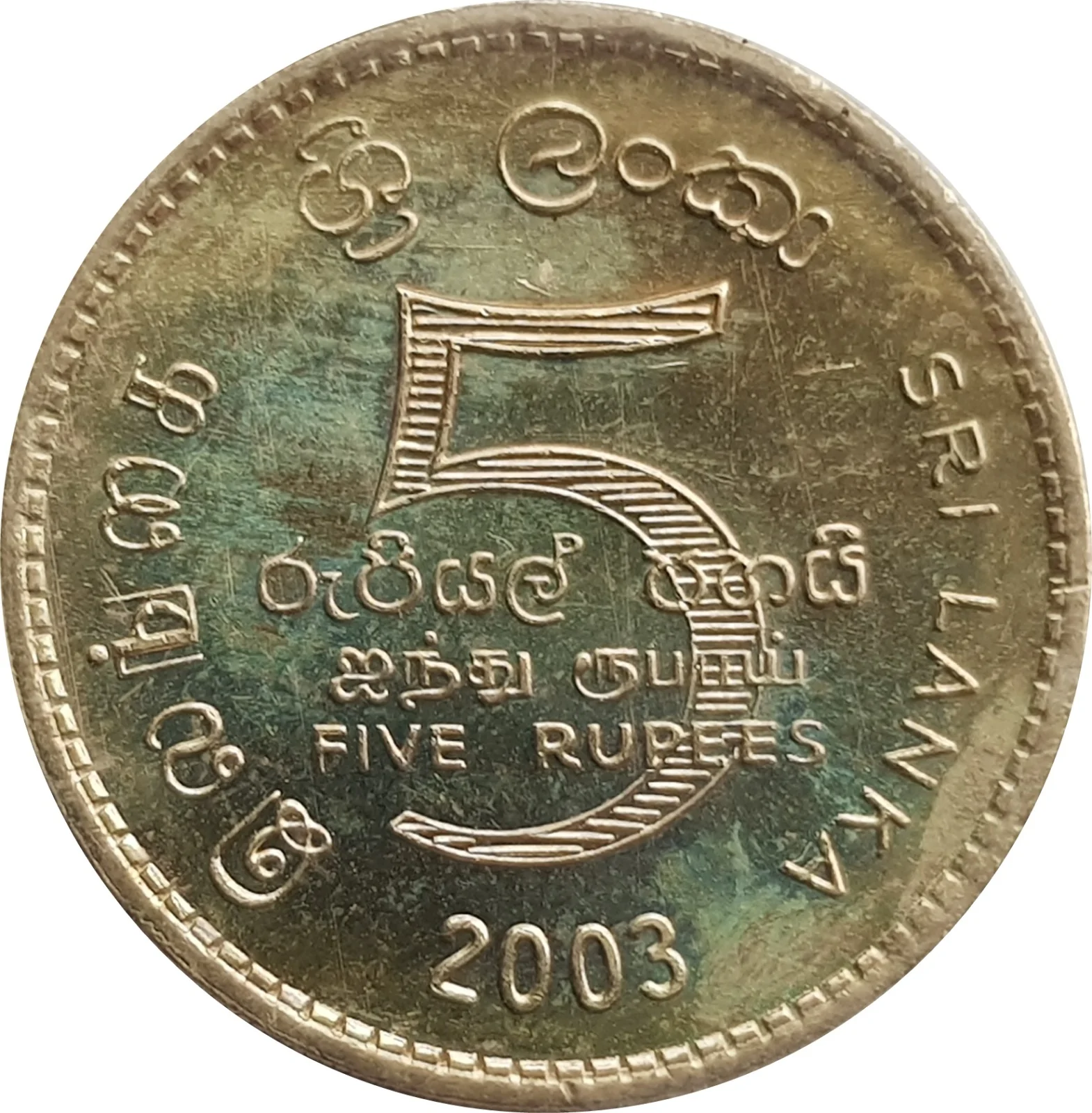
Reverse
Mints
| Name | Mark |
|---|---|
| Royal Mint | — |
Mintings
| Year | Mint Mark | Mintage | Quality | Collection |
|---|---|---|---|---|
| 2003 | — | 4,000,000 |
Historical background
In 2003, Sri Lanka's currency situation was characterized by relative stability and cautious optimism, underpinned by a ceasefire in the long-running civil war and a disciplined managed float regime. The Sri Lankan Rupee (LKR) was maintained by the Central Bank of Sri Lanka (CBSL) within a loosely managed band, with interventions aimed at preventing excessive volatility rather than targeting a fixed rate. This period saw moderate depreciation pressure, but it was managed effectively, with the rupee declining in a controlled manner from around 96 to 99 against the US dollar over the year, a modest change by historical standards.
This stability was largely supported by improved macroeconomic fundamentals and positive sentiment from the ongoing peace process. The ceasefire agreement signed in 2002 led to a surge in donor pledges at the Tokyo Donor Conference in mid-2003, boosting foreign exchange reserves. Furthermore, strong inflows from remittances, garment exports, and a recovering tourism sector provided fundamental support for the rupee. The CBSL's reserves increased steadily, giving the monetary authority greater capacity to smooth out market fluctuations and maintain confidence.
However, underlying vulnerabilities persisted. The fiscal deficit remained high, and public debt, both domestic and foreign, continued to be a significant burden. The currency stability was, therefore, fragile and highly contingent on the continuation of the peace process and external inflows. By late 2003, a political crisis between the President and Prime Minister created uncertainty, foreshadowing the future turbulence that would eventually undermine the economic gains and lead to more severe currency pressures in the years following the collapse of the ceasefire.
This stability was largely supported by improved macroeconomic fundamentals and positive sentiment from the ongoing peace process. The ceasefire agreement signed in 2002 led to a surge in donor pledges at the Tokyo Donor Conference in mid-2003, boosting foreign exchange reserves. Furthermore, strong inflows from remittances, garment exports, and a recovering tourism sector provided fundamental support for the rupee. The CBSL's reserves increased steadily, giving the monetary authority greater capacity to smooth out market fluctuations and maintain confidence.
However, underlying vulnerabilities persisted. The fiscal deficit remained high, and public debt, both domestic and foreign, continued to be a significant burden. The currency stability was, therefore, fragile and highly contingent on the continuation of the peace process and external inflows. By late 2003, a political crisis between the President and Prime Minister created uncertainty, foreshadowing the future turbulence that would eventually undermine the economic gains and lead to more severe currency pressures in the years following the collapse of the ceasefire.
🌱 Fairly Common