


5 euro (Treaty of Rome) – Italy
Add to wishlist
Non-circulating coins
Commemoration: 60th Anniversary of the Treaty of Rome
Italy
Context
Material

References
KM: #
Numista: #107087
Value
Exchange value: 5 EUR
Bullion value: $40.52
Inflation-adjusted value: 6.04 EUR
Obverse
Description:
Foreground: detail of the Capitoline Venus. Background: a map of Europe with six strips for its founding members.
Inscription:
REPUBBLICA ITALIANA
COLANERI
COLANERI
Translation:
Italian Republic
Cola Neri
Cola Neri
Script: Latin
Language: Italian
Engraver: Maria Carmela Colaneri
Reverse
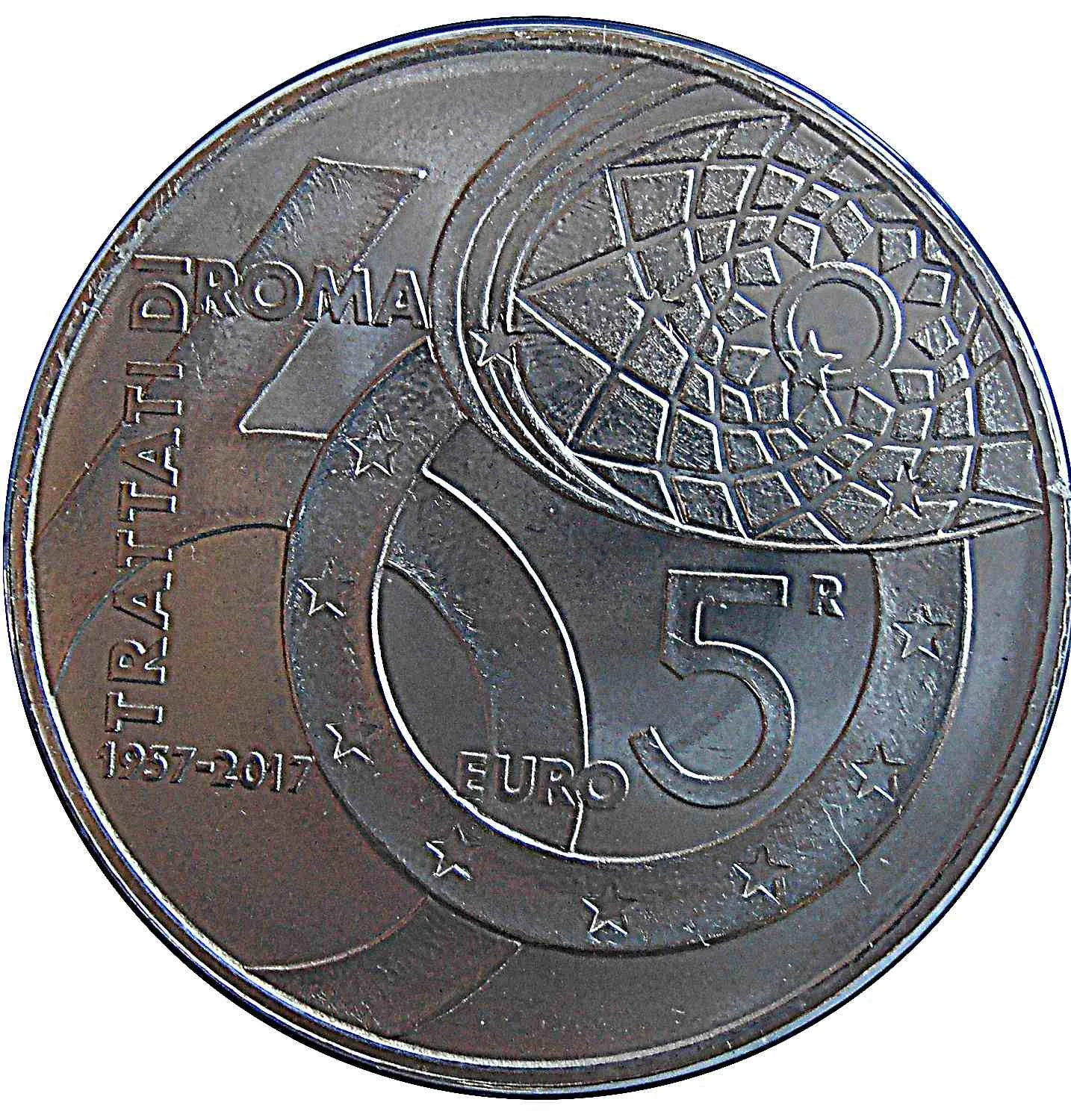
Description:
Michelangelo’s Capitol Square design, reinterpreted as three stripes for the European Parliament.
Inscription:
TRATTATI DI
ROMA
EURO 5 R
60
1957-2017
ROMA
EURO 5 R
60
1957-2017
Script: Latin
Engraver: Maria Carmela Colaneri
Edge
Continuous coarse milled.
Mints
| Name | Mark |
|---|---|
| Rome | R |
Historical background
In 2017, Italy's currency situation was defined by its entrenched membership in the Eurozone, using the euro as its legal tender. The year was marked by persistent economic fragility, with public debt exceeding 130% of GDP—one of the highest ratios in the world—and a banking sector still burdened by a high level of non-performing loans (NPLs). This weak economic foundation fueled ongoing political and public debate about the sustainability of Italy's position within the single currency. While there was no imminent threat of exit, vocal Eurosceptic movements, particularly the Five Star Movement and the Lega, periodically questioned the benefits of the euro, arguing it hampered Italy's competitiveness.
The primary monetary policy decisions affecting Italy were made by the European Central Bank (ECB), which continued its expansive quantitative easing (QE) program throughout the year. This policy, involving large-scale purchases of government bonds, was crucial for keeping Italy's borrowing costs at historically low levels, allowing the government to service its massive debt. However, this also highlighted Italy's dependency on external support and the constraints of not having a national currency to devalue or an independent central bank to act as a lender of last resort for its specific needs.
Domestically, the government, led by Prime Minister Paolo Gentiloni, focused on stabilizing the financial system, including state-backed rescues of troubled banks like Monte dei Paschi di Siena. These interventions were complex under EU state-aid rules, underscoring the tension between national crisis management and Eurozone regulations. Overall, 2017 was a year of managed stability within the euro, but one that laid bare the underlying structural vulnerabilities that would fuel greater political contention over the currency in the years to follow.
The primary monetary policy decisions affecting Italy were made by the European Central Bank (ECB), which continued its expansive quantitative easing (QE) program throughout the year. This policy, involving large-scale purchases of government bonds, was crucial for keeping Italy's borrowing costs at historically low levels, allowing the government to service its massive debt. However, this also highlighted Italy's dependency on external support and the constraints of not having a national currency to devalue or an independent central bank to act as a lender of last resort for its specific needs.
Domestically, the government, led by Prime Minister Paolo Gentiloni, focused on stabilizing the financial system, including state-backed rescues of troubled banks like Monte dei Paschi di Siena. These interventions were complex under EU state-aid rules, underscoring the tension between national crisis management and Eurozone regulations. Overall, 2017 was a year of managed stability within the euro, but one that laid bare the underlying structural vulnerabilities that would fuel greater political contention over the currency in the years to follow.

💎 Extremely Rare