

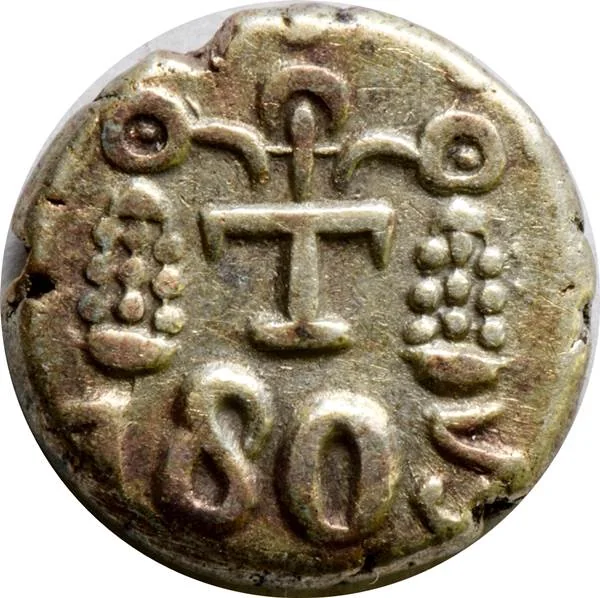
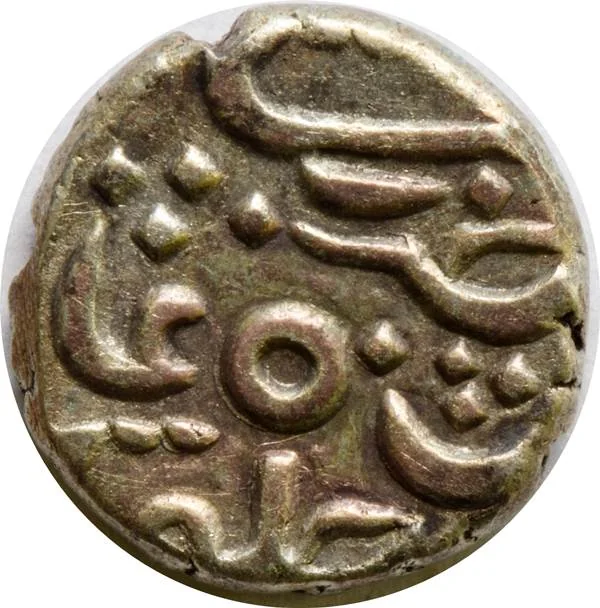

Obverse
Description:
Scales over date. "T" for Tellicherry.
Inscription:
T
1805
1805
Reverse
Description:
Zarb Mumbai, Shah Alam's reign.
Edge
Plain
Mintings
| Year | Mint Mark | Mintage | Quality | Collection |
|---|---|---|---|---|
| 1805 | — | — |
Historical background
In 1805, the Bombay Presidency faced a complex and fragmented currency situation, a legacy of its diverse commercial history. The region operated without a unified monetary standard, with a multitude of coins from various origins circulating simultaneously. The most prominent were the silver rupee of the Mughal Empire and its local derivatives, but these competed with gold pagodas from the south, silver francs from French territories, Spanish dollars (pieces of eight) from global trade, and a host of older, debased local coins. This proliferation led to chronic confusion in exchange rates, facilitated fraud, and posed a significant obstacle to both regional commerce and the administration of the East India Company.
The East India Company’s authority, while growing after the Second Anglo-Maratha War (1803-05), did not yet extend to full control over the monetary system. The Company’s own Bombay rupee was in circulation, but it struggled for preeminence. The core problem was a severe shortage of specie (coin), particularly of reliable silver, which stifled trade and revenue collection. Transactions often relied on cumbersome copper coins for small change, while larger dealings required constant reference to shroffs (money changers), who wielded significant power by assessing the varying metallic content and worth of each coin.
Consequently, the monetary landscape in 1805 was one of transition and disorder. The Presidency was caught between a decaying past of multiple metallic standards and a future of uniform currency that the Company desired but could not yet impose. The situation demanded reform, setting the stage for the Company’s more concerted efforts in the following decades to suppress rival currencies, establish its mints as preeminent, and ultimately move towards a standardized silver rupee-based system for all of British India.
The East India Company’s authority, while growing after the Second Anglo-Maratha War (1803-05), did not yet extend to full control over the monetary system. The Company’s own Bombay rupee was in circulation, but it struggled for preeminence. The core problem was a severe shortage of specie (coin), particularly of reliable silver, which stifled trade and revenue collection. Transactions often relied on cumbersome copper coins for small change, while larger dealings required constant reference to shroffs (money changers), who wielded significant power by assessing the varying metallic content and worth of each coin.
Consequently, the monetary landscape in 1805 was one of transition and disorder. The Presidency was caught between a decaying past of multiple metallic standards and a future of uniform currency that the Company desired but could not yet impose. The situation demanded reform, setting the stage for the Company’s more concerted efforts in the following decades to suppress rival currencies, establish its mints as preeminent, and ultimately move towards a standardized silver rupee-based system for all of British India.
💎 Extremely Rare