

3 Rubles (EAEU) – Russian Federation
Non-circulating coins
Commemoration: 5th Anniversary of the EAEU
Russia
Context
Year: 2019
Country: Russia 
Issuer: Russian Federation
Period:
(since 1991)
Currency:
(since 1998)
Total mintage: 3,000
Material

References
Value
Exchange value: 3 RUB
Bullion value: $89.85
Inflation-adjusted value: 5.51 RUB
Obverse
Description:
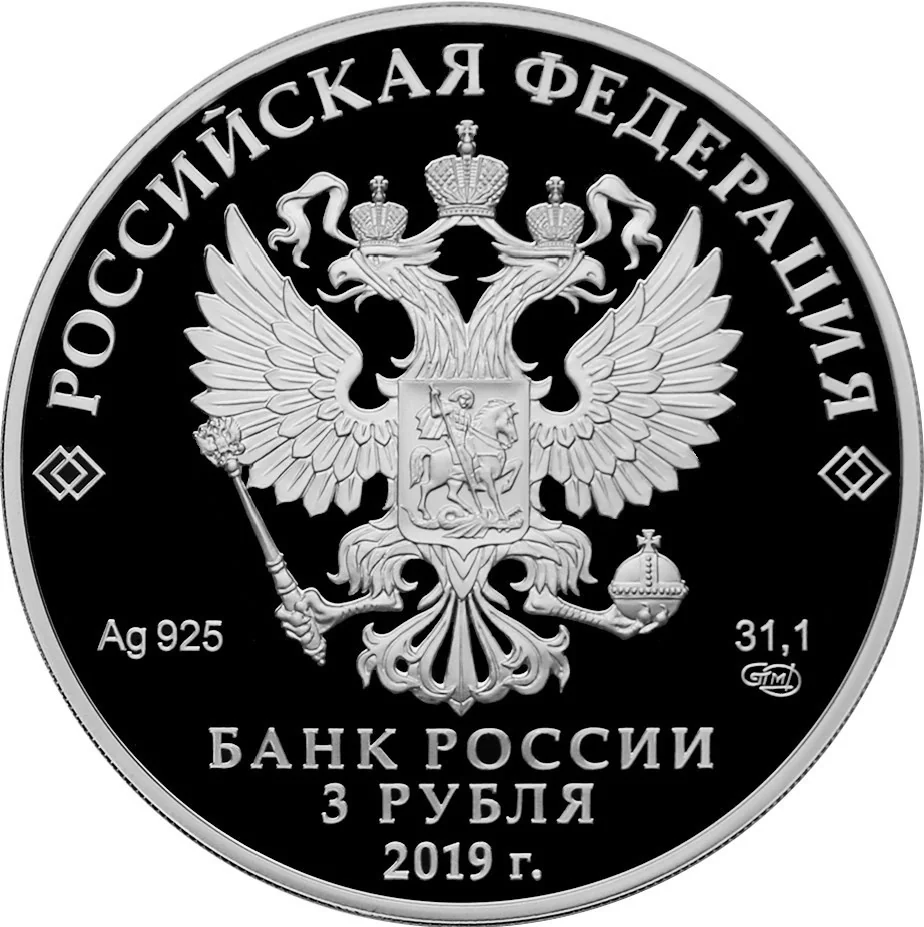
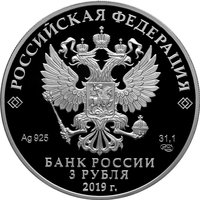
The obverse features the Russian Federation coat of arms with the country name above. Below are the metal specifications, mint mark, and the inscriptions "BANK OF RUSSIA," "3 ROUBLES," and the year.
Inscription:
РОССИЙСКАЯ ФЕДЕРАЦИЯ
Ag 925 31,1
СПМД
БАНК РОССИИ
3 РУБЛЯ
2019 г.
Ag 925 31,1
СПМД
БАНК РОССИИ
3 РУБЛЯ
2019 г.
Translation:
RUSSIAN FEDERATION
Ag 925 31.1
SPMD
BANK OF RUSSIA
3 RUBLES
2019
Ag 925 31.1
SPMD
BANK OF RUSSIA
3 RUBLES
2019
Language: Russian
Engraver: Alexandra Arsenyevna Dolgopolova
Designer: Elena Viktorovna Kramskaya
Reverse
Description:
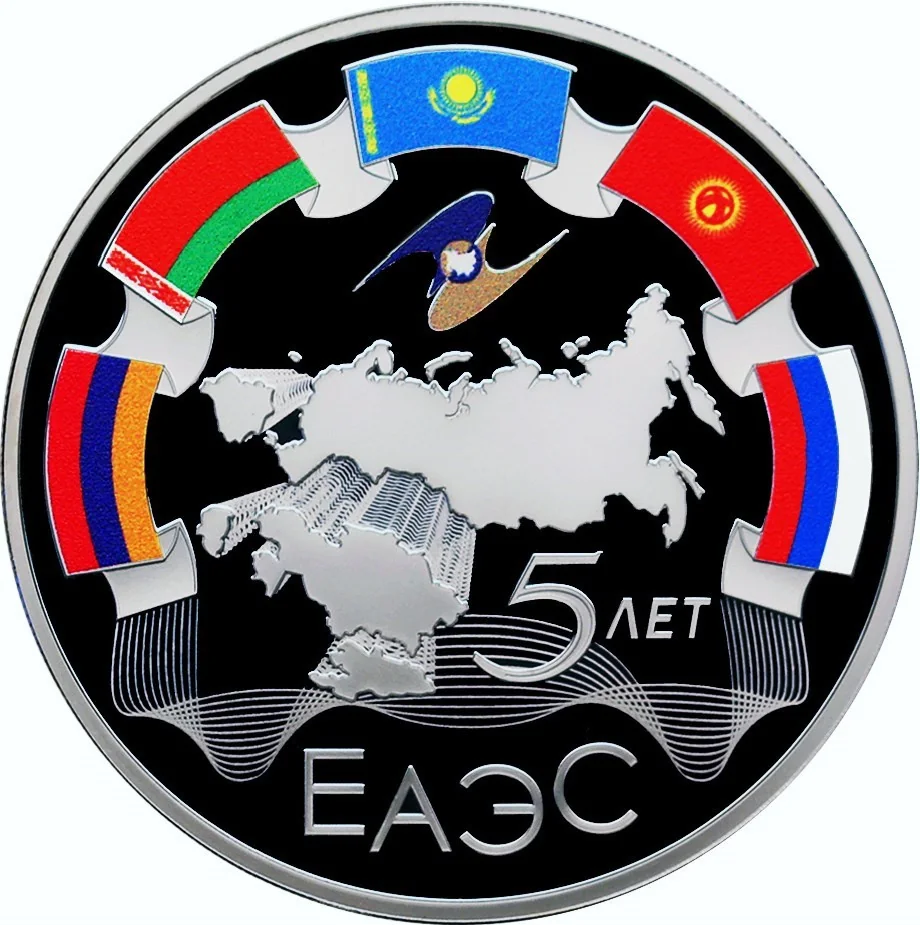
Central EAEU member silhouettes, with their national flags arching above and curving downward around the EAEU emblem. "5 ЛЕТ" and "ЕАЭС" are at the bottom.
Inscription:
5
ЛЕТ
ЕАЭС
ЛЕТ
ЕАЭС
Translation:
5 Years of the EAEU
Script: Cyrillic
Language: Russian
Designer: Sergey Vladilenovich Sutyagin
Edge
300 corrugations
Mints
| Name | Mark |
|---|---|
| Saint Petersburg | (СПМД) |
Mintings
| Year | Mint Mark | Mintage | Quality | Collection |
|---|---|---|---|---|
| 2019 | СПМД | 3,000 | Proof |
Historical background
In 2019, the Russian ruble (RUB) demonstrated notable stability and even modest strength, a significant shift from the volatility experienced earlier in the decade. This relative calm was primarily anchored by two key factors: conservative fiscal policy and supportive external conditions. The Russian Ministry of Finance continued its "budget rule," which automatically channels excess oil revenues into the National Wealth Fund when prices exceed a set baseline, insulating the domestic economy and currency from commodity price swings. Concurrently, the Central Bank of Russia maintained a consistent tight monetary policy, with a key interest rate of 7.75% at year's end, which helped control inflation and made ruble-denominated assets attractive.
The external environment was broadly favorable. Global oil prices, while not at peak levels, remained relatively firm, with the Brent crude benchmark averaging around $64 per barrel for the year. This provided a steady flow of export revenues, supporting the country's current account surplus. Furthermore, the absence of major new international sanctions—following the significant rounds imposed in 2014 and 2018—removed a key source of downward pressure and investor uncertainty. The ruble's performance was also aided by a generally weaker US dollar in global markets during parts of the year.
However, underlying vulnerabilities persisted beneath the surface stability. The economy continued to face structural challenges, including low growth potential, limited foreign investment due to geopolitical tensions, and susceptibility to any future downturn in energy markets. Inflation, though controlled, ended the year at 3%, slightly above the Central Bank's target. Overall, 2019 represented a year of consolidation for the ruble, where prudent domestic policies and a benign external climate allowed it to recover from previous shocks, yet without resolving the longer-term dependencies and risks inherent in the Russian economic model.
The external environment was broadly favorable. Global oil prices, while not at peak levels, remained relatively firm, with the Brent crude benchmark averaging around $64 per barrel for the year. This provided a steady flow of export revenues, supporting the country's current account surplus. Furthermore, the absence of major new international sanctions—following the significant rounds imposed in 2014 and 2018—removed a key source of downward pressure and investor uncertainty. The ruble's performance was also aided by a generally weaker US dollar in global markets during parts of the year.
However, underlying vulnerabilities persisted beneath the surface stability. The economy continued to face structural challenges, including low growth potential, limited foreign investment due to geopolitical tensions, and susceptibility to any future downturn in energy markets. Inflation, though controlled, ended the year at 3%, slightly above the Central Bank's target. Overall, 2019 represented a year of consolidation for the ruble, where prudent domestic policies and a benign external climate allowed it to recover from previous shocks, yet without resolving the longer-term dependencies and risks inherent in the Russian economic model.
✨ Legendary