

1 Gulden – Netherlands
Non-circulating coins
Commemoration: Coronation of Queen Beatrix
Netherlands
Context
Year: 1980
Issuer: Netherlands 
Ruler: Beatrix
Currency:
(1817—2001)
Demonetized: Yes
Total mintage: 157
Material
References
KM: #Click to copy to clipboard200a
Numista: #177570
Value
Exchange value: 1 NLG
Bullion value: $18.46
Inflation-adjusted value: 2.96 NLG
Obverse
Description:
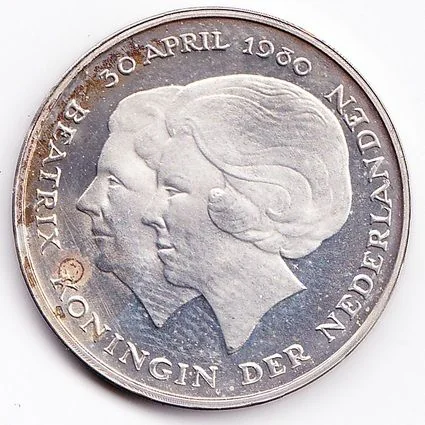
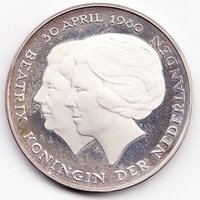
Juliana and Beatrix conjoined left-facing heads.
Inscription:
BEATRIX KONINGIN DER NEDERLANDEN 30 APRIL 1980
Translation:
Beatrix Queen of the Netherlands 30 April 1980
Script: Latin
Language: Dutch
Engraver: Catharina Elisabeth van Rood
Reverse
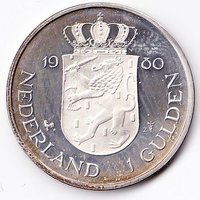
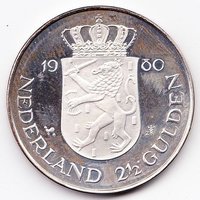
Description:
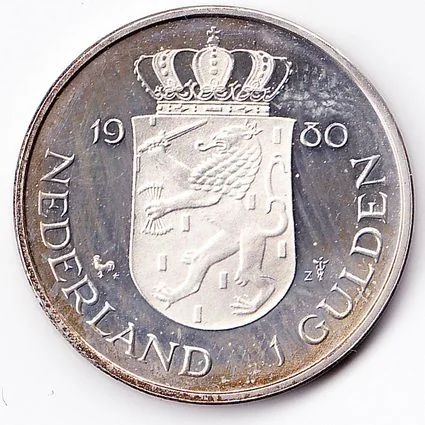
Arms flank date.
Inscription:
1980
Z
NEDERLAND 1 GULDEN
Z
NEDERLAND 1 GULDEN
Translation:
1980
Z
NETHERLANDS 1 GUILDER
Z
NETHERLANDS 1 GUILDER
Script: Latin
Engraver: Catharina Elisabeth van Rood
Edge
Categories
| Symbols> Coat of Arms |
| Event> Coronation |
| Person> Monarch |
| Symbol> Crown |
Mints
| Name | Mark |
|---|---|
| Royal Dutch Mint | — |
Mintings
| Year | Mint Mark | Mintage | Quality | Collection |
|---|---|---|---|---|
| 1980 | — | 157 | In sets |
Historical background
The Netherlands entered the 1980s grappling with the economic turbulence of the previous decade, heavily influenced by its membership in the European Monetary System (EMS), established in 1979. The core objective of the EMS was to reduce exchange rate variability and achieve monetary stability in Europe through the Exchange Rate Mechanism (ERM). The Dutch guilder was a central pillar of this system, maintaining an unwavering peg to the Deutsche Mark (DM) at a rate of approximately 1 DM = 1.126 guilder. This policy, known as the "hard guilder" policy, was a deliberate choice by De Nederlandsche Bank (DNB) to import the anti-inflationary credibility of the Bundesbank, prioritizing price stability and low interest rates over autonomous monetary policy.
Domestically, this commitment came at a significant cost in the early 1980s. The economy was in a deep recession, plagued by high unemployment, large government deficits, and a rigid labor market. The tight monetary policy required to maintain the DM peg kept interest rates high, exacerbating the economic downturn and contributing to widespread social unrest and cutbacks in public spending, known as the "Dutch disease" of the era. Despite this domestic pain, the political and monetary authorities, supported by a strong export sector, viewed the stable exchange rate as a non-negotiable anchor for long-term economic health and European integration.
Consequently, the currency situation in the Netherlands in 1980 was defined by this stark duality. Externally, the guilder was a symbol of stability, acting as a second anchor currency within the ERM alongside the Deutsche Mark. Internally, the necessary policies to defend that peg deepened a severe recession. This unwavering commitment ultimately solidified the Netherlands' reputation as a core, stability-oriented member of the European monetary project, a position that would later smooth its path into the European Economic and Monetary Union and the adoption of the euro.
Domestically, this commitment came at a significant cost in the early 1980s. The economy was in a deep recession, plagued by high unemployment, large government deficits, and a rigid labor market. The tight monetary policy required to maintain the DM peg kept interest rates high, exacerbating the economic downturn and contributing to widespread social unrest and cutbacks in public spending, known as the "Dutch disease" of the era. Despite this domestic pain, the political and monetary authorities, supported by a strong export sector, viewed the stable exchange rate as a non-negotiable anchor for long-term economic health and European integration.
Consequently, the currency situation in the Netherlands in 1980 was defined by this stark duality. Externally, the guilder was a symbol of stability, acting as a second anchor currency within the ERM alongside the Deutsche Mark. Internally, the necessary policies to defend that peg deepened a severe recession. This unwavering commitment ultimately solidified the Netherlands' reputation as a core, stability-oriented member of the European monetary project, a position that would later smooth its path into the European Economic and Monetary Union and the adoption of the euro.
⭐ Rare