

100 pesetas – Spain
Add to wishlist
Spain
Obverse
Description:
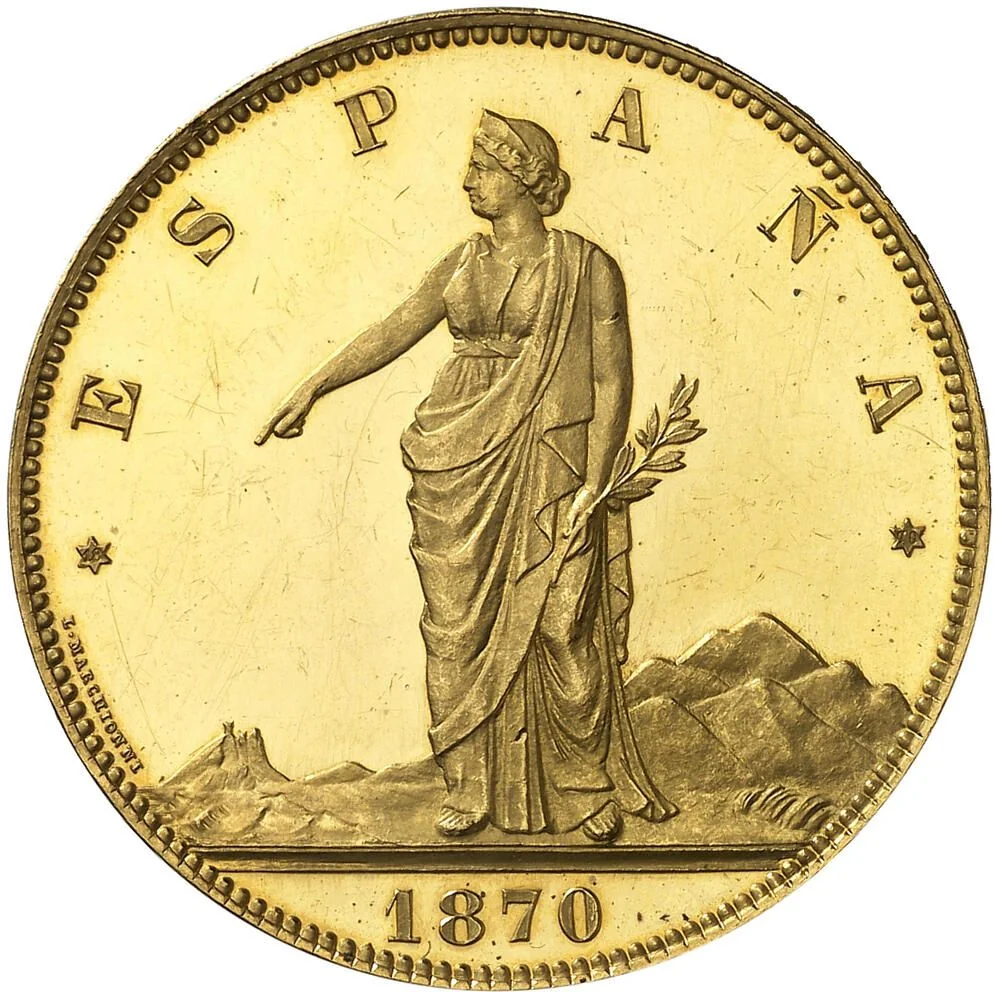
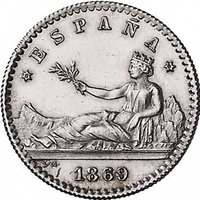
Hispania standing left, raising right arm and holding a laurel branch, with mountains behind.
Inscription:
🟌 ESPAÑA 🟌
L · MARCHIONNI
1870
L · MARCHIONNI
1870
Translation:
Spain
L. Marchionni
1870
L. Marchionni
1870
Script: Latin
Engraver: Luis Marchionni y Hombrón
Designer: José Esteban Lozano
Reverse
Description:
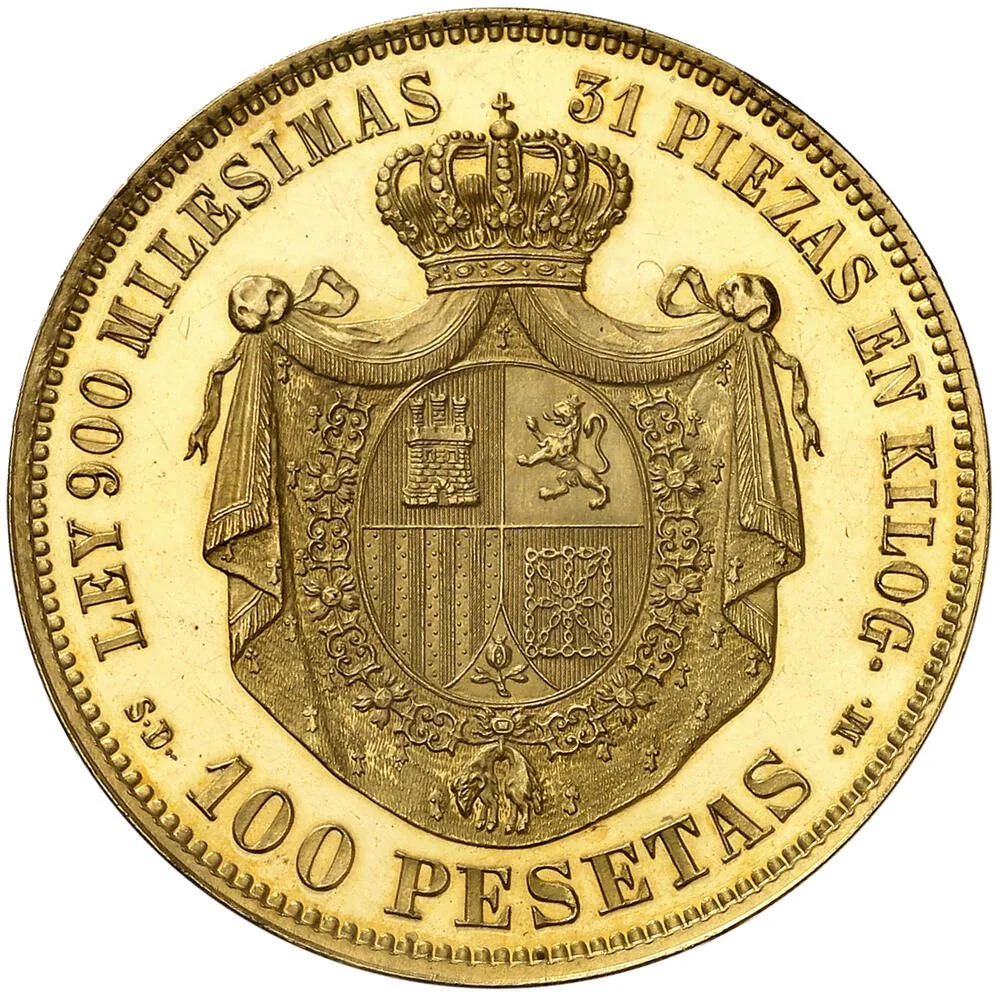
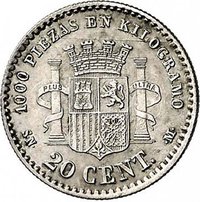
Crowned oval Spanish coat of arms with Golden Fleece collar.
Inscription:
LEY 900 MILESIMAS 31 PIEZAS EN KILOG ·
S · D · 100 PESETAS · M ·
S · D · 100 PESETAS · M ·
Translation:
Law 900 thousandths, 31 pieces per kilogram,
S D 100 Pesetas M
S D 100 Pesetas M
Script: Latin
Language: Spanish
Engraver: Luis Marchionni y Hombrón
Designer: José Esteban Lozano
Edge
Categories
| Symbol> Allegory |
| Symbols> Coat of Arms |
Mints
| Name | Mark |
|---|---|
| Royal Mint of Madrid | (🟌) |
Mintings
| Year | Mint Mark | Mintage | Quality | Collection |
|---|---|---|---|---|
| 1870 | 🟌 | 12 |
Historical background
In 1870, Spain was in a state of monetary disarray, caught between its colonial past and the modernizing pressures of a unified Europe. The country operated on a bimetallic system based on the peseta, introduced in 1868 to replace the complex array of older coins like the real and escudo. The peseta was defined as 4.5 grams of silver or 0.290322 grams of gold, aligning it with the Latin Monetary Union, an attempt to create a common currency standard with France, Italy, Belgium, and Switzerland. However, Spain's official membership was never ratified, leaving it in a peripheral and unstable relationship with this bloc.
This period was marked by a global scarcity of silver due to new discoveries, which caused its market value to fall below its official legal rate. Consequently, Spain suffered from Gresham's Law, where "bad money drives out good": gold coins, being undervalued by the state, were hoarded or exported, leaving primarily silver and devalued banknotes in domestic circulation. The government's finances were also deeply strained from decades of political instability, colonial wars, and infrastructure projects, leading to persistent budget deficits often covered by borrowing from the Bank of Spain and increasing the money supply.
The result was a fragile and inconsistent currency in practice. While the peseta was the official unit, the actual economy dealt with a mix of undervalued gold coins, a flood of silver, and paper banknotes that often traded at a discount to their face value. This instability reflected Spain's broader economic challenges and its struggle to fully integrate into the European financial system, a situation that would continue to pose problems for decades.
This period was marked by a global scarcity of silver due to new discoveries, which caused its market value to fall below its official legal rate. Consequently, Spain suffered from Gresham's Law, where "bad money drives out good": gold coins, being undervalued by the state, were hoarded or exported, leaving primarily silver and devalued banknotes in domestic circulation. The government's finances were also deeply strained from decades of political instability, colonial wars, and infrastructure projects, leading to persistent budget deficits often covered by borrowing from the Bank of Spain and increasing the money supply.
The result was a fragile and inconsistent currency in practice. While the peseta was the official unit, the actual economy dealt with a mix of undervalued gold coins, a flood of silver, and paper banknotes that often traded at a discount to their face value. This instability reflected Spain's broader economic challenges and its struggle to fully integrate into the European financial system, a situation that would continue to pose problems for decades.
💎 Extremely Rare