

8 florins – Austrian Empire
Add to wishlist
Austria
Context
Years: 1870–1892
Country: Austria
Issuer: Austrian Empire
Ruler: Francis Joseph I
Currency:
(1857—1892)
Subdivision: 8 florins = 20 Francs
Demonetized: Yes
Total mintage: 1,890,652
Material
References
KM: #
Numista: #17723
Value
Bullion value: $893.61
Obverse
Description:
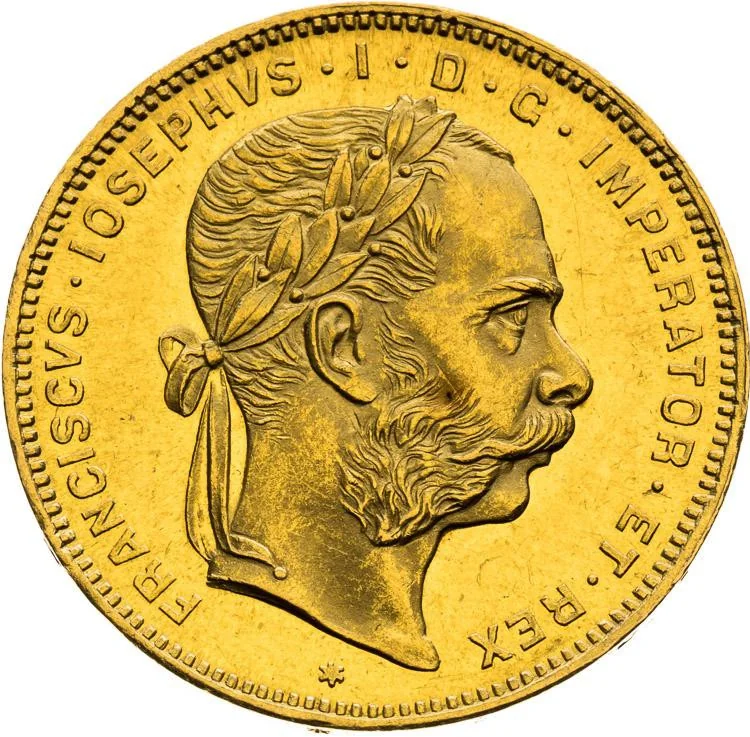
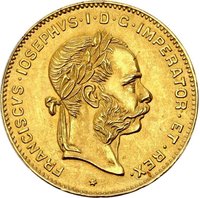
Laureate bust of Emperor Franz Joseph I, with full moustache and long sideburns. Encircled by legend.
Inscription:
FRANCISCVS·IOSEPHVS·I·D·G·IMPERATOR·ET·REX *
Translation:
FRANCIS JOSEPH I, BY THE GRACE OF GOD, EMPEROR AND KING *
Script: Latin
Language: Latin
Engraver: Josef Tautenhayn
Reverse
Description:
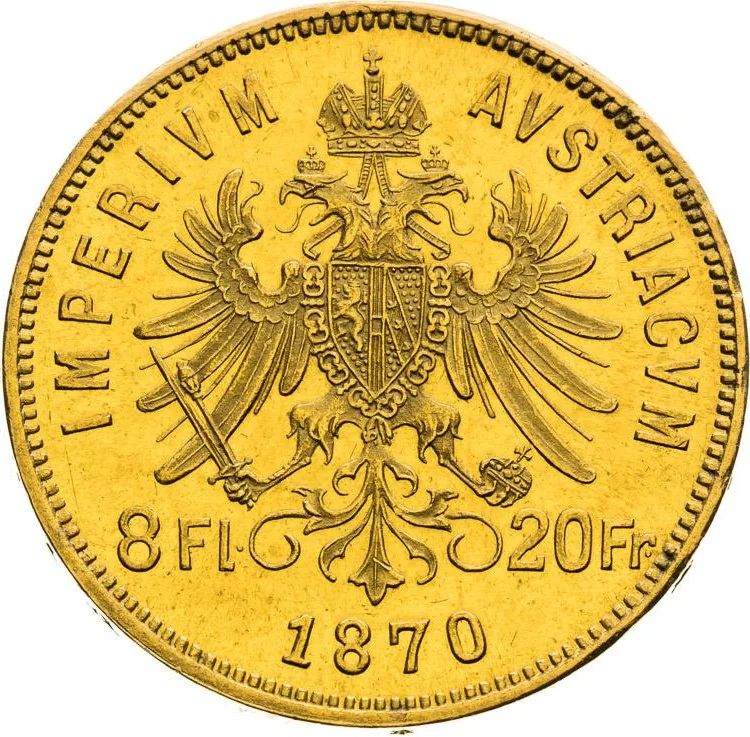
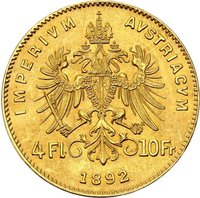
A crowned double-headed eagle with outstretched wings holds a sword and a crown. It bears a shield with the Golden Fleece collar. The inscription reads "Empire of Austria" and the denomination "8 Fl - 20 Fr". The date is at the bottom.
Inscription:
IMPERIVM AVSTRIACVM
8Fl· 20Fr
1892
8Fl· 20Fr
1892
Translation:
Austrian Empire
8 Florins 20 Francs
1892
8 Florins 20 Francs
1892
Script: Latin
Language: Latin
Engraver: Anton Scharff
Edge
Categories
| Symbol> Double-headed eagle |
Mints
| Name | Mark |
|---|---|
| Münze Österreich | — |
Mintings
| Year | Mint Mark | Mintage | Quality | Collection |
|---|---|---|---|---|
| 1870 | — | 25,256 | ||
| 1871 | — | 33,790 | ||
| 1872 | — | 5,185 | ||
| 1873 | — | 23,095 | ||
| 1874 | — | 41,540 | ||
| 1875 | — | 86,387 | ||
| 1876 | — | 146,320 | ||
| 1877 | — | 125,192 | ||
| 1878 | — | 125,103 | ||
| 1879 | — | 43,146 | ||
| 1880 | — | 61,563 | ||
| 1881 | — | 61,507 | ||
| 1882 | — | 114,671 | ||
| 1883 | — | 30,814 | ||
| 1884 | — | 91,016 | ||
| 1885 | — | 178,318 | ||
| 1886 | — | 139,657 | ||
| 1887 | — | 174,227 | ||
| 1888 | — | 113,519 | ||
| 1889 | — | 207,819 | ||
| 1890 | — | 43,151 | ||
| 1891 | — | 19,376 | ||
| 1892 | — | — |
Historical background
By 1870, the Austrian Empire's currency situation was defined by a protracted and challenging transition from a silver to a gold standard, a process complicated by fiscal instability and political fragmentation. Following the Austro-Prussian War of 1866, the state, burdened by debt and unable to resume convertibility of its paper notes, operated on a forced paper currency known as the Gulden (florin). This inconvertible paper money, the Wiener Währung (Viennese currency), circulated alongside silver coins and a separate, stable silver-based currency used in Hungary, the Kontinentwährung, creating a complex and often confusing monetary duality within the empire.
The core issue was a chronic lack of specie (precious metal) to back the circulating paper florins, which led to their depreciation and fluctuating exchange rates against major gold-backed currencies like the British pound. This monetary uncertainty hampered trade, investment, and economic planning. While the government and the Austro-Hungarian Bank (established in 1867) aimed for monetary unification and a return to metal convertibility, political negotiations between the Austrian and Hungarian halves of the newly formed Dual Monarchy (1867) delayed decisive reform. The Hungarian leadership insisted on a modern gold standard as a condition for any unified system.
Consequently, the year 1870 found the empire at a crossroads, still grappling with the legacy of its paper currency but on the cusp of significant change. International pressure from expanding global gold-standard networks and the desire for domestic economic credibility were pushing the government toward resolution. This culminated just a year later, in 1871, with the decision to adopt the gold standard, leading to the introduction of a new, unified currency—the crown (Krone)—in 1892. Thus, the 1870 currency landscape was one of lingering disorder, yet poised for the fundamental reforms that would finally provide monetary stability.
The core issue was a chronic lack of specie (precious metal) to back the circulating paper florins, which led to their depreciation and fluctuating exchange rates against major gold-backed currencies like the British pound. This monetary uncertainty hampered trade, investment, and economic planning. While the government and the Austro-Hungarian Bank (established in 1867) aimed for monetary unification and a return to metal convertibility, political negotiations between the Austrian and Hungarian halves of the newly formed Dual Monarchy (1867) delayed decisive reform. The Hungarian leadership insisted on a modern gold standard as a condition for any unified system.
Consequently, the year 1870 found the empire at a crossroads, still grappling with the legacy of its paper currency but on the cusp of significant change. International pressure from expanding global gold-standard networks and the desire for domestic economic credibility were pushing the government toward resolution. This culminated just a year later, in 1871, with the decision to adopt the gold standard, leading to the introduction of a new, unified currency—the crown (Krone)—in 1892. Thus, the 1870 currency landscape was one of lingering disorder, yet poised for the fundamental reforms that would finally provide monetary stability.
🌱 Fairly Common