

50 pence (Liberation of Jersey) – Jersey
Add to wishlist
Circulating commemorative coins
Commemoration: 40th anniversary of the Liberation of Jersey
Context
Year: 1985
Country: British Crown dependencies
Issuer: Jersey
Ruler: Elizabeth II
Currency:
(since 1971)
Total mintage: 65,000
Material
Diameter: 30 mm
Weight: 13.5 g
Shape: Equilateral curve heptagon
Composition: Copper-nickel
Technique: Milled
Alignment: Medal alignment
flip
References
KM: #
Numista: #17699
Value
Exchange value: 0.50 JEP
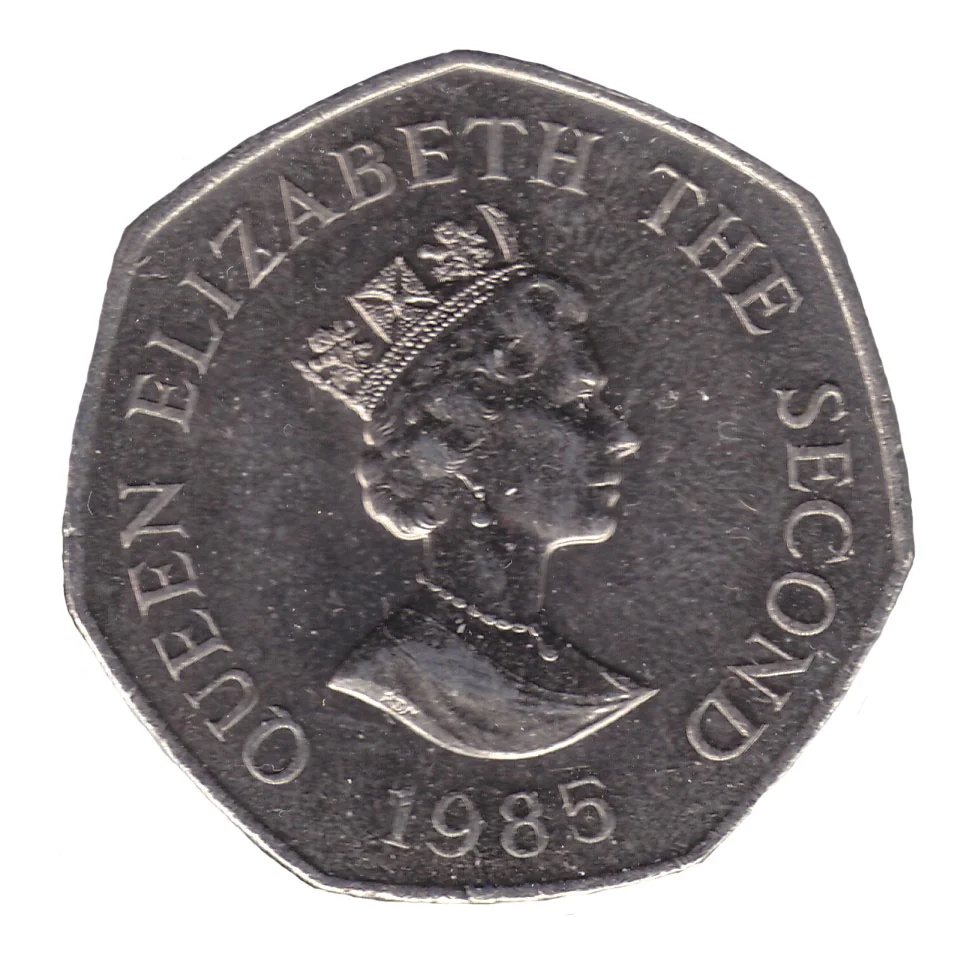
Obverse
Description:
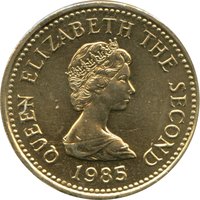
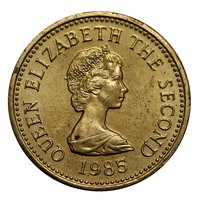
Queen Elizabeth III crowned, facing right, wearing the George IV State Diadem.
Inscription:
QUEEN ELIZABETH THE SECOND
1985
1985
Script: Latin
Engraver: Raphael David Maklouf
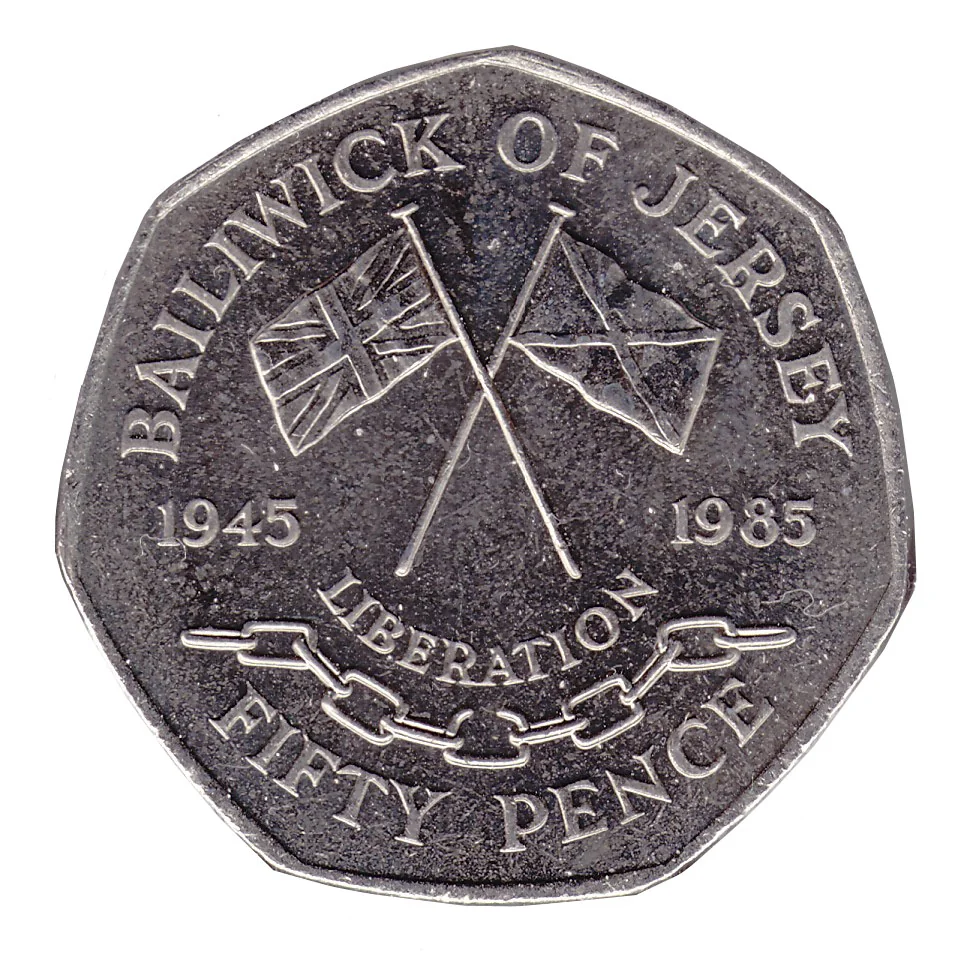
Reverse
Description:
Crossed flags over chain links, dates above, denomination below.
Inscription:
BAILIWICK OF JERSEY
1945 1985
LIBERATION
FIFTY PENCE
1945 1985
LIBERATION
FIFTY PENCE
Script: Latin
Engraver: Robert Elderton
Edge
Plain
Mintings
| Year | Mint Mark | Mintage | Quality | Collection |
|---|---|---|---|---|
| 1985 | — | 65,000 |
Historical background
In 1985, Jersey's currency situation was characterised by a unique and stable dual-currency system, deeply tied to its constitutional relationship with the United Kingdom. As a Crown Dependency, Jersey was not part of the UK but had its own government and issued its own banknotes and coins. These were denominated in pounds sterling and operated on a "one-for-one, parity" basis with UK currency. Both Jersey and UK notes and coins circulated freely and were accepted interchangeably on the island, providing practical convenience for commerce and tourism.
The system was underpinned by the Jersey Currency Fund, established in 1972, which held sterling reserves and UK government securities to fully back the local note issue. This conservative monetary policy ensured absolute confidence in the Jersey pound, preventing any deviation in value from the UK pound sterling. There was no independent monetary policy; interest rates and broader financial conditions were effectively set by the Bank of England. The island's economy, increasingly focused on finance and tourism, relied on this stability and its seamless link to the British financial system.
Therefore, 1985 saw no currency crisis or significant change for Jersey. The situation was one of quiet continuity, with the system functioning precisely as intended. The key discussions of the era were less about currency mechanics and more about the growing importance of the banking sector and how to manage economic growth while preserving the island's fiscal autonomy and the strength of its currency peg, which remained a cornerstone of its economic identity.
The system was underpinned by the Jersey Currency Fund, established in 1972, which held sterling reserves and UK government securities to fully back the local note issue. This conservative monetary policy ensured absolute confidence in the Jersey pound, preventing any deviation in value from the UK pound sterling. There was no independent monetary policy; interest rates and broader financial conditions were effectively set by the Bank of England. The island's economy, increasingly focused on finance and tourism, relied on this stability and its seamless link to the British financial system.
Therefore, 1985 saw no currency crisis or significant change for Jersey. The situation was one of quiet continuity, with the system functioning precisely as intended. The key discussions of the era were less about currency mechanics and more about the growing importance of the banking sector and how to manage economic growth while preserving the island's fiscal autonomy and the strength of its currency peg, which remained a cornerstone of its economic identity.
🌱 Fairly Common