

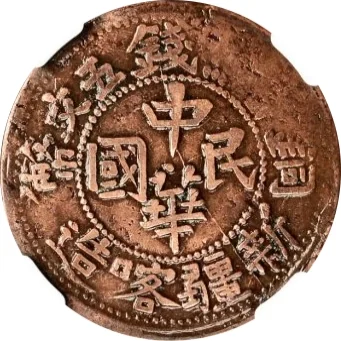
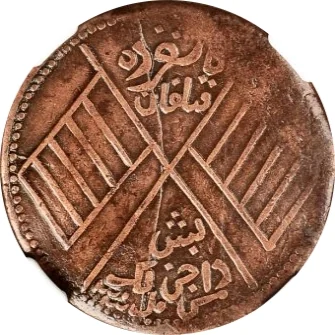
5 cash – Sinkiang Province
Add to wishlist
China
Context
Year: 1913
Islamic (Hijri) Year:: 1331
Country: China
Issuer: Sinkiang Province
Period:
(1912—1949)
Currency:
(1939—1949)
Demonetized: Yes
Material
References
Y: #
Numista: #17679
Obverse
Description:
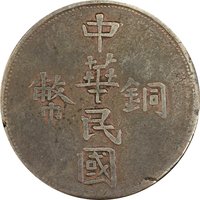
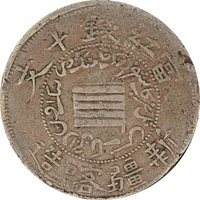
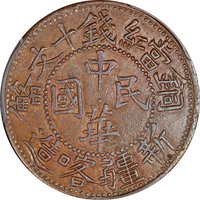
Four ideograms read vertically, right to left, among others.
Inscription:
文五錢紅當
幣銅
中
國民
華
造喀疆新
幣銅
中
國民
華
造喀疆新
Translation:
RED COIN FIFTY CASH
COPPER COIN
MADE IN XINJIANG
REPUBLIC OF CHINA
ZHONGHUA MINGUO
COPPER COIN
MADE IN XINJIANG
REPUBLIC OF CHINA
ZHONGHUA MINGUO
Language: Chinese
Reverse
Edge
Mintings
| Year | Mint Mark | Mintage | Quality | Collection |
|---|---|---|---|---|
| 1913 | — | — |
Historical background
In 1913, Sinkiang (Xinjiang) Province existed in a state of fragmented monetary authority and economic isolation following the collapse of the Qing Dynasty in 1911. The province was under the military governorship of Yang Zengxin, who nominally pledged loyalty to the new Republic of China but ruled with de facto autonomy. This political separation from central China was mirrored in its currency system, which was a complex and chaotic mix of legacy Qing coins, local imitations, and foreign silver.
The primary circulating medium was the Xinjiang Tael (Xinjiang liang), a silver-based unit, and its subdivision, the Xinjiang Red Cash (Hongqian). These were minted at provincial mints in cities like Kashgar and Ürümqi, but their weight, purity, and value were not standardized with national currency, fluctuating between regions. Crucially, the most common everyday coins were copper-based "Red Cash" coins, so named for their distinctive color. Their value was not fixed to silver, leading to volatile exchange rates and rampant counterfeiting, which further eroded public trust and complicated trade.
Furthermore, the monetary landscape was complicated by significant foreign influence due to Xinjiang's position on the Silk Road. Russian Tsarist rubles, particularly silver coins and paper notes from the Russo-Asiatic Bank, circulated widely, especially in the north, and were often preferred for their relative stability in large transactions. British Indian rupees and even Persian and Afghan coins circulated in southern oases like Kashgar. This multi-currency environment, devoid of a strong central banking authority, reflected Yang Zengxin's priority of political control over economic integration, leaving the province with an unstable and internally fragmented financial system.
The primary circulating medium was the Xinjiang Tael (Xinjiang liang), a silver-based unit, and its subdivision, the Xinjiang Red Cash (Hongqian). These were minted at provincial mints in cities like Kashgar and Ürümqi, but their weight, purity, and value were not standardized with national currency, fluctuating between regions. Crucially, the most common everyday coins were copper-based "Red Cash" coins, so named for their distinctive color. Their value was not fixed to silver, leading to volatile exchange rates and rampant counterfeiting, which further eroded public trust and complicated trade.
Furthermore, the monetary landscape was complicated by significant foreign influence due to Xinjiang's position on the Silk Road. Russian Tsarist rubles, particularly silver coins and paper notes from the Russo-Asiatic Bank, circulated widely, especially in the north, and were often preferred for their relative stability in large transactions. British Indian rupees and even Persian and Afghan coins circulated in southern oases like Kashgar. This multi-currency environment, devoid of a strong central banking authority, reflected Yang Zengxin's priority of political control over economic integration, leaving the province with an unstable and internally fragmented financial system.
✨ Legendary