


10 Rubles – Transnistria
Non-circulating coins
Commemoration: Series Reserve Jagorlyk
Moldova
Context
Year: 2019
Country: Moldova 
Issuer: Transnistria
Issuing organization: Transnistrian Republican Bank
Period:
(since 1990)
Currency:
(since 2000)
Total mintage: 500
Material
Diameter: 33 mm
Weight: 15.55 g
Silver weight: 14.38 g
Shape: Round
Composition: 92.5% Silver
Standard: Silver half ounce
Magnetic: No
Alignment: Medal alignment
flip

References
KM: #Click to copy to clipboard349
Numista: #176217
Value
Exchange value: 10 PRB
Bullion value: $40.49
Obverse
Description:
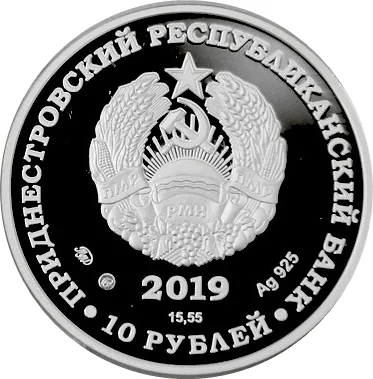
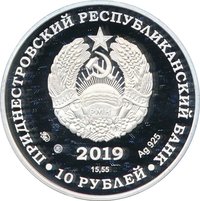
State Emblem of the Transnistrian Moldovan Republic at center. Denomination and date.
Inscription:
ПРИДНЕСТРОВСКИЙ РЕСПУБЛИКАНСКИЙ БАНК
ММД 2019 Ag 925
15,55
• 10 РУБЛЕЙ •
ММД 2019 Ag 925
15,55
• 10 РУБЛЕЙ •
Translation:
Transnistrian Republican Bank
Moscow Mint 2019 Silver 925
15.55
• 10 RUBLES •
Moscow Mint 2019 Silver 925
15.55
• 10 RUBLES •
Script: Cyrillic
Language: Russian
Reverse
Description:
Greater pasque flower (Pulsatilla grandis).
Inscription:
ЗАПОВЕДНИК «ЯГОРЛЫК»
ПРОСТРЕЛ КРУПНЫЙ
ПРОСТРЕЛ КРУПНЫЙ
Translation:
Yagorlyk Nature Reserve
Large Pasqueflower
Large Pasqueflower
Script: Cyrillic
Language: Russian
Engraver: Kitaeva I.A.
Edge
Plain
Mints
| Name | Mark |
|---|---|
| Moscow Mint | (ММД) |
Mintings
| Year | Mint Mark | Mintage | Quality | Collection |
|---|---|---|---|---|
| 2019 | ММД | 250 | Proof | |
| 2019 | ММД | 250 | Prooflike |
Historical background
In 2019, the currency situation in the unrecognized Pridnestrovian Moldavian Republic (Transnistria) remained a complex and unique "triple-currency" system, a direct legacy of its political isolation. The region officially used the Transnistrian ruble (PRB), a non-convertible currency issued by the Transnistrian Republican Bank. However, due to a lack of international recognition and the need for external trade, the US dollar and the euro functioned as parallel de facto currencies for significant transactions, savings, and real estate. The Russian ruble also circulated, though to a lesser extent, reflecting the region's political and economic dependence on Russian support.
Economically, the Transnistrian ruble was artificially stabilized by authorities but existed in a near-permanent state of controlled crisis. Its value was not set by a free market but administratively pegged to a basket of currencies, primarily the US dollar. This created a persistent gap between the official exchange rate and the higher black-market rate, which citizens and businesses often relied upon for practical conversion. Inflation was a constant concern, and the currency's instability discouraged long-term banking in PRB, pushing the population toward dollarization for financial security.
The year 2019 saw no major shifts in this fragile equilibrium, but the underlying pressures were mounting. The region's economy remained reliant on a few large, export-oriented industrial enterprises (like the steel plant MMZ), which conducted trade in foreign currency. This dynamic perpetuated a cycle where hard currency earnings entered the economy but were hoarded or used for imports, while the local ruble primarily facilitated domestic wages and small-scale trade. Consequently, the currency situation continued to symbolize Transnistria's broader predicament: a functionally separate entity operating with a fragile monetary system, entirely dependent on external economic ties and political patronage to sustain its viability.
Economically, the Transnistrian ruble was artificially stabilized by authorities but existed in a near-permanent state of controlled crisis. Its value was not set by a free market but administratively pegged to a basket of currencies, primarily the US dollar. This created a persistent gap between the official exchange rate and the higher black-market rate, which citizens and businesses often relied upon for practical conversion. Inflation was a constant concern, and the currency's instability discouraged long-term banking in PRB, pushing the population toward dollarization for financial security.
The year 2019 saw no major shifts in this fragile equilibrium, but the underlying pressures were mounting. The region's economy remained reliant on a few large, export-oriented industrial enterprises (like the steel plant MMZ), which conducted trade in foreign currency. This dynamic perpetuated a cycle where hard currency earnings entered the economy but were hoarded or used for imports, while the local ruble primarily facilitated domestic wages and small-scale trade. Consequently, the currency situation continued to symbolize Transnistria's broader predicament: a functionally separate entity operating with a fragile monetary system, entirely dependent on external economic ties and political patronage to sustain its viability.

✨ Legendary